

 English
  日本語
日本語  Tiếng Việt
  简体中文
简体中文  한국어
한국어 This article examines the key factors causing fuel price volatility in Vietnam in early 2026, broader economic impacts, policy measures, and more

10Jul2026
Highlight content / Highlight Content JP / Highlight content vi / Latest News & Report / Vietnam Briefing
Comments: No Comments.
Fuel price volatility is becoming an increasingly important issue for the Vietnamese economy, as the country remains heavily reliant on imported petroleum products and the global energy market. In recent years, fluctuations in gasoline and diesel prices have not only impacted transportation and logistics but also production costs, consumer prices, inflation, and business competitiveness. This article examines the key factors causing fuel price volatility, their broader economic impacts, policy measures, and recommendations for addressing these fluctuations.
Overview of Vietnam’s Energy Market in the first half of 2026
Vietnam’s petroleum market in the first half of 2026 saw complex cycles of volatility, shaped by the strong interplay of global supply-demand factors, geopolitical conflicts, and the Government’s regulatory intervention efforts.
From late February through March 2026, the blockade of the Strait of Hormuz, tighter global supply, and airspace restrictions in the Middle East pushed global energy prices into a new crisis.[1] In Vietnam, domestic base fuel prices reacted immediately and sharply to the global upswing. In addition, market-specific factors such as fluctuations in the USD/VND exchange rate and persistent domestic inflationary pressure further amplified the rise in fuel prices.[2]
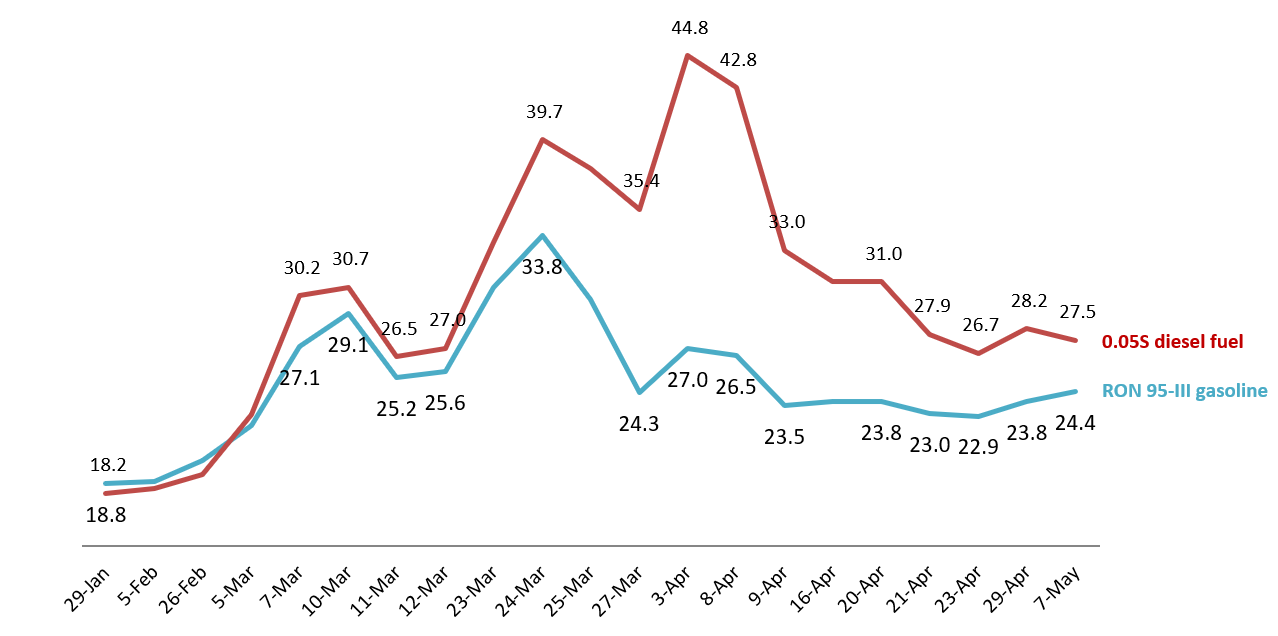
Fluctuations in Retail Fuel Prices in Vietnam in the first months of 2026
Unit: thousand VND/liter
Source: B&Company’s synthesis
At the peak of the price adjustment cycle, domestic retail prices of RON95-III gasoline rose sharply, posting their largest increase and exceeding VND 33,800 per liter, up 49.1% from the same period in 2025. Meanwhile, 0.05S diesel peaked at VND 44,800 per liter, marking a 105.1% increase compared with the corresponding adjustment period in 2025.[3]
Entering May 2026, the market began to cool down, supported by signs of peace negotiations in the Middle East that helped ease transport flows through the Strait of Hormuz, along with special fiscal intervention packages introduced by Vietnam’s National Assembly and Government.[4] Retail fuel prices in Vietnam also fell sharply and then stabilized at around VND 24,000 per liter for RON95-III gasoline and VND 27,000 per liter for 0.05S diesel. However, these prices remained 23% and 58% higher, respectively, than in the same period of 2025.[5]
The Economic Impact of Rising Fuel Prices
Fuel remains an essential input for Vietnam’s economy, supporting daily mobility, goods circulation, production activities, agriculture, and household consumption. In 2025, domestic petroleum consumption reached around 28.6 million m³/tonnes, equivalent to approximately 2.2–2.3 million m³/tonnes per month, reflecting the country’s continued dependence on fuel for regular economic activity.[6]
Given this role, fuel price volatility is not only an energy market issue but also a broader business and macroeconomic concern. It can affect corporate cost planning, market stability, and overall economic management, with specific impacts on production, logistics, inflation, growth, monetary policy, and exchange-rate management.
Higher production and operating costs[7]
Higher fuel prices directly raise operating costs for businesses, as fuel is a core input for transportation, machinery operation, industrial production, and goods distribution. In many heavy industries, fuel can account for around 25%–35% of production costs, while it represents about 15%–20% of the cost structure for many consumer goods and equipment products. As a result, prolonged fuel price increases can push up the cost of finished goods, narrow corporate profit margins, and weaken the competitiveness of Vietnamese products in both domestic and export markets, especially in energy-intensive sectors and those with long supply chains.
The impact varies by sector but is particularly visible in industry, agriculture, and construction. Industrial firms face higher costs for operating machinery, transporting inputs, and distributing finished products, while petroleum-related inputs also affect materials such as plastics, chemicals, and packaging. In agriculture, higher fuel prices increase mechanization and transport costs, with machinery rental costs for ploughing and harvesting in the Mekong Delta reportedly rising by 15%–25% from the beginning of 2026. The construction sector is also highly exposed, as the Ministry of Construction estimated that the March 2026 fuel price surge raised construction cost estimates by 1.91%–8.09%, alongside sharp increases in key material prices such as cement, sand, stone, bricks, and asphalt.
Rising logistics costs[8]
Rising logistics costs have become one of the clearest channels through which higher fuel prices and geopolitical instability are affecting Vietnam’s economy.
According to a rapid survey of 49 logistics companies conducted by the VLA Office from March 3 to 11, 2026, geopolitical tensions in the Middle East, especially maritime insecurity in the Red Sea, have created clear pressure on Vietnamese logistics businesses. Nearly 90% of surveyed companies reported moderate to severe impacts, with 51% facing severe or crisis-level disruptions, while 43% cited a sudden surge in freight rates as their biggest challenge.
Beyond rising freight rates, companies also reported longer shipping times, delayed or cancelled customer orders, and growing difficulty in securing international transport bookings. These disruptions indicate that the impact goes beyond transport costs, affecting delivery reliability, supply-chain planning, and customer order fulfillment.
The pressure is particularly strong because fuel represents a large share of logistics operating costs. In road transport, gasoline and diesel account for around 35%–40% of total business expenses. Higher diesel prices therefore have an immediate impact on road freight, logistics services, last-mile delivery, maritime transport, and aviation.
Each fuel price hike creates pressure to raise transport fares and logistics service fees by around 5%–12%. Given the thin profit margins in the transport sector, these additional costs are often passed directly on to final selling prices. As a result, higher fuel and freight costs do not remain confined to the logistics industry, but gradually spread across the wider economy, making consumer goods more expensive and adding further pressure on businesses and households.
Macroeconomic impacts of rising fuel prices[9]
Rising fuel prices create broad macroeconomic pressure by increasing costs across multiple sectors, not only in transportation but also in food, construction materials, plastics, consumer goods, and services. As fuel is a key input for production and distribution, higher prices tend to raise business operating costs and are gradually passed on to final consumer prices. According to the National Statistics Office (NSO), Vietnam’s CPI rose by 0.29% month-on-month in May 2026, partly reflecting higher domestic fuel prices in line with global trends and rising construction material costs driven by higher input and transportation expenses.
Sustained high fuel prices also add to inflationary pressure. When companies face higher fuel and logistics costs, they may increase selling prices to protect margins, pushing up the overall consumer price index. NSO data showed that Vietnam’s inflation reached 5.6% year-on-year in May 2026, with higher imported fuel prices among the key contributing factors.
These developments also complicate monetary policy and exchange-rate management. Cost-push inflation forces the State Bank of Vietnam to balance inflation control and exchange-rate stability with the need to maintain reasonable interest rates for business activity. At the same time, higher oil prices increase demand for foreign currency, particularly the U.S. dollar, to pay for fuel imports. As imported petroleum products account for a large share of Vietnam’s domestic supply, rising import payments can put additional depreciation pressure on the Vietnamese dong. In 2026, the State Bank of Vietnam repeatedly warned that geopolitical tensions in the Middle East and global energy price instability were creating challenges for USD/VND exchange-rate management and liquidity conditions in the domestic money market.
Key Macro Policy Responses by the Government and Inter-Ministerial Agencies
Amid rising inflationary pressure and global fuel price volatility in early 2026, the Vietnamese Government and relevant ministries introduced several measures to stabilize domestic fuel prices, reduce cost pressures, and support businesses.
Key Macro Policy Measures in Response to Fuel Price Volatility in Vietnam, 2026
| Policy measure | Legal basis/period | Key contents | Expected impact |
| Special fiscal support package – Phase 1 | Decision No. 482/QD-TTg, effective from March 27 to April 15, 2026 | Reduced the environmental protection tax on gasoline, diesel and aviation fuel to VND 0/liter; lowered the special consumption tax on gasoline to 0%; exempted VAT declaration and payment at both sales and import stages | Helped immediately reduce the tax burden in domestic fuel prices and limit the pass-through from global energy prices to consumer prices |
| Special fiscal support package – Phase 2 | Resolution No. 19/2026/QH16, effective from April 16 to June 30, 2026 | Continued the tax relief measures, including VND 0/liter environmental protection tax for gasoline, diesel, kerosene, fuel oil and aviation fuel; maintained 0% special consumption tax on gasoline; allowed full input VAT deduction | Provided a longer legal basis for fuel price stabilization and helped keep domestic retail prices lower than in neighboring border countries |
| Support for the Petroleum Price Stabilization Fund | Decision No. 483/QD-TTg, Circular No. 19/2026/TT-BCT and Decision No. 632/QD-BCT | Allowed a state budget advance from increased central budget revenue in 2025 to support the Petroleum Price Stabilization Fund; provided guidance on fund collection, use and repayment | Expanded the Government’s financial room to manage fuel prices flexibly during each adjustment cycle and reduce sudden market shocks |
Source: B&Company’s synthesis
Recommendations for businesses
Amid growing volatility in fossil fuel markets, businesses in Vietnam need to move beyond short-term cost-cutting measures and build more resilient, long-term adaptation strategies. For industrial enterprises, the priority is to reduce exposure to energy price fluctuations by improving operational efficiency and strengthening supply-chain management. This can be achieved through better logistics planning, higher energy efficiency at factories, and the adoption of advanced technologies in production management.[10]
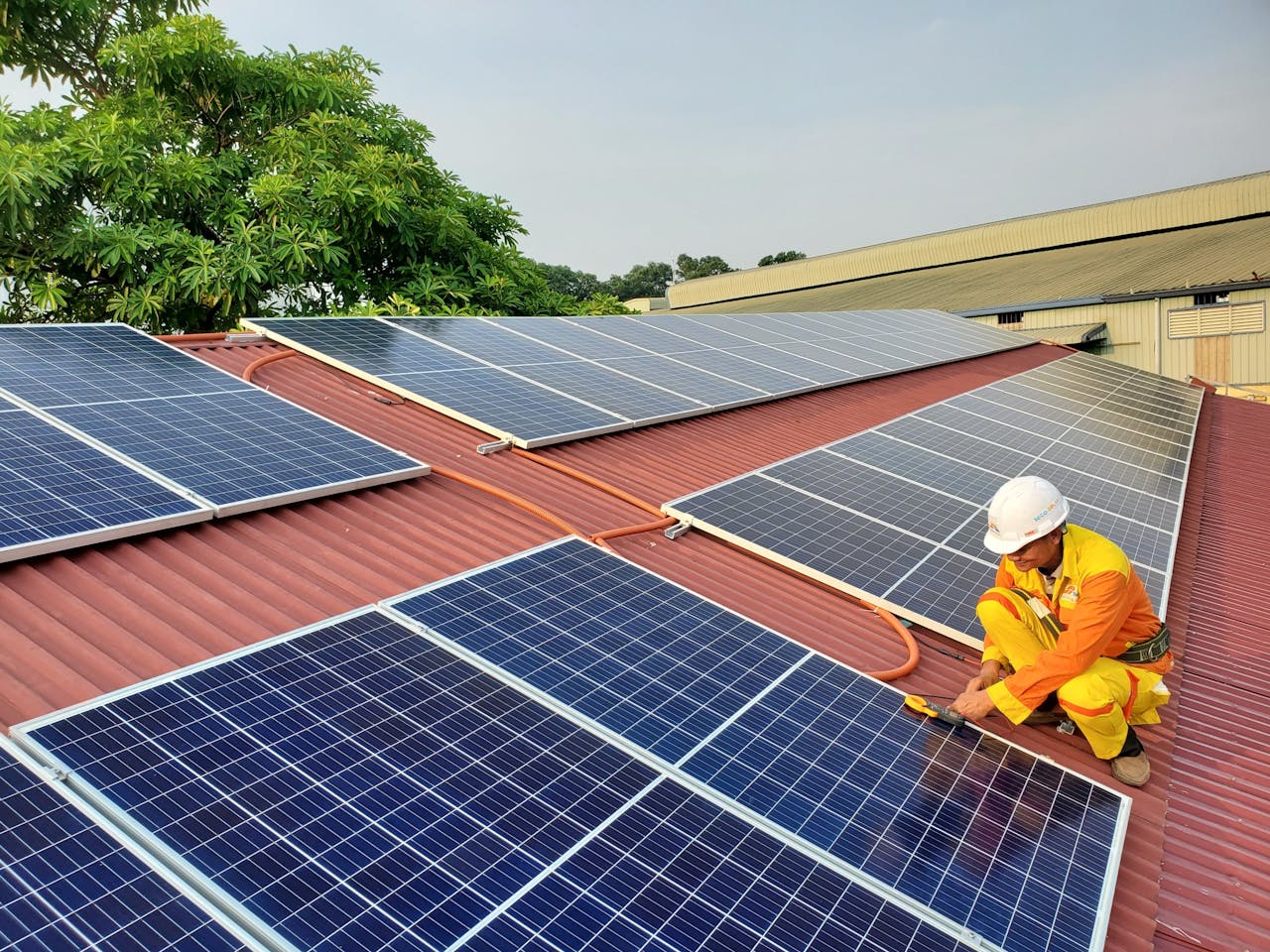
At the same time, energy diversification should become a core part of corporate risk management. Solutions such as rooftop solar power can help companies reduce dependence on the national grid and traditional fossil fuels, while improving cost stability over the long term.[11]
For foreign companies operating in or sourcing from Vietnam, fuel price volatility should be considered in procurement, logistics, and pricing strategies. Companies may need to review supplier contracts, build more flexible delivery plans, diversify logistics partners, and incorporate fuel and exchange-rate scenarios into cost planning. Working with local partners to improve supply-chain visibility can also help reduce disruption risks.
For petroleum retailers, the impact of the energy transition is even more structural. As consumers gradually shift toward electric vehicles, fuel stations can no longer rely solely on fossil fuel sales. Instead, they need to reposition themselves as integrated “Energy and Convenience” service hubs. This means installing fast EV chargers at suitable locations, expanding convenience-store operations, and adding value-added services such as automatic car washes, quick repair services, and rest areas. Such a model would help petroleum retailers diversify revenue sources, retain customer traffic, and sustain growth in the green transition era.[12]
In conclusion, fuel price volatility has become a significant challenge for Vietnam, affecting not only transport and logistics but also production costs, inflation, and overall business competitiveness. While government measures can help ease short-term pressure, businesses need to strengthen their own resilience through cost optimization, energy efficiency, and supply-chain management. In the longer term, adapting to the energy transition and diversifying energy sources will be essential for maintaining stable growth in an increasingly uncertain market. For foreign investors, understanding fuel price trends is important when evaluating operating costs, supply-chain risks, and the overall business environment in Vietnam. The insights discussed in this article can help investors make more informed decisions regarding market entry, expansion plans, and long-term investment strategies.
Read more
From RON95 to E10: Vietnam’s Biofuel shift and its impact on fuel retail and mobility
Hanoi’s petrol motorbike restrictions: What it means for Japanese mobility brands
* If you wish to quote any information from this article, please kindly cite the source along with the link to the original article to respect copyright.
| B&Company
The first Japanese company specializing in market research in Vietnam since 2008. We provide a wide range of services including industry reports, industry interviews, consumer surveys, business matching. Additionally, we have recently developed a database of over 1,000,000 companies in Vietnam, which can be used to search for partners and analyze the market. Please do not hesitate to contact us if you have any queries. info@b-company.jp + (84) 24 3978 5165 |
[1] https://vneconomy.vn/boi-canh-the-gioi-bat-on-gia-xang-dau-trong-nuoc-dong-loat-tang-phi-ma.htm
[2] https://doisongvaphattrien.vn/vi-sao-gia-xang-dau-lien-tuc-nhay-mua-du-bao-thi-truong-xang-dau-thang-62026-con-nhieu-bien-dong-a48594.html
[3] https://minhbach.moit.gov.vn/tin-tuc/thong-bao/mot-so-thong-tin-ve-viec-dieu-hanh-gia-xang-dau-ngay-20-3-2025.html, https://minhbach.moit.gov.vn/tin-tuc/thong-bao/thong-tin-dieu-hanh-gia-xang-dau-ngay-03-4-2025.html
[4] https://vietnambiz.vn/gia-xang-dau-hom-nay-56-lao-doc-vi-trien-vong-dat-thoa-thuan-hoa-binh-my-iran-20266573955809.htm
[5] https://minhbach.moit.gov.vn/tin-tuc/mot-so-thong-tin-ve-viec-dieu-hanh-gia-xang-dau-ngay-15-12-2024.html, https://minhbach.moit.gov.vn/tin-tuc/mot-so-thong-tin-ve-viec-dieu-hanh-gia-xang-dau-ngay-15-12-2024.html
[6] https://moit.gov.vn/en/news/join-hands-to-safeguard-energy-security-amid-middle-east-crisis.html
[7] https://www.vietnamtradeportal.gov.vn/index.php?id=2894&r=site%2F, https://www.vietnamtradeportal.gov.vn/index.php?id=2894&r=site%2Fdisplay; https://baominhagri.com/gia-xang-dau-tang-ky-luc-2026-giai-phap-toi-uu-chi-phi-cho-nha-nong; https://thuvienphapluat.vn/cong-van/Thuong-mai/Cong-van-5026-BXD-KTQLXD-2026-tac-dong-bien-dong-gia-xang-dau-toi-tinh-hinh-dau-tu-xay-dung-700369.aspx
[8] https://vla.com.vn/wp-content/uploads/2026/03/BAN-TIN-VLA-SO-146-16.03.2026.pdf
[9] https://www.nso.gov.vn/en/cpi/ , https://www.reuters.com/world/asia-pacific/vietnam-inflation-accelerates-may-trade-deficit-widens-2026-06-03/, https://vietnamnet.vn/en/rising-fuel-prices-put-pressure-on-vietnam-s-exchange-rate-central-bank-says-2496919.html
[10] https://www.vcci.com.vn/en/news/ung-pho-gia-xang-dau-doanh-nghiep-cong-nghiep-siet-chi-phi-san-xuat
[11] https://piacom.vn/bien-dong-gia-xang-2026-nguoi-tieu-dung-thay-doi-thoi-quen-doanh-nghiep-xang-dau-can-thich-ung-ra-sao/
[12] https://piacom.vn/bien-dong-gia-xang-2026-nguoi-tieu-dung-thay-doi-thoi-quen-doanh-nghiep-xang-dau-can-thich-ung-ra-sao/
Related article

























Log in / Register
SUBSCRIBE NEWSLETTER