

 English
  日本語
日本語  Tiếng Việt
  简体中文
简体中文  한국어
한국어 By the end of 2025, Vietnam agriculture exports were projected to approach USD 70 billion, reflecting its strong growth and competitiveness.

03Apr2026
Latest News & Report / Vietnam Briefing
Comments: No Comments.
Abstract
Vietnam’s agriculture sector has experienced significant transformation in recent years, driven by strong export demand, technological adoption, and supportive government policies. As a key pillar of the economy, the sector plays an important role in ensuring food security while strengthening Vietnam’s position in global agricultural supply chains. By the end of 2025, agro-forestry-fishery exports were projected to approach USD 70 billion[1], reflecting the sector’s strong growth and rising competitiveness.
This article provides a regular update on Vietnam’s agriculture market in Q4 2025, highlighting key developments relevant to investors, policymakers, and agribusiness stakeholders. It summarizes major investment activities and policy changes affecting agricultural production, value chains, and market access, offering insights into emerging opportunities and strategic implications for the sector.
Investment Updates
Vietnam’s agriculture sector continues to attract both domestic and foreign investment, supported by strong export performance, government incentives, and increasing global demand for food products. Several developments in 2025 illustrate the growing interest in modernizing agricultural production, expanding trade partnerships, and strengthening supply chains.
1. Vietnam’s agricultural exports to Japan reached USD 1.3 billion in Q4[2]
In Q4 2025, agricultural cooperation between Vietnam and Japan continued to strengthen, with Vietnam’s agricultural exports to Japan reaching around USD 1.34 billion, up 15.5% year-on-year, while imports from Japan totalled about USD 202 million. Key Vietnamese exports included wood products, seafood, coffee, fruits and vegetables, and rubber products.
The bulletin also highlighted future export opportunities for Vietnamese products in Japan, particularly processed seafood, tropical fruits, and high-quality rice, as Japan faces domestic supply shortages. In addition, Japan continues to support Vietnam through technology transfer and development projects, including initiatives on low-emission rice production, disaster risk reduction, and waste-to-energy, reflecting a shift toward more sustainable and high-value agricultural cooperation.
2. Vietnam and China Strengthen Agricultural Trade Cooperation with New Export Protocols[3]
In November 2025, Vietnam and China held a meeting under the bilateral agricultural cooperation committee to discuss expanding collaboration in agricultural trade and technology. The two sides explored ways to improve cross-border supply chains, expand agricultural export protocols, and enhance food safety standards for products traded between the two countries.
China remains Vietnam’s largest agricultural export market for many products such as fruits and vegetables. Strengthening institutional cooperation is expected to facilitate investment in logistics infrastructure, cold storage, and processing facilities that support agricultural trade between the two economies.
3. Viet Nam promotes its agricultural products in Egypt, the Middle East and Africa[4]
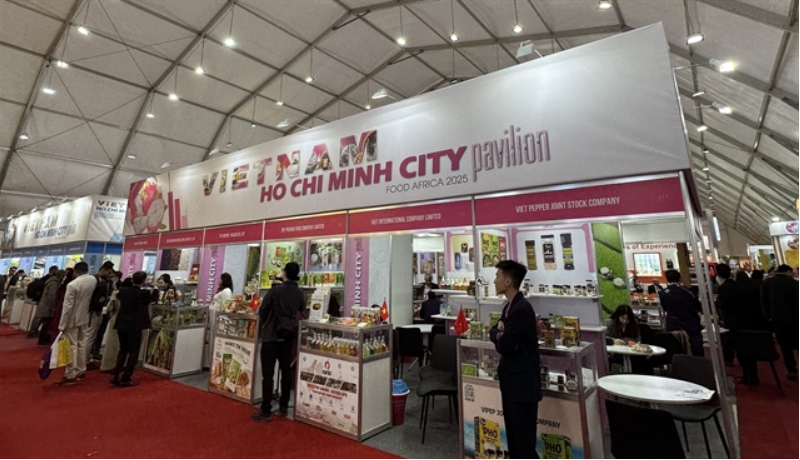
In December 2025, Vietnam promoted its agricultural products at the Food Africa 2025 exhibition in Cairo, Egypt, with a Vietnamese pavilion organized by the Ho Chi Minh City Investment and Trade Promotion Centre featuring 33 companies showcasing products such as rice, coffee, pepper, cashew nuts, dried fruits, beverages, and canned seafood.
The event aimed to connect Vietnamese exporters with distributors and partners in Egypt, the Middle East, and Africa, positioning Egypt as a key gateway to these markets.
Buyer interest was particularly strong for Vietnamese staples, including seafood, coffee, and rice, while Vietnam’s agricultural exports to Egypt reached about USD 193 million in the first 11 months of 2025, highlighting growing trade ties and Vietnam’s strategy to diversify agricultural export markets beyond traditional destinations.
The Vietnam – Ho Chi Minh City Pavilion at Food Africa 2025
Source: Vietnamnews
4. Vietnam–Cuba agricultural investment project worth over USD 50 million[5]
On December 5, 2025, Vietnamese and Cuban partners signed an agricultural cooperation project valued at approximately USD 50.56 million in Cuba’s Artemisa province. The project includes the supply of agricultural machinery, technology transfer, and infrastructure development to improve agricultural productivity.
This initiative demonstrates Vietnam’s growing role not only as an agricultural exporter but also as an outward investor in agriculture. The broader implication is the strengthening of South–South cooperation and the expansion of Vietnamese agribusiness capabilities into overseas agricultural production projects.
5. Vietnam and Brazil deepen cooperation in smart agriculture[6]
On December 18, 2025, Vietnam and Brazil strengthened collaboration in smart agriculture during a workshop focusing on innovation and technology transfer in agricultural value chains. The cooperation involves research partnerships between Vietnamese institutions and Brazil’s Agricultural Research Corporation (Embrapa), particularly in precision farming, cold chain management, and advanced technologies such as AI-enabled agricultural sensors and crop gene editing.
This collaboration reflects both countries’ efforts to modernize agriculture and improve sustainability. The implication is that technology transfer and joint research could attract investment in agri-tech startups, digital farming solutions, and modern agricultural infrastructure in Vietnam.
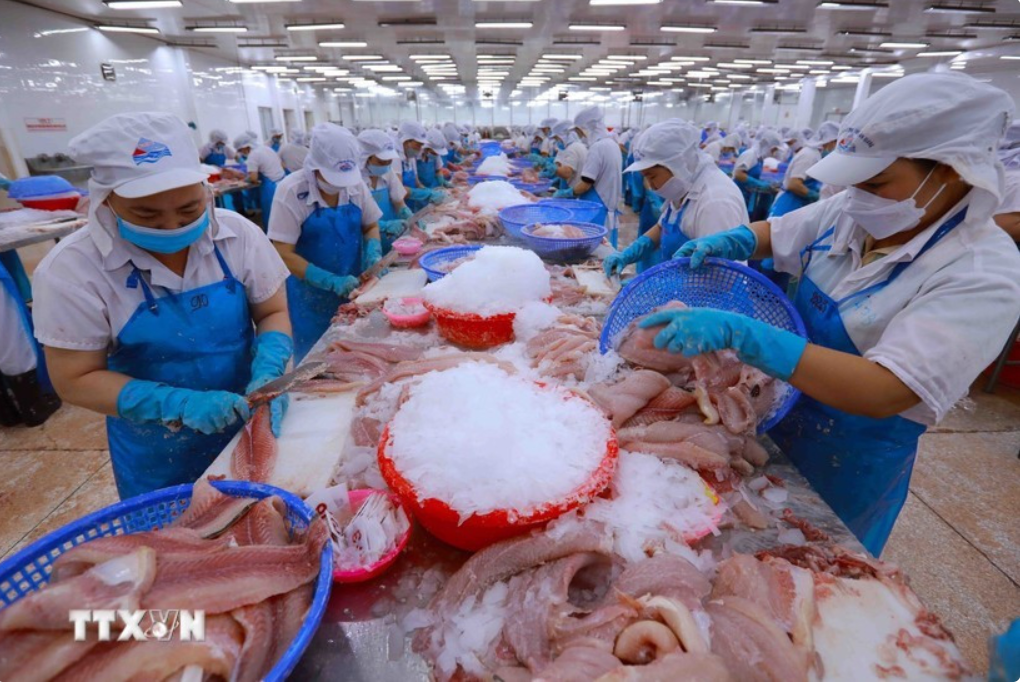
Workers process aquatic products for export
Source: Vietnamplus.vn
Policy Update
1. Circular No. 58/2025/TT-BNNMT stipulating economic and technical norms for forest allocation and leasing comes into effect from November 27, 2025
Circular sets out the technical procedures for forest allocation and forest leasing in Vietnam, aiming to improve consistency, transparency, and effectiveness in forest resource management. It provides step-by-step guidance for the entire process, including plan preparation, forest status survey and assessment, map preparation, appraisal, document completion, on-site handover, and record digitization and archiving.
The Circular also gives detailed instructions for key stages such as boundary identification, data collection, community consultation, and forest status mapping.
2. Decree 301/2025/ND-CP – tightening penalties in the fisheries sector, particularly for IUU and VMS-related violations
The Government issued Decree 301/2025/ND-CP on 17 November 2025, effective on the same day, to amend Decree 38/2024/ND-CP on administrative sanctions in the fisheries sector.
A notable point is that this decree increases penalties and adds remedial measures for violations related to vessel monitoring systems (VMS), including failure to transmit data, disabling the equipment, operating fishing vessels without the required device, failing to return vessels to port when the equipment malfunctions, and violations related to port entry, fishing vessel registration numbers, and the origin of illegally harvested aquatic products. Some fines under the decree reach VND 500–700 million, and even VND 800 million to 1 billion for certain serious violations. These sanctions are accompanied by additional penalties such as revocation of fishing licenses, withdrawal of captain certificates, and mandatory requirements to install, repair, or fully transmit VMS data.
Read more
* If you wish to quote any information from this article, please kindly cite the source along with the link to the original article to respect copyright.
| B&Company
The first Japanese company specializing in market research in Vietnam since 2008. We provide a wide range of services including industry reports, industry interviews, consumer surveys, business matching. Additionally, we have recently developed a database of over 900,000 companies in Vietnam, which can be used to search for partners and analyze the market. Please do not hesitate to contact us if you have any queries. info@b-company.jp + (84) 28 3910 3913 |
[1] https://vietnamnews.vn/economy/1730576/viet-nam-eyes-2025-as-breakthrough-year-for-agricultural-exports.html
[2] https://ispae.vn/vn/tID13200_ban-tin-hop-tac-nong-nghiep-viet-nam-nhat-ban-quy-42025.html?
[3] https://www.tridge.com/news/vietnam-china-agricultural-trade-cooperation-aayuqn?
[4] https://vietnamnews.vn/economy/1731542/viet-nam-promotes-its-agricultural-products-in-egypt-middle-east-and-africa.html
[5] https://en.nhandan.vn/viet-nam-and-cuba-sign-agricultural-cooperation-project-worth-50-million-usd-post156408.html
[6] https://www.vietnam.vn/en/viet-nam-brazil-tang-cuong-hop-tac-trong-linh-vuc-nong-nghiep-thong-minh
Related article



















Log in / Register
SUBSCRIBE NEWSLETTER