

 English
  日本語
日本語  Tiếng Việt
  简体中文
简体中文  한국어
한국어 Over the past two decades, Vietnam has transformed into a key IT talent hub, with a workforce that is growing both in number and quality.

11Jul2025
Latest News & Report / Vietnam Briefing
Comments: No Comments.
The information technology (IT) workforce market in Vietnam has made significant strides since 2000. Over the past two decades, Vietnam has transformed into a key IT talent hub in the region, with a workforce that is growing both in number and quality. Hanoi and Ho Chi Minh City serve as the main centers, home to the majority of top IT training institutions and technology companies, which have produced a large pool of software engineers and programmers. In addition to local demand, international cooperation, particularly with Japan, has played a crucial role in effectively developing and utilizing this workforce.
The Supply of IT Workforce in Vietnam
Scale and Training:
The IT sector currently employs more than 500,000 people in various technology-related fields. This figure is estimated to represent about 1% of the total workforce aged 15 and above in Vietnam. This is a significant number, highlighting the growing importance of IT in the digital economy and the fourth industrial revolution.
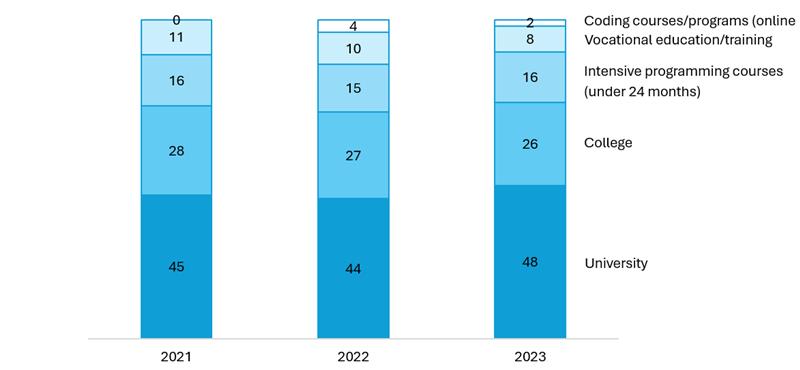
Educational background of IT personnel in Vietnam
Unit: %
Source: B&Company compilation from TopDev
The majority of IT professionals have degrees from universities (48%) and colleges (26%) in fields related to IT and computer science. The number of students entering IT programs (software engineering) each year ranges from 50,000 to 57,000, based on data from the Ministry of Education and Training from 2019 to 2022. This stable enrollment rate reflects the strong interest of young people in IT, affirming the sector’s attractiveness in terms of career opportunities.
Popular Skills:
NodeJS, Java, MySQL, Spring Boot, Laravel, .NET Core, Django, and AWS are among the most common technologies in the field. Recently, many young professionals have also been self-learning languages like Python, Kotlin, Swift, and Go to stay ahead of new technological trends. In addition to programming skills, proficiency in foreign languages is becoming increasingly important. Most developers have a basic level of English, and a portion are proficient in Japanese to work with Japanese clients. Soft skills and understanding modern software development processes are also gradually improving through collaboration between businesses and academic institutions. In summary, Vietnam’s IT workforce is abundant in quantity and continually improving in quality to meet the demands of businesses.
Demand for the IT Workforce in Vietnam
Demand Growth and Supply-Demand Gap:
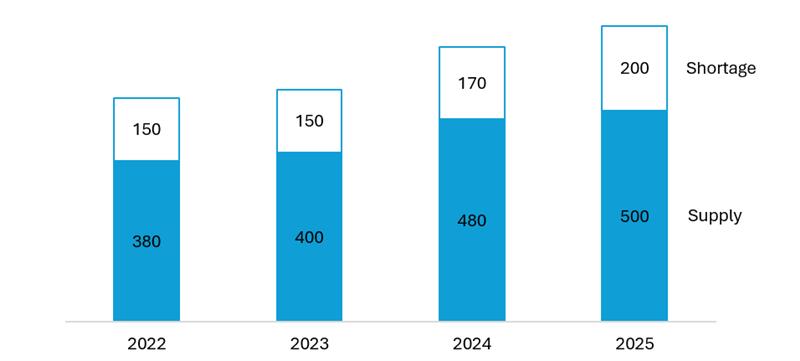
In recent years, the demand for IT professionals in Vietnam has grown rapidly. Over the past five years, this demand has increased consistently, leading to a workforce shortage despite the large number of new graduates each year. According to a report by TopDev, in 2022, the demand for IT professionals rose to 530,000, but a shortage of 150,000 workers was projected. This gap suggests that supply has not kept pace with demand, especially for positions requiring higher experience and skills. Therefore, the current challenge is not only expanding training capacity but also improving the quality of education to bridge the gap between academic knowledge and the practical skills businesses require. Additionally, the distribution of the workforce across regions and emerging fields (AI, blockchain, cybersecurity, etc.) needs to be balanced to meet future trends.
IT human resource demand in the Vietnamese software industry
Unit: thousand people
Source: B&Company compilation from TopDev
Average Salary:
The IT sector offers some of the highest salary levels in the Vietnamese labor market. Salaries vary widely depending on experience, skills, and geographical location. Ho Chi Minh City, as the largest IT hub in the country, offers higher salaries compared to other regions. Hanoi is the second largest IT center, followed by Da Nang. According to a 2023 survey, the average IT salary in Ho Chi Minh City is about $1,390 per month, approximately 12% higher than in Hanoi ($1,244/month) and Da Nang ($1,190/month) (“Vietnam IT Market Report 2023” – TopDev).
Average Salaries for Some IT Positions (Itviec report):
| Job Category | Experience Range (Years) | Salary Range (USD) | Example Positions |
| Software Development | 6-8 years | 1,220 – 1,824 | Back-end Developer, Front-end Developer, Full-stack Developer, Mobile Developer, Game Developer, Embedded Engineer |
| Product Management | 6-8 years | 1,296 – 2,038 | Product Owner/Product Manager, Business Analyst |
| Management & Consulting | 6-8 years | 1,094 – 3,840 | Project Leader, Bridge Engineer, Salesforce Consultant, IT Manager, Tech Lead, IT Consultant, CTO |
| Designing | 6-8 years | 1,384 | Designer |
| Testing | 7-8 years | 1,012 – 1,524 | Tester, QA-QC |
| Cloud, Infrastructure & Security | 3-4 years | 1,124 – 2,424 | System Admin, DevOps Engineer, Cloud Engineer, Network Engineer, Security Consultant |
| Data Analytics | 5-6 years | 1,252 – 1,764 | Data Engineer, Data Scientist, Database Engineer |
| AI & Blockchain | 4 years | 1,510 – 1,510 | AI Engineer, Blockchain Engineer |
| Others | 5-6 years | 692 – 2,958 | ERP Consultant, Firmware Engineer, Solution Architect, IT Support |
Source: B&Company compilation from ITViet
As technology evolves rapidly, companies also expect IT employees to be self-motivated learners who can adapt to new technologies. Emerging technologies such as cybersecurity, artificial intelligence (AI) & machine learning, cloud computing, IoT, Big Data, and blockchain are facing both quantity and quality workforce shortages, creating a high demand for engineers skilled in these fields. Many companies are willing to hire candidates who are not yet familiar with new technologies but possess a solid foundation and quick learning abilities.
Japanese Companies and the Demand for IT Talent in Vietnam
In recent years, Vietnam has become one of the strategic destinations for Japanese companies in software development and IT services. With a young, skilled workforce, affordable costs, and the ability to quickly learn Japanese, Japanese companies are increasingly seeking to hire IT professionals in Vietnam, especially through the offshore development model.
Demand for IT talent in Vietnam
| Category | Content |
| Software Development | · Web/Mobile Developer (PHP, Java, .NET, Python, React, Flutter)
· Embedded Developer serving the automotive and electronics industries · Bridge System Engineer (BrSE) – proficient in both technical skills and Japanese communication |
| Software Testing (Tester, QA-QC) | · Manual/Automation Tester
· QA following Japanese business standards |
| Systems, Infrastructure, and Security | · System Admin, DevOps, Cloud Engineer (AWS, Azure, GCP)
· Information Security and Network Security Engineers |
| Data and Artificial Intelligence | · Data Engineer, Data Scientist
· AI/ML Engineer (applying AI in areas such as cameras, manufacturing, healthcare…) |
| Product Management and Business Analysis | · Business Analyst, Product Owner
· Project Manager with experience in managing offshore teams |
| System Consulting and Process Automation to Drive Internal Process Improvements | · ERP Consultant (SAP, Oracle, Dynamics)
· RPA Developer (UiPath, WinActor…) |
Source: B&Company compilation
References:
Several universities in Vietnam provide IT engineering education:
| University Name | Location | Key Strengths | Website |
| Hanoi University of Science and Technology (HUST) | Hanoi | Leading IT engineering program, ABET-accredited | hust.edu.vn |
| University of Danang – University of Science and Technology (DUT) | Da Nang | Strong in IT and engineering, international CDIO program | dut.udn.vn |
* If you wish to quote any information from this article, please kindly cite the source along with the link to the original article to respect copyright.
| B&Company
The first Japanese company specializing in market research in Vietnam since 2008. We provide a wide range of services including industry reports, industry interviews, consumer surveys, business matching. Additionally, we have recently developed a database of over 900,000 companies in Vietnam, which can be used to search for partners and analyze the market. Please do not hesitate to contact us if you have any queries. info@b-company.jp + (84) 28 3910 3913 |
Related article






































Log in / Register
SUBSCRIBE NEWSLETTER