

 English
  日本語
日本語  Tiếng Việt
  简体中文
简体中文  한국어
한국어 As DX and automation accelerate across industries, the need for technical personnel who can adapt to the digital environment is increasing.

31Jul2026
Latest News & Report / Vietnam Briefing
Comments: No Comments.
Digital transformation (DX) is advancing across many industries, and the labor market is witnessing significant change. Not only is manual work decreasing in corporate offices, but the way people choose specialized skills and academic majors has also changed. Public and private companies are being forced to revise their human resources strategies to adapt to this major shift.
Current State of the Labor Market
The labor force decreased from 55.8 million to 50.6 million between 2019 and 2021 due to the impact of the pandemic. It has since recovered, reaching approximately 53 million in 2024, showing a slight increase compared to the previous year. In recent years, overall productivity growth has been driven primarily not by productivity gains across all three sectors (agriculture, industry, and services), but by labor reallocation- the shift of workers from low-productivity agriculture to high-productivity industry and services.[1]
Labor Market Size
Unit: 10 million people
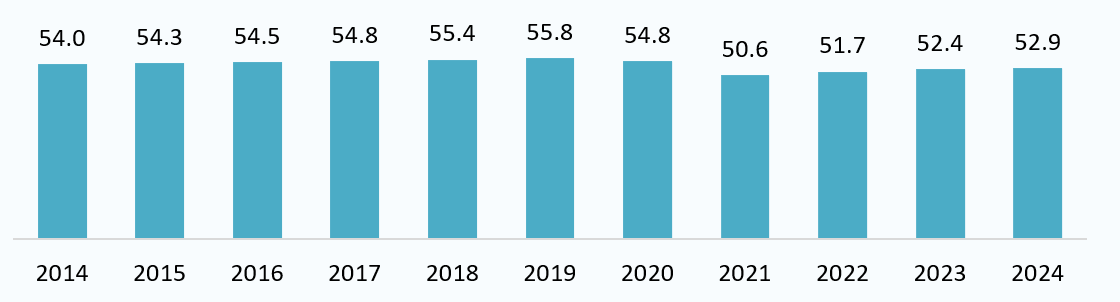
Source: National Statistics Office (formerly General Statistics Office)
According to the International Labour Organization (ILO), the labor market is primarily divided into three categories: agriculture, forestry, and fisheries; industry and construction; and services. Post-pandemic (2022–2024), while employment in agriculture has slightly decreased, the number of workers in industry and construction and in services has been increasing. These sectors reached new peaks by the end of 2024, with 17.5 million people working in industry and construction and 21 million in services.
Employment
Unit: million people
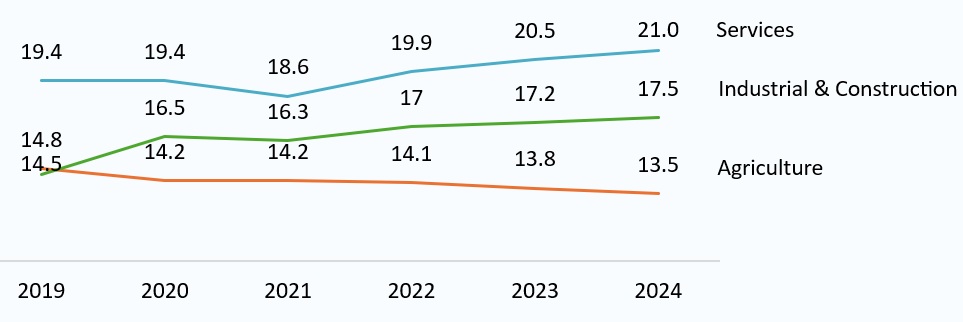
Source: National Statistics Office
By age group, workers aged 25 to 49 form the numerical core of the workforce. This age group demonstrates high adaptability to DX and new technologies. They can quickly adapt to sectors where demand is constantly evolving, and IT adoption is advancing, such as the service industry, manufacturing automation, and e-commerce. Meanwhile, the overall age of the workforce is steadily increasing. An upward trend in employment numbers was observed for those aged 50 and above. This age group is concentrated in occupations that do not require advanced digital skills, such as agriculture, handicrafts, apparel manufacturing, and traditional retail, where their experience and stability are valued.
Number of Workers by Age Group
Unit: million people
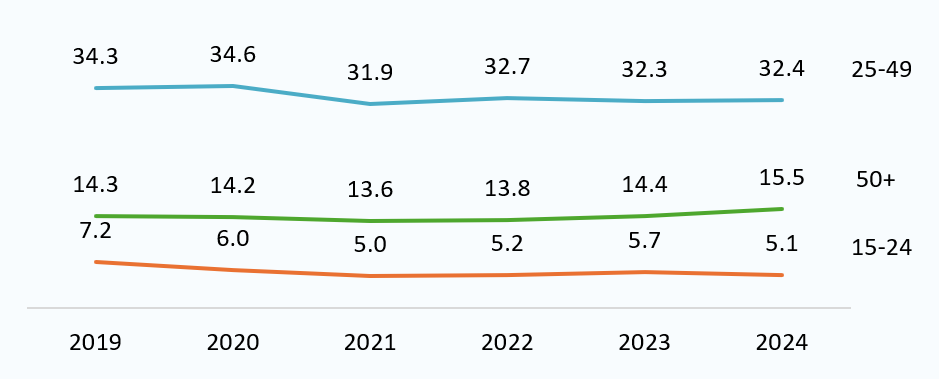
Source: National Statistics Office
DX and Future Workforce Alignment Policy
The government has implemented educational reforms to address future workforce needs through national programs focused on DX and vocational education.
For example, the “National Digital Transformation Program until 2025 (Vision to 2030)” was announced, emphasizing the importance of developing digital skills across all industries and calling for efforts from both organizations and individuals. It also addresses the e-government strategy and the development of the digital economy and digital society. Measures to achieve these goals are outlined. For instance, it calls for evaluating the implementation status of DX initiatives from ministries to local enterprises, and for providing better conditions for IT companies to promote the use of cutting-edge technologies at[2] .
Furthermore, as part of Technical and Vocational Education and Training (TVET) reform, the German Federal Ministry for Economic Cooperation and Development and the Vietnam Directorate of Vocational Education and Training (DVET) are working together to raise the standards of vocational training schools. This program focuses on adapting TVET to a world of increasing digitalization. Its main activities include training courses for vocational colleges, technical training facilities, policy advice, capacity building, technical support for TVET 4.0, and the development of an open educational resource platform.[3]
Future Trends in the Labor Market in DX
The growing demand for digital skills and higher education qualifications is expected to drive a restructuring of human resource development methods. As DX and automation accelerate across industries, the need for technical personnel who can adapt to the digital environment is increasing. At the same time, particularly in the manufacturing, construction, and service industries, there is a growing risk that many low-skilled and repetitive jobs will be replaced by machines and software due to business management systems that incorporate automation and artificial intelligence.[4]
Examples of DX-Driven Companies
| No | Company Name | Industry | Key Initiatives |
| 1 | Vinamilk | Dairy Products | · Smart Warehouse with Laser-Guided Vehicles and Rail-Guided Vehicles
· Automated Stacker Cranes, Ultra-High Temperature Processing Line, Warehouse Management System |
| 2 | Samsung Electronics | Electronic devices | · Autonomous pallet transport robots equipped with safety sensors and computer vision for internal logistics |
| 3 | Coteccons | Construction | · Microsoft’s cloud and AI tools
· 4D/5D Scheduling Integration with BIM (Building Information Modeling) |
| 4 | Lazada Logistics | E-commerce Logistics | · A 20,000-square-meter AI-powered sorting center in Binh Duong
· Application of Machine Learning to Core Operations |
| 5 | Techcombank | Finance | · Accelerating digital product offerings and driving large-scale digital customer acquisition through digital banking on the platform |
Source: B&Company Analysis
The World Economic Forum report, based on a survey of over 300 companies, reports a significant increase in high-tech roles such as AI and machine learning specialists. This is followed by roles such as e-commerce specialists and business development experts.
Growth Rate of Required Positions (2025)
Unit: %
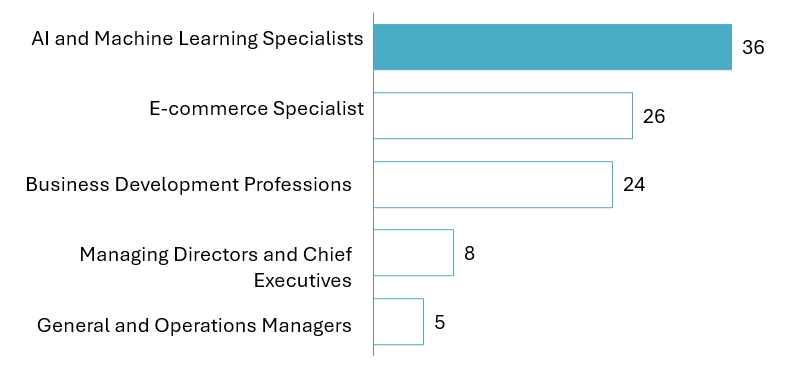
Source: World Economic Forum (2025)
According to the Advanced Human Resource Development Report by JICA and B&Company (2022), qualification requirements for workers are expected to become stricter in the future. The proportion of jobs requiring university degrees or higher is increasing, and the overall demand for higher education is also rising. In particular, postgraduate qualifications are becoming more common and may become the new standard for many professional roles. This suggests a gradual replacement of the traditional advantage held by bachelor’s degree holders in the labor market.
Demanded Educational Background
Unit: %
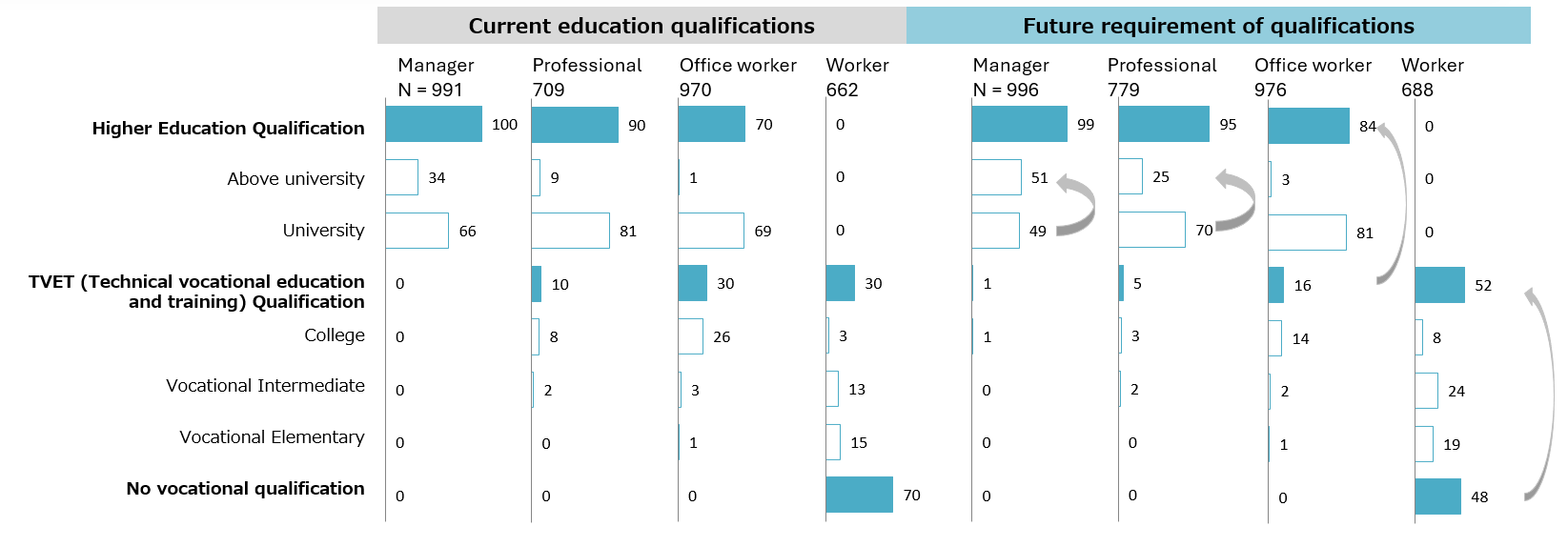
Source: B&Company, JICA (2022)[5]
As a result, reforms are underway to align education and human resource development systems with future skill needs. Key skills are shifting from analytical thinking and leadership (2025) to skills like big data expertise and cybersecurity (2030), reflecting efforts to adapt to the continuous advancement of IT technologies in the era of digital transformation.
Core Skills Required for Talent (2025 & 2030)
Unit: %
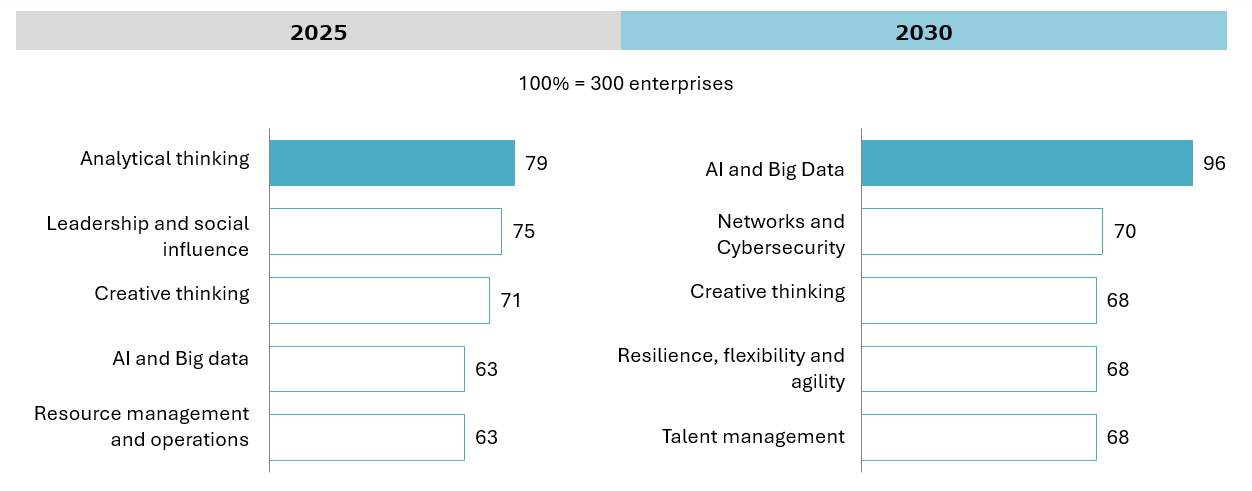
Source: B&Company, JICA (2022)[5]
Challenges
Access to technology and regulations remain significant barriers.
Restricted access to IT is particularly pronounced in rural areas and among small and medium-sized enterprises (SMEs). Rural areas have only 64% internet access, lower than urban areas (82%), limiting the full utilization of digital tools and platforms. Similarly, the DX of domestic SMEs is slow; according to a 2021 World Bank report, only about 23% of Vietnamese firms have introduced innovative products or process changes[6]. Outdated legal frameworks also pose significant barriers. Laws related to data privacy, cybersecurity, and digital labor rights have not kept pace with rapid DX. The lack of regulations governing areas like online work and digital contract enforcement creates uncertainty for businesses and workers, dampening their willingness to embrace digital innovation.
DX will reshape the labor market in the coming years. As companies adopt more advanced technologies, changes will occur in worker skill demands, positions, and working models. To maintain its international competitiveness, Vietnam must focus on developing a more flexible, digitally skilled workforce through consistent education, skills upgrading, and forward-looking human resource development strategies.[7]
* If you wish to quote any information from this article, please kindly cite the source along with the link to the original article to respect copyright.
| B&Company
The first Japanese company specializing in market research in Vietnam since 2008. We provide a wide range of services including industry reports, industry interviews, consumer surveys, business matching. Additionally, we have recently developed a database of over 1,000,000 companies in Vietnam, which can be used to search for partners and analyze the market. Please do not hesitate to contact us if you have any queries. info@b-company.jp + (84) 24 3978 5165 |
[2] VietnamPlus (2024) <Access>
[3] TVET Vietnam (2020 – 2024) <Access>
[5] B&Company, JICA (2022) <Access>
Related article






































Log in / Register
SUBSCRIBE NEWSLETTER