

 English
  日本語
日本語  Tiếng Việt
  简体中文
简体中文  한국어
한국어 Digital transformation in the Vietnam healthcare sector is expanding, with the digital healthcare market reaching USD 815 million in 2026.

17Mar2026
Latest News & Report / Vietnam Briefing
Comments: No Comments.
Abstract
Vietnam’s digital transformation in the healthcare sector is expanding, with the digital healthcare market reaching USD 815 million in 2026. Applications such as electronic medical records, telemedicine, and AI diagnostics are increasingly adopted. However, the sector still faces key challenges, including limited data interoperability and insufficient digital infrastructure at primary healthcare facilities.
The term digital transformation in this context encompasses the integration of digital technologies, telemedicine, artificial intelligence (AI), electronic health records (EHR), big data analytics, mobile health (mHealth) applications, and Internet of Medical Things (IoMT) devices into the full spectrum of healthcare service delivery, management, and research. This article provides an overview of where Vietnam’s healthcare digital transformation stands today, the market forces driving it, the trends reshaping it, and the key players leading the charge.
Market Overview
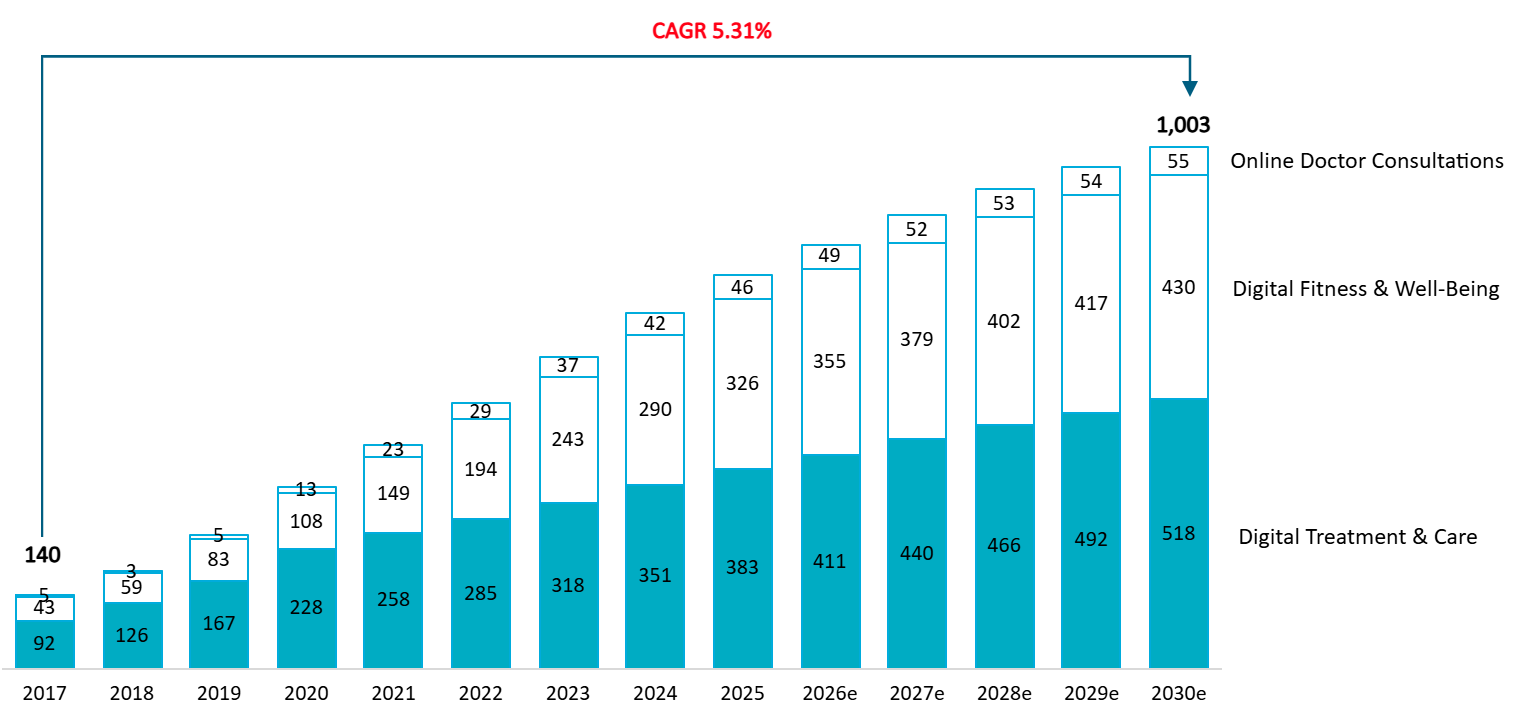
Vietnamese Digital healthcare sector’s revenue is expected to reach approximately USD 815 million in 2026, growing to USD 1 billion by 2028 at a CAGR of 5.31%[1]. While the market expands quickly during 2020-2024, which is likely to be triggered by COVID-19’s accelerated telemedicine adoption, growth becomes more gradual in later years, suggesting the industry is transitioning from an early adoption phase toward a more mature digital health ecosystem. The Digital treatment & care segment consistently represents the largest share of the market, increasing from USD 92M in 2017 to about USD 518M in 2030.
Vietnamese Digital Health Market’s Revenue (2017 – 2030)
Unit: million USD
Source: Statista
Proactive Government Policy as Key Driver
National Digital Transformation Program (Decision 749/QĐ-TTg)
The Vietnamese government has been the primary architect of the healthcare digital transformation agenda. Crucially, the government has designated healthcare as a top-priority sector under this program, which targets 100% of healthcare facilities adopting electronic health records (EHR), e-prescriptions, and cashless payments by 2025, while promoting the development of a national health database and telemedicine platforms[2].
However, the target of achieving 100% EHR adoption by 2025 is highly ambitious. Many district and rural hospitals lack the resources to maintain costly on-premises server infrastructure. Without a shared cloud-based health platform, sustaining EHR systems could be difficult. This may open opportunities for international cloud infrastructure and SaaS providers to support hospitals through service-based models rather than full system investments.
Decision No. 3516/QĐ-BYT: Digital Transformation Strategy for the Health Sector for 2025-2030
Beyond this program, in November 2025, the Ministry of Health issued Decision No. 3516/QĐ-BYT[3]. The strategy aims to build a nationwide integrated digital health ecosystem, with health data as the core connecting central and local healthcare systems. It also focuses on establishing digital architecture standards for the healthcare sector and promoting key platforms such as EHR, telemedicine services, national health data systems, and the application of AI and data analytics. This strategy serves as the main policy framework guiding Vietnam’s next phase of healthcare digital transformation.
Promoted Electronic Health Book in VNEID
A landmark milestone occurred in October 2024, when Prime Minister Pham Minh Chinh formally activated the rollout of the Electronic Health Book within the VNEID national digital identity application, with the stated goal that every Vietnamese citizen would possess a digital health record by 2025[4]. By January 2026, over 34 million electronic health records had already been created and integrated into the VNeID platform. However, in many lower-tier hospitals, data entry remains fragmented, inconsistently standardized, and sometimes prone to input errors. This suggests a potential opportunity for AI-based solutions that can automate the cleaning, normalization, and integration of legacy health data, improving data quality for nationwide health information systems[5].
Recent policies such as the Decree on Health Data Management (2025)[6] and the nationwide rollout of electronic medical records (EMR) aim to standardize health data and integrate it with national digital platforms and databases. These frameworks require measures such as data encryption, digital signatures, access control, audit logging, and the use of standards such as HL7 CDA, HL7 FHIR and DICOM. However, the standardization and governance of healthcare data at a nationwide scale are still under development, and there is not yet a single comprehensive and dedicated legal instrument specifically governing patient data protection.
Digital transformation trends in Healthcare sector
Electronic Health Records and Interoperability
Electronic health records (EHR) represent the foundational layer of a digitally transformed healthcare system. By early 2026, approximately 1,210 of 1,650 public and private hospitals nationwide had announced the implementation of electronic medical record (EMR) systems[7]. While adoption has been strong among upper-tier hospitals, autonomous public hospitals in lower-tier groups continue to face funding and technical capacity constraints. Interoperability – the ability for patient data to move seamlessly across facilities and platforms – remains a work in progress, with the Ministry of Health coordinating with the Ministry of Public Security to construct 12 specialized databases linked to the national integrated data platform.
The 12 databases include: information systems in the fields of maternal and child health and reproductive health; child management database; medical examination and treatment database; food safety database; national immunization information management system; social assistance recipient database; HIV/AIDS prevention database; social assistance facility database; social worker database; disability database; healthcare facility environment database; and healthcare human resources database.
AI and Big Data in Clinical Decision-Making
Vietnam’s Industry 4.0 agenda has created a supportive policy environment for AI adoption in healthcare, with international partnerships accelerating technology transfer. For example, in 2025, FPT Group partnered with TR (South Korea) to promote AI applications in smart healthcare, while Saigon Medical Group collaborated with Topcon Healthcare (Japan) and DKSH Vietnam to apply AI in ophthalmology diagnosis and treatment.
In December 2025, as part of the Ministry of Health’s digital transformation roadmap, the Drug Administration of Vietnam organized a training series on AI awareness and workplace applications in collaboration with FPT Group. The initiative also aims to deploy AI in the drug registration review process, replacing manual submission procedures, reducing administrative waiting times for businesses, and developing systems to detect and flag fraudulent or inconsistent application documents[8].
Health-Tech Startup Ecosystem Growth
Vietnam’s healthcare digital transformation is fostering a vibrant health-tech startup ecosystem. The sector has become one of the most actively funded in the country, supported by regulatory reforms such as the 2024 amendment to the Law on Pharmacy, which recognizes pharmacy chains and e-commerce drug distribution. Platforms like TrueDoc illustrate this trend by offering integrated online-offline healthcare services, including teleconsultation, home doctor visits, corporate checkups, medication delivery, and referrals through a large nationwide provider network[9].
Main players
Vietnam’s digital health ecosystem is characterized by a layered structure led by domestic technology conglomerates, where major infrastructure providers such as Viettel Group, VNPT, FPT Corporation, and CMC Technology & Solution dominate hospital IT systems, EMR deployment, and national healthcare data infrastructure. Meanwhile, health-tech startups like eDoctor, Jio Health, and Docosan primarily focus on telemedicine, care navigation, and patient-facing digital services rather than core infrastructure. International companies such as GE HealthCare and Siemens Healthineers tend to enter the market through partnerships with local system integrators, contributing specialized medtech and AI-driven healthcare solutions.
Main players in Vietnam’s Digital Healthcare sector
| Category | Company | Headquarter | Offerings | Notable projects |
| Infrastructure Giants | Viettel Group | Vietnam | Viettel Solution: Enterprise EMR (for large hospitals) and Ready-to-Use EMR (for small hospitals) | Deploy electronic medical records (EMR) at more than 200 healthcare facilities, helping to digitalize clinical workflows |
| VNPT | Vietnam | VNPT HIS and “smart hospital” solution ecosystem; diagnostics connectivity | Reported ~8,000 medical facilities using its IT/digital solutions (25M people served; 70M visits) | |
| FPT Corporation | Vietnam | Hospital IT/EMR ecosystem; AI and modernization programs | EMR deployments across 70+ hospitals in 6 months (2025); expanded strategic partnership with GE HealthCare (2025). | |
| CMC TS | Vietnam | Smart emergency services, epidemic mapping, the National Health Database, and the application of Geographic Information Systems (GIS) in healthcare, among others. | Cooperate with Hop Luc Healthcare System to deploy IT infrastructure and solutions such as AI-based OCR for automated document processing and RPA for workflow automation,… | |
| Startups/ Telemedicine | eDoctor | Vietnam | Mobile app: Telemedicine, Teleconsulting, home testing | Included in the World Bank telemedicine business model review.
Signed a partnership with Phano Pharmacy to provide online pharmacy services and home delivery of medications to customers. |
| Jio Health | Vietnam | Hybrid clinics, telemedicine, cytological diagnosis, home visit and mobile apps | Included in the World Bank telemedicine business model review. | |
| Docosan | Vietnam | Care access/navigation and booking (platform model | Included in the World Bank telemedicine business model review.
Promote digital transformation through a platform connecting patients with more than 1,000 healthcare facilities (Vinmec, Thu Cúc, Hoàn Mỹ, etc.). |
|
| International Telemedicine | Doctor Anywhere | Singapore | Telemedicine and hybrid services via clinics/partners and home services | Profiled in World Bank review (services spanning telemedicine and clinic/home options). |
| AI/ Medtech specialization | GE HealthCare | United States | Medtech + digital solutions; AI-driven innovation via partners | Strategic cooperation agreement with FPT to accelerate AI-powered healthcare innovation (2025). |
| Siemens Healthineers | Germany | Radiology imaging IT / enterprise imaging portfolio (plus devices) | Vietnam informatics deployments are not comprehensively disclosed publicly (unspecified); historic PACS example exists |
B&Company’s synthesis
Key Challenges
Despite rapid digitalization, Vietnam’s healthcare sector still faces several structural challenges that may slow investment returns. One major issue is limited interoperability between healthcare information systems, as patient data across hospitals and platforms is not yet fully standardized or integrated. In addition, many district and lower-tier hospitals lack sufficient financial resources and technical capacity to maintain complex IT infrastructure such as electronic medical record (EMR) systems. The regulatory framework for health data governance and patient data protection is still evolving, creating compliance uncertainty for companies operating in digital health and cross-platform data solutions.
Key Opportunities
At the same time, these gaps create substantial opportunities for investors in Vietnam’s expanding digital health market. The government’s push for nationwide EMR adoption, national health databases, and telemedicine platforms is generating demand for scalable digital infrastructure and integrated healthcare technologies. Investors can capture growth in areas such as cloud-based hospital systems, healthcare SaaS models, AI-powered data cleaning and analytics, telemedicine platforms, and digital patient management solutions. As Vietnam moves toward building a nationwide integrated digital health ecosystem, companies that provide interoperability solutions, AI-driven healthcare tools, and cloud infrastructure are likely to play a critical role in the next stage of the sector’s development.
Read more
* If you wish to quote any information from this article, please kindly cite the source along with the link to the original article to respect copyright.
| B&Company
The first Japanese company specializing in market research in Vietnam since 2008. We provide a wide range of services including industry reports, industry interviews, consumer surveys, business matching. Additionally, we have recently developed a database of over 900,000 companies in Vietnam, which can be used to search for partners and analyze the market. Please do not hesitate to contact us if you have any queries. info@b-company.jp + (84) 28 3910 3913 |
[1] https://www.statista.com/outlook/hmo/digital-health/vietnam?srsltid=AfmBOoqr_ajmdAK_hsy0jKp9lyTOwuHVGpWXhFsdNrk2fITYPM4M_zN7#revenue
[2] https://chinhphu.vn/default.aspx?pageid=27160&docid=200163
[3] https://thuvienphapluat.vn/van-ban/Cong-nghe-thong-tin/Quyet-dinh-3516-QD-BYT-2025-Chien-luoc-chuyen-doi-so-giai-doan-2025-2030-680780.aspx
[4] https://baochinhphu.vn/thu-tuong-moi-cong-dan-viet-nam-se-deu-co-so-suc-khoe-dien-tu-10224100218202132.htm
[5] https://www.vietnam.vn/en/tiep-tuc-dinh-hinh-dien-mao-y-te-so-nang-cao-hieu-qua-phuc-vu-nguoi-dan?
[6] https://thuvienphapluat.vn/van-ban/Cong-nghe-thong-tin/Decree-102-2025-ND-CP-management-of-data-on-health-sector-659918.aspx
[7] https://www.vietnam.vn/en/y-te-so-dang-dinh-hinh-tuong-lai-cham-soc-suc-khoe
[8] https://fpt-is.com/fpt-dong-hanh-cung-cuc-quan-ly-duoc-nang-cao-nang-luc-so-moi-can-bo-huong-toi-mot-tro-ly-ai-trong-cong-viec/
Related article







































Log in / Register
SUBSCRIBE NEWSLETTER