
 English
 日本語
 Tiếng Việt
 简体中文
 한국어
While public schools form the foundation, the private sector is expanding rapidly, offering diverse options ranging from K-12 to vocational training.

05Nov2026
Latest News & Report
Comments: No Comments.
The education industry is entering a new phase of development, driven by strong demand, a growing middle class, and encouragement of private sector participation. While public schools form the foundation, the private sector is expanding rapidly, offering diverse options ranging from K-12 (kindergarten through high school) to vocational training. Advances in educational technology are creating dynamic learning environments that transcend traditional models, bringing opportunities for investment and innovation.
Basic Statistics
| Indicators | Unit | 2020 | 2021 | 2022 | 2023 | 2024 |
| Kindergarten | Thousand | 15.0 | 15.5 | 15.3 | 15.3 | 15.2 |
| General Schools (Elementary, Junior High, High) | Thousand | 26.3 | 26.2 | 26.1 | 25.9 | 25.7 |
| Vocational Education Institutions | Thousand | 3.0 | 3.0 | 2.8 | 2.7 | 2.5 |
| University | Unit | 237 | 241 | 242 | 242 | 243 |
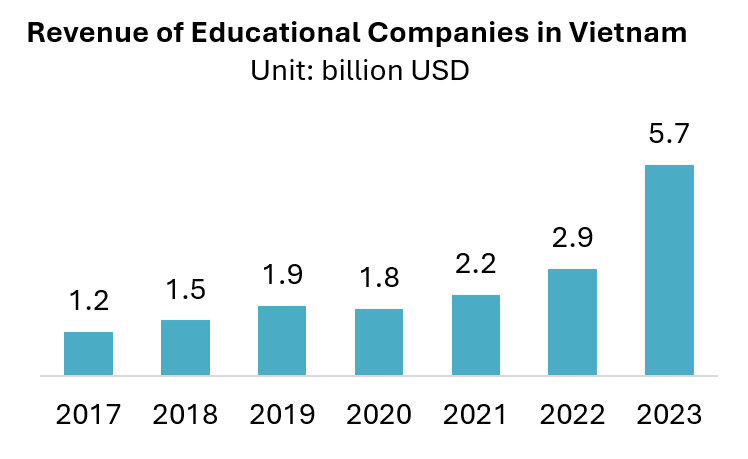
| Education Company | Thousand | 16.6 | 17.4 | 18.8 | 21.4 | NA |
| Education Expenditures | Billion USD | 10.3 | 10.1 | 10.6 | 12.1 | 13.0 |
| FDI Inflows | Million USD | 109 | 512 | 254 | 48 | 40 |
Source: National Statistics Office
Regulations
The education sector permits full foreign ownership. Foreign investors must obtain an operating license and comply with domestic education standards. Under Decree 86/2018, foreign-invested schools offering foreign curricula in kindergarten and compulsory education are permitted to admit up to 50% Vietnamese students.
However, many schools marketed as international schools are not legally classified as foreign-owned schools. Instead, they are often registered as Vietnamese-owned private schools (bilingual schools or schools with cooperative programs). In such cases, they are exempt from the 50% Vietnamese student cap stipulated by Decree 86. Consequently, it is not uncommon for these schools to have 80-95% Vietnamese students among their actual enrollment. Branding using terms like international or academy is widespread. While they appear identical to parents as international schools, the legal classification and applicable regulations can differ entirely from school to school.
The government actively encourages private and foreign investment. Resolution 35/2019 aims to increase the share of private educational institutions (to 13.5% of the total by 2025[1] ). Key laws include the 2019 Education Law (liberalizing private school structures), the 2020 Investment Law, and the new Decrees 124/125. The registration process remains multi-stage (IRC, ERC, operating license), though reforms in 2024-25 aim to streamline approval procedures.
Market Overview
The public sector underpins the education system, with near-universal coverage of basic education. Primary school completion rates exceed 98%, and adequate educational standards are ensured in all provinces. For the 2024-2025 academic year, there are approximately 12,000 primary schools, 8,500 middle schools, 2,400 high schools, and 2,900 comprehensive schools (e.g., primary-middle, middle-high, primary-middle-high). The majority of these are open to the public.
Private and international schools are steadily gaining popularity, and while their share remains small, their presence is growing. For the 2024-2025 academic year, approximately 2% of junior high and high school students and about 10% of elementary school students attend non-public schools. For kindergartens and universities, non-public institutions account for about 19-26% of enrollment.
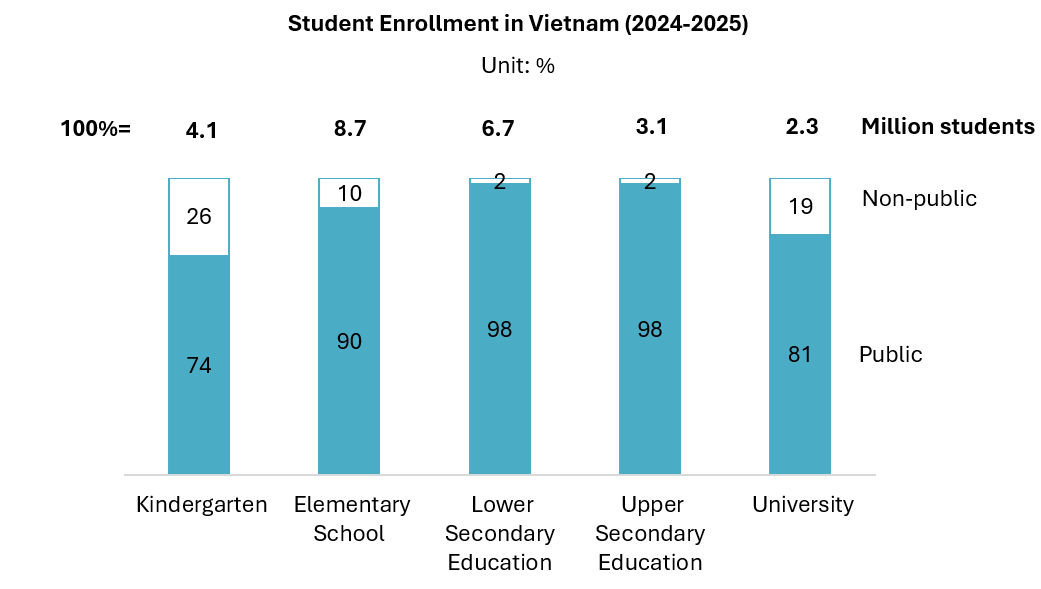
Source: National Statistics Office, Ministry of Education and Training
Meanwhile, many Vietnamese are studying abroad. By 2025, approximately 250,000 Vietnamese are expected to be studying overseas at the high school, university, and graduate school levels, indicating strong demand for international pathways. The main destinations are Japan (approx. 44,000), South Korea (approx. 43,300), Australia (approx. 33,000), the United States (approx. 31,300), and Taiwan (approx. 27,400)[2].
Households invest heavily in education (24% of household expenditure goes to education[3]). At the primary and secondary levels, tuition fees are the main expense. Semi-private schools (institutions relying on both government funding and other sources) also exist. In higher education, extracurricular lessons, exam preparation, and private university tuition are high costs. English learning is particularly prevalent, with hundreds of private language centers (ILA, Apollo, VUS, etc.) operating. Parents view English fluency as a critical skill. STEM and IT training also see strong demand. Market growth drivers include an expanding middle class, a tech-savvy younger generation, and government incentives (such as tax breaks).
STEM Education in Schools
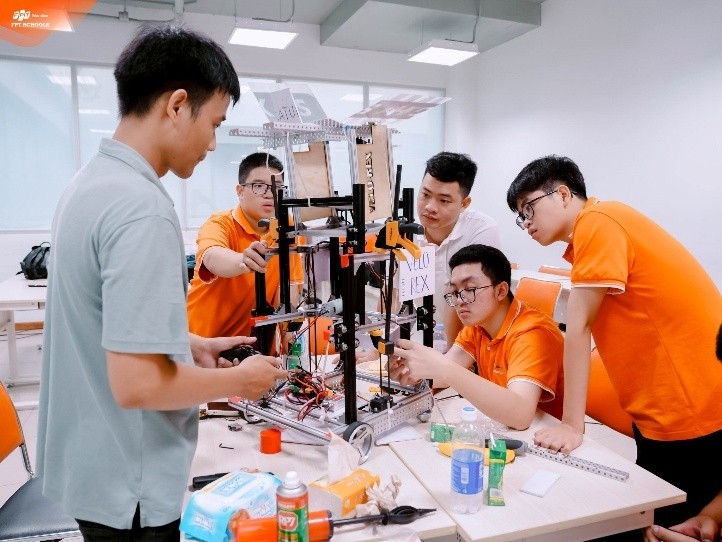
Source: FPT School
Challenges persist. In major cities, competition between private and international schools has intensified, leading to saturation in the high-end market. High operating costs and pricing pressures have forced some smaller schools to close or downsize. International school tuition ranges from 5,000 USD to 20,000 USD per year, placing it out of reach for the majority of families. Meanwhile, quality varies significantly, with insufficient teacher qualifications and inconsistent curricula. Concerns persist regarding disparities between urban and rural areas, teacher shortages, and the need for stronger quality assurance.
In recent years, the education sector has attracted record investment. In 2025, the ADB arranged a 150 million USD sustainability-linked loan for VinSchool[4].
Major players
Private operators are categorized into three groups: K–12 schools, such as Vinschool and Edufit; English language, qualification testing, and study abroad platforms such as Apollo, ILA, British Council, and IDP; and higher education systems including FPT University, RMIT, and Vin University. To meet demand for seamless pathways from kindergarten through university, there is a trend toward expanding operations by partnering with educational institutions in the US, UK, and Australia, or leveraging strong support from group companies. While the market is moving toward higher-priced programs and vertical integration, mid-tier K–12 operators still have room for growth.
Key players in Vietnam’s Education market
| No | Company | Country | Established | Headquarters | Overview |
| 1 | Vinschool | Vietnam | 2013 | Hanoi | A K–12 school operated by Vingroup. Western-style curriculum, CIS accredited |
| 2 | Vin University | Vietnam | 2018 | Hanoi | A private, non-profit research university established with investment from Vingroup and in partnership with Temple University (USA). Focuses on engineering, IT, and business. Admitted its first students in 2020 |
| 3 | FPT Education | Vietnam | 1999 | Hanoi | A subsidiary of FPT. Includes FPT University, FPT High School, and various training institutions (IT, foreign languages, vocational training). Partners with overseas universities (e.g., the University of Greenwich).= |
| 4 | Edufit Education | Vietnam | 2011 | Hanoi | Operates Dewey International School (K–12) and Sakura Montessori (early childhood education). Raised $34 million in 2019 |
| 5 | EQuest Education | Vietnam | 2003 | Ho Chi Minh City | Private education conglomerate. English instruction, international K–12 schools, U.S. degree programs through Broward College Vietnam |
| 6 | Apollo English | United Kingdom | 1994 | Ho Chi Minh City | The largest English education center. Serving all generations: children, teenagers, and adults. Global curriculum and extensive classroom network |
| 7 | ILA (International Language Academy) | Vietnam | 1993 | Ho Chi Minh City | Pioneer English Academy. Offers K–12 English programs and overseas study counseling. Operates dozens of schools |
| 8 | British Council | United Kingdom | 1993 | Hanoi | A UK cultural and educational organization. Provides English language exams (IELTS), language courses, arts programs, teacher training, and consulting services. A hub for international educational cooperation. |
| 9 | RMIT University | Australia | 2000 | Ho Chi Minh City | A branch campus of the Melbourne University. Faculties include Design, Business, IT, and Engineering. Campuses in Ho Chi Minh City, Hanoi, and Da Nang. Enrollment exceeds 12,000 students (as of 2024); Vietnam’s first foreign university |
| 10 | IDP Education | Australia | 1996 | Ho Chi Minh City | Provides overseas study placement services, English language testing (IELTS), and study support for[5] at multiple locations |
Source: B&Company analysis
Market Trends
Market Entry:
International educational institutions are entering Vietnam, including Western Sydney University (Hanoi, 2023), Greenwich Vietnam (a joint program between the University of Greenwich and FPT University), and Waseda University and Vietnam National University Hanoi’s double degree program. Domestic companies such as Vinschool, Edufit, and EQuest are also expanding their classrooms in various provinces, promoting bilingual classes and international curricula. The education sector is diversifying, becoming more competitive, and shifting toward private companies.
EdTech:
The pandemic accelerated online learning and EdTech investment. The e-learning market was worth 330 million USD in 2023, up 15% year-on-year[6] . In 2023 alone, millions of dollars in investment from dozens of investors flowed into EdTech startups.
Rising internet penetration (79%)[7] and improved IT literacy have normalized digital education (apps, online tutors, coding platforms). Notable players include TOPICA EdTech Group (online degree programs, corporate training), Elsa Speak (AI-based English pronunciation app), Vuihoc.vn, Marathon Education (K–12 tutoring platform), and Edmicro (adaptive learning, data-driven assessment tools).
Schools and language centers are adopting integrated IT systems, also known as Learning Management Systems (LMS). Major IT companies like VNPT, FPT, and CMC are developing integrated digital education systems.
International and Private Schools:
Enrollment in K–12 schools adopting foreign curricula and bilingual programs is increasing, particularly in Hanoi and Ho Chi Minh City. Major foreign schools include the Canadian International School (CIS) and the Australian-based St. Nicholas schools under the EQest umbrella. Vietnam also aims to attract branch campuses of top universities; for example, the government’s 2030 strategy encourages the establishment of campuses by renowned foreign universities. Simultaneously, many Vietnamese companies (often conglomerate-affiliated) are opening private academies to capture expanding middle-class demand. Market research indicates that registrations for new private schools surged in the early 2020s, responding to policies permitting non-public schools.
Demand for Language & Skills Classes:
Globalization and the advancement of the knowledge economy have heightened demand for English and vocational skills. Parents continue to spend heavily on after-school language courses, with language centers (e.g., ILA, Apollo, British Council) being popular. Demand for STEM and technical classes is also increasing, with many students participating in coding boot camps and robotics clubs or taking specialized exam preparation courses for international certifications. This growing interest in practical, globally applicable skills is reshaping the educational landscape. Educational institutions are being urged to expand bilingual education, digital education, and skills-based learning programs.
English has been a compulsory subject in the general education curriculum since the third grade of elementary school. However, not all teachers meet the required standards, and there are cases where students struggle to keep up with the lesson content. According to the EdTech Agency, only about 58% of students reach CEFR (Common European Framework of Reference for Languages) level B1 (intermediate: able to communicate on everyday topics at a basic level), while just 5% reach level B2 (upper-intermediate: able to understand and express themselves relatively fluently on more complex topics). Furthermore, rising demand for overseas study has increased the need for English proficiency required for visas and entrance exams.
A similar trend is observed for Japanese language learning. Surveys by organizations like the Japan Foundation indicate that the number of Japanese language learners in Vietnam reached approximately 170,000 by 2021, making it one of the largest markets globally. As of 2019, approximately 73,000 Vietnamese students were studying in Japan, accounting for about a quarter of all international students. This indicates significant learning demand aimed at studying in Japan or securing employment with Japanese companies. Against this backdrop, demand for diverse foreign language learning—including tutoring centers, language schools, and online learning services focused not only on English but also Japanese—is expanding further.
Meanwhile, the number of K-12 (elementary through high school) students in 2024 is approximately 23.2 million, about ten times the number of university and junior college students (approximately 2 million). The general education curriculum (2018) requires 12th-grade students to achieve B1-level language proficiency. While many university students are also expected to achieve B1 level, this is the level they should have attained by high school graduation. The supplementary and additional education mentioned earlier for K-12 students has ended up covering content at a level far exceeding that of university.
Read more
Explanation of the Vietnam Education system and chances for foreign investors
* If you wish to quote any information from this article, please kindly cite the source along with the link to the original article to respect copyright.
| B&Company
The first Japanese company specializing in market research in Vietnam since 2008. We provide a wide range of services including industry reports, industry interviews, consumer surveys, business matching. Additionally, we have recently developed a database of over 1,000,000 companies in Vietnam, which can be used to search for partners and analyze the market. Please do not hesitate to contact us if you have any queries. info@b-company.jp + (84) 24 3978 5165 |
[1] Vietnam Briefing (2024) <Access>
[3] Hanoi Times (2022) <Access>
[5] IELTS is administered by multiple providers
Related article












Log in / Register
SUBSCRIBE NEWSLETTER