

 English
  日本語
日本語  Tiếng Việt
  简体中文
简体中文  한국어
한국어 Vietnam's first dedicated law on AI covers activities from AI research and development to the provision, deployment, and use of AI systems.

25Aug2026
Latest News & Report / Vietnam Briefing
Comments: No Comments.
Background
Artificial Intelligence (AI) has emerged as one of the most transformative technologies shaping the global economy. In Vietnam, AI is increasingly being applied across manufacturing, finance, healthcare, education, e-commerce, and public services. Alongside its potential to improve productivity and foster innovation, the rapid development of AI has also raised concerns regarding privacy, cybersecurity, misinformation, legal liability, and the transparency of AI-assisted decision-making. [1]
On December 10, 2025, Vietnam’s National Assembly passed the Law on Artificial Intelligence (Law No. 134/2025/QH15)[2], which officially came into effect on March 1, 2026. This is Vietnam’s first dedicated law on AI, covering activities ranging from AI research and development to the provision, deployment, and use of AI systems. The law addresses AI-related risks while promoting technological sovereignty, national AI infrastructure, and the development of a competitive AI ecosystem.
From Fragmented Regulations to a Dedicated AI Law
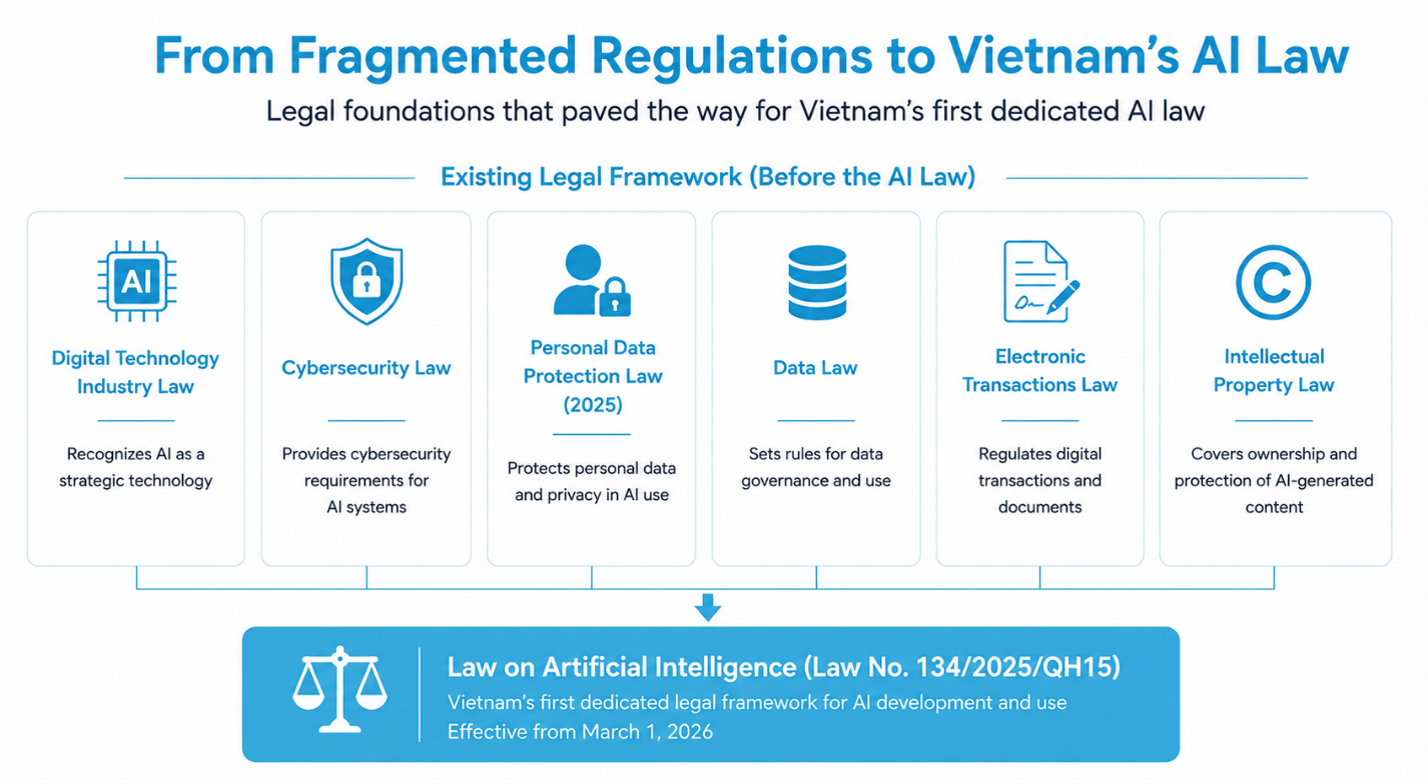
Prior to the enactment of the AI Law, Vietnam did not have a unified legal framework specifically governing artificial intelligence. Instead, AI-related issues were addressed across various pieces of legislation. The Law on Digital Technology Industry (Law No. 71/2025/QH15)[3] was the first Vietnamese law to explicitly mention artificial intelligence, identifying AI as a strategic technology that should be prioritized for development. The Cybersecurity Law[4] and the 2025 Law on Personal Data Protection[5] established the legal foundations for cybersecurity, privacy, and the use of data in AI systems. The Law on Data[6], the Law on Electronic Transactions[7], and the Law on Intellectual Property[8] regulate data governance, digital transactions, and ownership of AI-generated content.
As AI applications expanded across both the public and private sectors, this fragmented legal framework became increasingly insufficient. Law No. 134/2025/QH15 fills this gap by establishing Vietnam’s first dedicated legal framework for AI.
B&Company’s synthesis
Key Highlights of Vietnam’s AI Law
Vietnam’s Law on Artificial Intelligence establishes a comprehensive framework that combines AI governance with policies supporting innovation and long-term technological development. Five provisions stand out.
| Key Provision | Key Requirements | Relevant Provisions |
| AI Systems Will Be Regulated According to Their Risk Levels | • AI systems classified as high-, medium-, or low-risk
• High-risk: conformity and impact assessments, incident management • Medium risk: self-classification and notification |
Articles 8, 9, 10, 13, and 15 |
| AI-Generated Content Must Be Clearly Identifiable | • Users must be informed when interacting with AI
• AI-generated or modified audio, images, and videos must be clearly identifiable • Applies to generative AI used for content creation and customer engagement |
Articles 17 and 18 |
| AI Can Support Human Decisions but Cannot Replace Human Responsibility | • AI may support but not replace human judgment
• Organizations and users remain responsible for AI-related damages • Particularly relevant to healthcare, education, finance, and public services |
Articles 4, 6, 7, and 25 |
| The Law Supports Vietnam’s Long-Term AI Development | • Development of national computing infrastructure and AI databases
• AI training and testing platforms • Development of Vietnamese and ethnic-minority-language LLMs |
Articles 5 and 26–31 |
| Businesses Will Be Given Time to Adapt | • Regulatory sandboxes and financial/investment incentives
• National Artificial Intelligence Development Fund • Transition period: 18 months for healthcare, education, and finance; 12 months for other sectors |
Articles 32–34 and transitional provisions of the Law |
B&Company’s synthesis
Implications for Businesses and the Digital Economy
The impact of the AI Law extends beyond companies that develop AI technologies. As AI becomes embedded in everyday business processes, organizations that use third-party AI tools may also need to consider transparency, human oversight, data protection, and accountability.
| Business group | Potential impact |
| AI developers and providers | Greater requirements for risk classification, documentation, conformity assessment, monitoring, and incident management |
| Companies using AI | Greater attention to transparency, human oversight, data governance, and responsible deployment |
| Investors and technology companies | Greater regulatory clarity, while compliance requirements may increase initial costs |
| AI startups and SMEs | Potential access to infrastructure, data, sandbox environments, and government support |
| Businesses in essential sectors | Greater scrutiny where AI may affect health, safety, rights, or public interests |
B&Company’s synthesis
For technology developers and providers, the law is likely to increase compliance responsibilities, particularly for high-risk systems. However, clearer rules may also reduce regulatory uncertainty and strengthen user and investor confidence over time.
For companies that simply use AI rather than develop it, the impact is more indirect but increasingly relevant. Businesses using chatbots, generative AI for marketing, AI-assisted recruitment, analytics, or automated decision-making should assess how these applications are classified and whether transparency, human oversight, or other obligations apply.
At the ecosystem level, government support for AI infrastructure, sandboxes, startups, and Vietnamese-language models could create new opportunities for technology companies and investors. However, Vietnam will still need to strengthen computing capacity, data resources, and AI talent to fully realize these opportunities.
Conclusion
The entry into force of Vietnam’s Law on Artificial Intelligence (Law No. 134/2025/QH15) on March 1, 2026, marks an important milestone in the country’s efforts to establish a legal foundation for the digital economy. The law combines risk management with policies that promote innovation and technological self-reliance. As AI adoption accelerates across industries, the new law provides greater legal certainty for both AI developers and businesses integrating AI into their operations.
Read more
* If you wish to quote any information from this article, please kindly cite the source along with the link to the original article to respect copyright.
| B&Company
The first Japanese company specializing in market research in Vietnam since 2008. We provide a wide range of services including industry reports, industry interviews, consumer surveys, business matching. Additionally, we have recently developed a database of over 1,000,000 companies in Vietnam, which can be used to search for partners and analyze the market. Please do not hesitate to contact us if you have any queries. info@b-company.jp + (84) 24 3978 5165 |
[1] VIET NAM Articial Intelligence Readiness Assessment Report
[2]https://thuvienphapluat.vn/van-ban/Cong-nghe-thong-tin/Luat-Tri-tue-nhan-tao-2025-so-134-2025-QH15-679013.aspx Law on Artificial Intelligence No. 134/2025/QH15
[3]https://thuvienphapluat.vn/van-ban/Cong-nghe-thong-tin/Law-71-2025-QH15-Digital-Technology-Industry-668801.aspx
[4] https://thuvienphapluat.vn/van-ban/Cong-nghe-thong-tin/Luat-an-ninh-mang-2018-351416.aspx
[5]https://thuvienphapluat.vn/van-ban/Bo-may-hanh-chinh/Luat-Bao-ve-du-lieu-ca-nhan-2025-so-91-2025-QH15-625628.aspx
[6] https://thuvienphapluat.vn/van-ban/Bo-may-hanh-chinh/Luat-Du-lieu-2024-so-60-2024-QH15-621343.aspx
[7] https://thuvienphapluat.vn/van-ban/Cong-nghe-thong-tin/Luat-Giao-dich-dien-tu-2023-20-2023-QH15-513347.aspx
[8] https://thuvienphapluat.vn/van-ban/So-huu-tri-tue/Luat-So-huu-tri-tue-2005-50-2005-QH11-7022.aspx
Related article














Log in / Register
SUBSCRIBE NEWSLETTER