

 English
  日本語
日本語  Tiếng Việt
  简体中文
简体中文  한국어
한국어 In 2025, Vietnam dairy industry reached a total revenue of 133,042 trillion VND, up around 1% compared to 2024, maintaining a large scale.
22Apr2026
Latest News & Report / Vietnam Briefing
Comments: No Comments.
Vietnam’s dairy industry is entering a new phase of development following the Government’s issuance of Decision No. 309/QD-TTg on the Strategy for the Development of the Dairy Industry to 2030, with a Vision to 2045. Although the market has already reached a considerable scale, processing capacity has become increasingly modern, and many large players are now active in the sector, the industry still faces a core bottleneck: domestic fresh milk supply has not kept pace with processing demand. The new strategy, therefore, aims not only to expand the industry’s scale but also to complete the value chain, improve raw-material self-sufficiency, and strengthen linkages across the sector.
Overview of Vietnam’s dairy industry
In 2025, Vietnam’s dairy industry operated in the context of both global and domestic economic volatility, affected by the global milk price downcycle, trade tensions, climate change, and the slow recovery of consumer demand. Nevertheless, according to the Vietnam Dairy Association (VDA), total industry revenue in 2025 was estimated at VND 133,042 trillion, up around 1% compared to 2024. In the same year, fresh milk output was estimated at approximately 1.67 billion liters, while milk powder output reached around 154 thousand tons. These figures suggest that the industry has maintained both a large scale and a certain degree of stability[1].
Number of milk and dairy-product processing companies in Vietnam, 2016–2024
Unit: companies
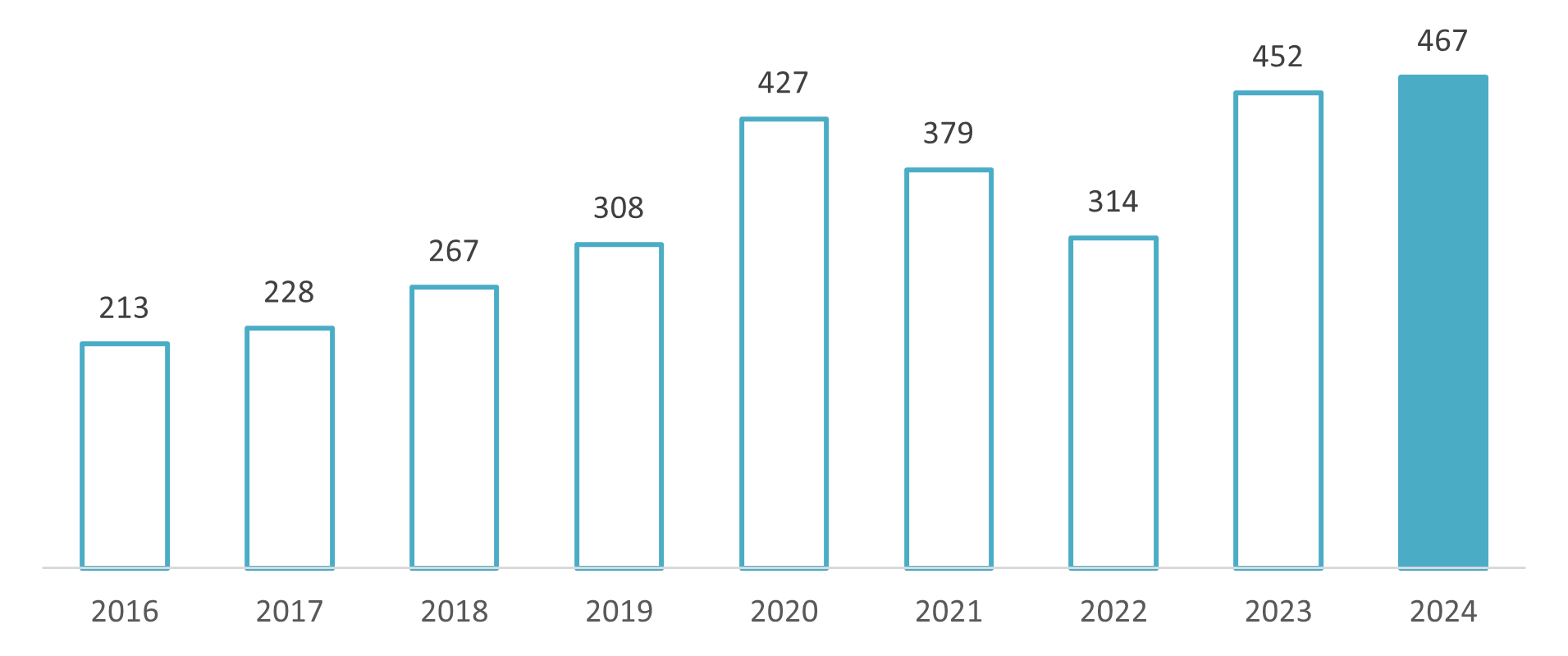
Source: B&Company’s Enterprise Database
In addition to revenue and output scale, the number of companies engaged in milk and dairy-product processing in Vietnam has also increased significantly over the past decade. From 213 companies in 2016, the number more than doubled to 467 in 2024, reflecting the industry’s growing attractiveness to manufacturers. Although there was a slight decline in 2021–2022, the strong recovery from 2023 suggests that Vietnam’s dairy market continues to be viewed as stable, albeit highly competitive.
In terms of market structure, Vietnam’s dairy industry is currently led by a group of major domestic and multinational corporations, each holding different strengths across segments ranging from liquid milk and fresh milk to milk powder and specialized nutrition.
Table: Key players in the Vietnam dairy industry
| No. | Company | Country of origin | Brands | Key products |
| 1 | Vinamilk | Vietnam | Vinamilk, Green Farm, Ong Tho, Probi, Susu, Optimum Gold | Liquid milk, yogurt, condensed milk, milk powder |
| 2 | TH true MILK / TH Group | Vietnam | TH true MILK, TH true YOGURT, TH TOPKID | Fresh milk, yogurt, premium/organic dairy products |
| 3 | FrieslandCampina Vietnam | Netherlands | Dutch Lady, Friso, Fristi, Yomost | Liquid milk, infant formula, drinking yogurt, condensed milk |
| 4 | Nutifood | Vietnam | NutiMilk, GrowPLUS+, Nuvi Growth Height | Milk powder, child nutrition, specialized adult nutrition |
| 5 | LOF / IDP | Vietnam | Kun, LOF, Malto, LOF Ba Vì | Drinking yogurt, fruit milk, nutritional beverages, mass-market liquid milk |
| 6 | Moc Chau Milk | Vietnam | Moc Chau Milk, Moc Chau Creamery | Fresh milk, yogurt, fresh dairy products |
| 7 | Nestlé Vietnam | Switzerland | NAN, Lactogen Gold | Infant formula, child nutrition |
| 8 | Abbott Vietnam | United States | Similac, PediaSure, Ensure, Grow, Glucerna | Infant formula, medical nutrition, adult nutrition |
| 9 | Fonterra | New Zealand | Anlene, Anmum, Anchor | Adult nutrition, maternal and child nutrition, dairy ingredients |
| 10 | Mead Johnson Nutrition Vietnam | United States | Enfa | Infant formula, toddler nutrition |
B&Company’s synthesis
Major achievements of Vietnam’s dairy industry
Vietnam’s dairy industry has developed a relatively well-defined competitive structure, led by major domestic players such as Vinamilk, TH True Milk, Nutifood, IDP, and Moc Chau Milk, alongside the strong presence of multinational corporations such as FrieslandCampina, Nestlé, Abbott, Mead Johnson, and Fonterra. Exports have also emerged as a clear, bright spot. In 2025, Vietnam’s dairy exports reached USD 390.86 million, up 20.6% from 2024. Iraq remained the largest market, accounting for 42% of total export value, followed by Cambodia, Singapore, and Turkey[2]. This suggests that Vietnamese dairy companies are no longer focused solely on the domestic market but are also building the capability to expand overseas.
At the same time, the industry’s consumption structure is moving toward higher-value segments. According to the Vietnam Dairy Association (VDA), domestic consumption is still growing, but one notable trend is the shift toward specialized nutrition products for the elderly, children, patients, diabetics, and other consumer groups with specific needs. This is an encouraging sign, as it shows that the market is not only expanding in volume but also upgrading in quality and value[3].
Another important achievement is the clear improvement in processing capacity and quality management among major dairy companies, reflected in the simultaneous standardization of farms, factories, and raw-milk procurement. Vinamilk provides a strong example: the company currently has 13 farms certified to Global G.A.P and ISO 9001:2015, 2 farms certified to Organic EU and Organic China standards, and 15 factories certified under systems such as FSSC 22000, Halal, and/or ISO 9000. This indicates that, at least among the industry leaders, Vietnam’s dairy value chain has become significantly more modern in terms of technology, operating standards, and quality control[4].
Structural challenges facing the industry
The biggest challenge facing Vietnam’s dairy industry today remains the supply of raw materials. Although processing capacity has improved substantially, domestic fresh milk production still lags behind industry demand. According to the Ministry of Industry and Trade, Vietnam produced around 1.86 billion liters of fresh milk in 2023, yet this met only about 38% of processing demand[5]. This imbalance remained evident in 2025, when fresh milk output grew by only about 1.9%, while imports of milk and dairy products rose sharply to around USD 1.26 billion, up 23.3% year on year. In other words, the sector’s main weakness no longer lies in consumption or downstream processing, but in the still-limited domestic raw-material base, which leaves the supply chain significantly dependent on imports to sustain production and stabilize the market.
At a deeper level, the industry’s difficulties also stem from the structure of dairy farming and intensifying competitive pressure. According to discussions at a 2025 industry seminar, dairy farmers are under strain from high production costs, volatile raw-milk prices, unstable market access, and shrinking agricultural and grassland areas due to urbanization, while many smallholder farms still operate at a limited scale and struggle to invest in technology. At the same time, the market is shifting rapidly toward cleaner, more organic, and more specialized nutritional products, forcing companies to raise standards in quality, traceability, and operational efficiency. This suggests that the challenge for Vietnam’s dairy industry is not simply to increase output, but to reorganize the entire value chain, from raw-material areas and household farms to procurement systems, technology adoption, and market standards[6].
The 2030–2045 strategy: a shift toward a complete dairy value chain
In response to the current bottlenecks facing the dairy industry, the Government issued Decision No. 309/QD-TTg on February 23, 2026, approving the Strategy for the Development of the Dairy Industry to 2030, with a Vision to 2045, with the aim of building a complete value chain from dairy herd development and increased domestic fresh milk supply to the processing of higher value-added dairy products.
Table: Key changes between Vietnam’s old and new dairy development strategies and targets
| No. | Indicator | Old Strategy (2025) |
New Strategy (2030–2045) |
|
| 2030 | 2045 | |||
| 1 | Domestic raw milk supply | 1.4 billion liters; ~40% of demand/year | 2.6 billion liters; ~60%–65% of processing demand/year | 8.0 billion liters; ~80%–85% of processing demand/year |
| 2 | Liquid milk / pasteurized-UHT milk output | 1.5 billion liters/year | 4.2 billion liters of processed liquid milk/year | 9.7 billion liters of processed liquid milk/year |
| 3 | Milk powder output | 170 thousand tons/year | 245 thousand tons/year | 415 thousand tons/year |
| 4 | Per-capita consumption | 34 liters/person/year | 40 liters/person/year | 100 liters/person/year |
| 5 | Priority product orientation | Focus on conventional core products: pasteurized/UHT milk, yogurt, milk powder, condensed milk | Shift to higher value-added products, new products, and lifecycle/specialized nutrition segments | More diversified, value-added, and internationally aligned product mix |
| 6 | Value-chain organization and linkages | Link processing plants with dairy-farming zones and demand centers; raise domestic fresh-milk use | Develop concentrated dairy farms combined with cooperatives/households; strengthen farmer-processor linkages | Form larger dairy groups/corporations with stronger regional and global competitiveness |
| 7 | Technology and quality management | Upgrade equipment and tech transfer; enforce product standards, food safety and market inspection | Add digital tech, blockchain, AI, traceability, new automation, and standards aligned with Codex/ISO/HACCP/Halal | Deepen next-generation automation and international-standard chain management |
| 8 | Sustainability / green development | Emphasize modern, sustainable, cleaner production with waste treatment and food safety. | Add LCA, green/eco labels, cleaner production, pollution prevention, and circular economy | Stronger green-growth and emissions-reduction orientation across production and consumption. |
B&Company’s synthesis from Decision No. 3399/QD-BCT and Decision No. 309/QD-TTg
In policy terms, the new strategy marks a clear shift in both scope and ambition. While Decision No. 3399/QD-BCT, issued in 2010, focused mainly on developing Vietnam’s dairy processing industry through 2025, with emphasis on output expansion, greater import substitution, product mix, and plant capacity linked to dairy farming areas, Decision No. 309/QD-TTg broadens the policy direction to cover the entire dairy value chain.
More specifically, the new strategy not only extends the vision to 2045, but also introduces several new priorities, including dairy herd development, higher self-sufficiency in domestic fresh milk supply, stronger linkages between farmers and processors, greater application of technology, traceability, food safety, export diversification, and greener production. Compared with the previous approach, which focused largely on processing capacity and selected product categories, the new strategy sets out a longer-term roadmap to strengthen domestic raw-material self-sufficiency, modernize the value chain, and deepen the participation of Vietnam’s dairy industry in regional and global value chains.
Strategic implications for foreign investors
Vietnam’s dairy market remains attractive, but the most promising opportunities are no longer in broad-based volume growth alone. As consumption shifts toward premium, specialized, and higher-value nutrition products, and as the new 2030–2045 strategy pushes for a more complete dairy value chain, foreign investors may find stronger potential in upstream inputs, dairy technology, traceability solutions, and specialized nutrition segments.
At the same time, the sector is becoming harder to enter. Competition is already intense, led by strong domestic champions and major international brands, while the industry still faces structural weaknesses in raw-milk supply, fragmented farming, and rising requirements for quality, traceability, and sustainability. This means foreign investors will need a more selective market-entry approach rather than a standard mass-market expansion model.
Foreign investors seeking to enter Vietnam’s dairy market should
– Focus on upstream and enabling capabilities, where Vietnam still has structural gaps, especially in raw-milk supply, farm productivity, cold chain, and processing technology.
– Target premium and specialized nutrition niches, where product formulation, quality assurance, and brand credibility matter more than scale alone.
– Use partnership-led entry models, such as JVs, strategic alliances, or technology cooperation with local players, to access supply networks and distribution faster.
– Align early with traceability and green standards, as the new strategy signals rising policy and market expectations around digital control, food safety, and sustainable production.
Read more
Import and sales of Japanese processed food – Potentials and chances for Japanese companies
* If you wish to quote any information from this article, please kindly cite the source along with the link to the original article to respect copyright.
| B&Company
The first Japanese company specializing in market research in Vietnam since 2008. We provide a wide range of services including industry reports, industry interviews, consumer surveys, business matching. Additionally, we have recently developed a database of over 900,000 companies in Vietnam, which can be used to search for partners and analyze the market. Please do not hesitate to contact us if you have any queries. info@b-company.jp + (84) 28 3910 3913 |
[1] https://vda.org.vn/hiep-hoi-sua-viet-nam-to-chuc-hoi-nghi-tong-ket-cong-tac-nam-2025-va-trien-khai-nhiem-vu-nam-2026/
[2] https://vda.org.vn/ban-tin-dien-bien-thi-truong-sua-thang-1-nam-2026/
[3] https://vda.org.vn/ban-tin-dien-bien-thi-truong-sua-thang-1-nam-2026/
[4] https://static2.vietstock.vn/vietstock/2025/3/21/20250321_vnm_250321_annual_report_2024.pdf
[5] https://moit.gov.vn/tin-tuc/phat-trien-cong-nghiep/hoi-thao-khoa-hoc-phat-trien-nganh-sua-viet-nam-den-nam-2030-tam-nhin-den-nam-2045-.html
[6] https://baochinhphu.vn/nganh-chan-nuoi-bo-sua-huong-toi-chuoi-lien-ket-khep-kin-de-hop-tac-phat-trien-102250923143440705.htm
Related article




















Log in / Register
SUBSCRIBE NEWSLETTER