

 English
  日本語
日本語  Tiếng Việt
  简体中文
简体中文  한국어
한국어 While tighter regulations in Vietnam market have introduced short-term adjustment pressures for retailers, they address long-standing issues.

25Feb2026
Highlight content / Highlight Content JP / Highlight content vi / Industry Reviews / Latest News & Report
Comments: No Comments.
By analyzing Vietnam’s retail market in the context of intensifying regulatory oversight, one can assess whether recent policy shifts represent a constraint on growth or a step toward market maturity. While tighter regulations have introduced short-term adjustment pressures for retailers (particularly smaller and informal operators), they address long-standing issues related to transparency, market order, and consumer trust. Over time, regulatory tightening is expected to facilitate structural upgrading, accelerate modern retail development, and foster a more sustainable and investment-ready retail ecosystem.
Overview of Vietnam’s retail market
Vietnam’s retail industry has been on a consistent upward trend, reflecting strong domestic consumption and economic resilience. Total retail sales of goods and services are projected to rise from USD 167 billion in 2021 to USD 269 billion in 2025 (CAGR 12.6%), underscoring sustained year-on-year growth in overall market size[1].
Total retail sales of goods and services revenue by Distribution channels
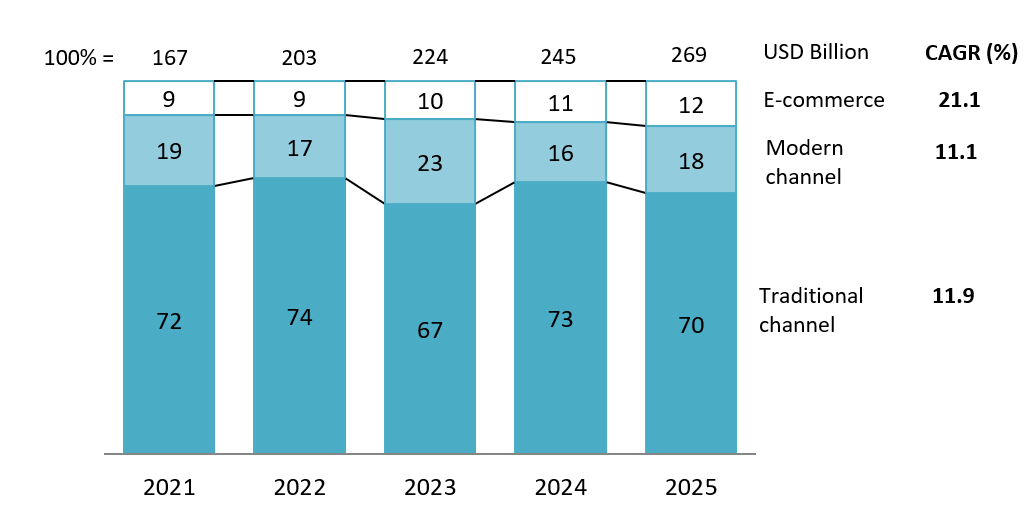
Source: Agency for Domestic Market Surveillance and Development – Ministry of Industry and Trade
Vietnam’s retail landscape remains dominated by traditional distribution channels, which accounted for about 70 % of total retail sales in 2025, while modern channels and e-commerce comprised roughly 18% and 12%, respectively. Traditional markets and household businesses continue to anchor daily commerce, particularly in rural and provincial areas. Modern retail formats such as supermarkets, convenience stores, and shopping malls have been rapidly expanding nationwide, facilitating fresher, branded, and higher-service shopping experiences. E-commerce in particular has been a major growth driver, with online retail turnover reaching roughly USD 32 billion in 2025 and growing, positioning Vietnam as one of Southeast Asia’s fastest-growing online markets[2].
Regulatory tightening in the Vietnamese retail industry
In 2025, the Vietnamese Government has issued some major tightenings in the retail sector. These initiatives are designed to formalise retail activities, improve consumer protection, and strengthen market order.
Some regulations issued in 2025
| Regulation | Effective date | Key highlights |
| Decree 70/2025/NĐ-CP | June 1, 2025 | Mandates electronic invoicing; tightens revenue reporting and documentation, especially for household businesses |
| Resolution 397/NQ-CP | December 5, 2025 | Government’s action plan about a crackdown on counterfeit, smuggled, and substandard goods; stricter inspections and penalties |
| Law 78/2025/QH15
Amendments to the Law on Product and Goods Quality |
January 1, 2026 | Introduces mandatory product traceability and digital product passports (QR/barcode-based); enhances supply chain transparency |
| Law 122/2025/QH15
Law on E-commerce |
July 1, 2026 | Establishes a comprehensive legal framework for e-commerce activities, including mandatory seller identity and business information verification, and strict platform responsibilities. |
Source: B&Company synthesized from Decree 70/2025/NĐ-CP, Resolution 397/NQ-CP, Law 78/2025/QH15, Law 122/2025/QH15
With Decree 70/2025/NĐ-CP, the Government has expanded mandatory e-invoicing requirements to include many household businesses and individual sellers previously operating largely on informal, cash-based systems. Under this decree, retailers meeting certain revenue thresholds must issue electronic invoices tied to digital point-of-sale systems, integrate with tax authority reporting, and retain records long-term[3]. This move aims to reduce undeclared sales and ensure tax compliance, while also supporting accurate revenue tracking across retail channels.
Moreover, law enforcement agencies have continuously detected and dismantled smuggling rings, trade fraud, counterfeit goods, and intellectual property infringements. Cases of trading counterfeit goods such as medicines, fake milk, fake functional foods, fake cosmetics, and food of unknown origin have been revealed. Under this context, the issuance of Resolution 397/NQ-CP further strengthens the country’s commitment to protecting customers’ rights and brands’ intellectual property.
In parallel, the amended Law on Product and Goods Quality, effective 1 January 2026, introduces mandatory traceability mechanisms including digital product passports, barcodes, or QR codes[4]. This mechanism enables authorities and consumers to verify the origin, production, and distribution history of goods. This reform addresses pervasive concerns about products of unknown origin and unverified quality, particularly common in informal retail and online listings[5].
With the impressive growth of e-commerce, misconducts prevail in virtual space. Online channels, notably live-streamed sales and social media commerce, have become fertile ground for sophisticated scams, with sellers advertising substandard products as “regional specialties,” and “hand-carried imports,” often leveraging influencers to build trust[6]. Vietnam’s first comprehensive Law on E-Commerce establishes clear obligations for e-commerce platforms, including mandatory electronic verification of seller identities, public disclosure of product and business information, and platform responsibility for censoring unlawful content and handling consumer complaints. It also introduces specific rules for livestream sales and affiliate marketing (mechanisms widely exploited for the sale of unverified or counterfeit products).
In practice, Vietnam’s regulatory tightening has been matched by decisive enforcement actions that go beyond issuing laws and decrees. For the case of Decree 70, the General Department of Taxation, in coordination with local tax departments, provincial People’s Committees, and market management forces, has conducted outreach, compliance checks, and guided businesses to adopt electronic invoices directly connected to the national tax system[7]. The fight against trade fraud is getting fierce: throughout 2025, inspectors conducted more than 27,500 inspections and handled over 23,000 violations nationwide[8]. Many of these cases displayed criminal signs, leading to prosecution alongside administrative penalties. This integrated and persistent enforcement effort demonstrates a stronger regulatory commitment to market order and consumer protection than seen in past cycles.
Immediate Challenges to the Market
Compliance pressure on small and informal retailers
The most immediate challenge stems from the rapid formalisation of retail activities, particularly under Decree 70 on electronic invoicing. Household businesses and small merchants in traditional channels, many of which rely on cash transactions and informal record-keeping, face difficulties adapting to digital invoicing, tax reporting, and documentation requirements. This transition has created short-term confusion, higher administrative burden, and in some cases, business disruption or exit, especially among retailers with limited digital capabilities[9].
Higher operating costs and supply chain adjustment
New requirements on tax compliance and product traceability have increased operating costs across the retail value chain. Retailers and suppliers must invest in systems, training, and process upgrades to meet regulatory standards. At the same time, traceability rules challenge fragmented and informal supply chains, where many products lack clear origin records. This adjustment period may lead to temporary supply disruptions, narrower assortments, and pricing pressure, particularly in price-sensitive segments.
Cautious consumer sentiment
On the demand side, increased media coverage of inspections, counterfeit crackdowns, and regulatory violations has made consumers more cautious in the short term. Heightened awareness around product origin, authenticity, and pricing transparency may temporarily suppress discretionary spending, especially in informal channels and online marketplaces. While positive for long-term trust, this cautious sentiment can weigh on short-term retail sales growth during the regulatory transition phase.
Long-term impact and implications for foreign investors
A more transparent and predictable retail environment
Over the long term, regulatory tightening is expected to significantly improve market transparency in Vietnam’s retail sector. It reduces information asymmetry and informal practices that have historically distorted competition. For foreign investors, this translates into a more predictable operating environment, clearer revenue reporting, and reduced regulatory arbitrage by informal players. Vietnamese authorities have explicitly framed these reforms as part of broader efforts to modernise the domestic market and align it with international standards, strengthening Vietnam’s credibility as a large consumer economy[10].
Acceleration of more modern retail channels
The regulatory framework benefits modern retail formats and distribution networks, which are better equipped to meet compliance, traceability, and reporting requirements. As small informal retailers face higher barriers to entry, modern trade is expected to gain share over time. This trend supports consolidation and scale, creating opportunities for foreign investors with experience in operating standardized retail models. Similarly, this also presents a huge opportunity for Vietnamese retailers such as WinCommerce and Bach Hoa Xanh to strengthen their market presence[11].
Improved consumer trust and brand protection
The regulation enhances consumer confidence and brand protection, which are critical for foreign-invested retailers and brand owners. Vietnam has long struggled with products of unclear origin and counterfeit goods. The introduction of digital product passports and stricter enforcement reduces these risks, allowing legitimate brands to compete on quality rather than price alone. Over time, stronger consumer trust supports premiumisation and brand-led growth strategies, areas where foreign retailers and suppliers typically have competitive advantages.
Conclusion
Overall, Vietnam’s regulatory tightening in retail is better understood as market cleansing for long-term maturity. Over time, these reforms are likely to accelerate the shift toward modern, organised, and digital retail channels, strengthen consumer trust, and create fairer competition. For the broader market, tighter regulation lays the foundation for a more resilient, credible, and investment-ready retail sector as Vietnam advances toward a higher-value consumer economy.
Read more
* If you wish to quote any information from this article, please kindly cite the source along with the link to the original article to respect copyright.
| B&Company
The first Japanese company specializing in market research in Vietnam since 2008. We provide a wide range of services including industry reports, industry interviews, consumer surveys, business matching. Additionally, we have recently developed a database of over 900,000 companies in Vietnam, which can be used to search for partners and analyze the market. Please do not hesitate to contact us if you have any queries. info@b-company.jp + (84) 28 3910 3913 |
[1] Agency for Domestic Market Surveillance and Development, Overview Report on Vietnam’s Domestic Market (https://dms.gov.vn/documents/d/guest/bc-ttnd-2025-pdf)
[2] Vietnam +, Vietnam’s retail market hits 269 Billion USD as e-commerce booms: report (https://en.vietnamplus.vn/vietnams-retail-market-hits-269-bln-usd-as-e-commerce-booms-report-post335169.vnp)
[3] Government News, Implementing Decree 70/2025/ND-CP: Towards transparency and digitalization of household business management (https://baochinhphu.vn/thuc-hien-nghi-dinh-70-2025-nd-cp-huong-toi-minh-bach-hoa-so-hoa-quan-ly-ho-kinh-doanh-102250529211550033.htm)
[4] Bao Moi, Combating counterfeiting: When each product has a digital passport (https://baomoi.com/chong-hang-gia-khi-moi-san-pham-co-mot-ho-chieu-so-c54410050.epi)
[5] VN Business, From 2026, 100% of e-commerce platforms and supermarkets will be required to display “Digital Product Passports” (https://vnbusiness.vn/tu-nam-2026-100-san-thuong-mai-dien-tu-va-sieu-thi-bat-buoc-hien-thi-ho-chieu-so-san-pham.html)
[6] Dai Doan Ket Newspaper, Counterfeit goods alert on e-commerce (https://daidoanket.vn/bao-dong-hang-gia-tren-thuong-mai-dien-tu-d6b79391.html)
[7] Nhan Dan Newspaper, Removing obstacles in the implementation of electronic invoices generated from cash registers (https://nhandan.vn/thao-go-vuong-mac-trong-trien-khai-hoa-don-dien-tu-khoi-tao-tu-may-tinh-tien-post884707.html)
[8] Agency for Domestic Market Surveillance and Development, Market Management Force summarizes work in 2025 and implements tasks for 2026 (https://dms.gov.vn/tin-chi-tiet/-/chi-tiet/luc-luong-quan-ly-thi-truong-tong-ket-cong-tac-nam-2025-trien-khai-nhiem-vu-nam-2026-10726-2.html)
[9] Dan Tri, Many businesses in Hanoi and Ho Chi Minh City close down or cease operations: General Department of Taxation explains the reasons (https://dantri.com.vn/kinh-doanh/nhieu-ho-kinh-doanh-o-ha-noi-tphcm-dong-cua-nghi-ban-cuc-thue-neu-ly-do-20250616013455388.htm)
[10] Ministry of Industry and Trade, Domestic trade development policy: Strengthening endogenous growth drivers in the new context (https://goglobal.moit.gov.vn/vi/chinh-sach-phat-trien-thuong-mai-trong-nuoc-cung-co-dong-luc-tang-truong-noi-sinh-trong-boi-canh-moi.html)
[11] CafeF, Reshaping the Vietnamese retail landscape: Which businesses will seize the opportunity? (https://cafef.vn/tai-dinh-hinh-buc-tranh-ban-le-viet-nam-co-den-tay-nhung-doanh-nghiep-nao-188251210231957364.chn)
Related article






































Log in / Register
SUBSCRIBE NEWSLETTER