

 English
  日本語
日本語  Tiếng Việt
  简体中文
简体中文  한국어
한국어 The Red River Delta is one of Vietnam’s socio-economic epicenters, attracting investors with its dynamic growth and strategic location.

23May2025
Latest News & Report / Vietnam Briefing
Comments: No Comments.
The Red River Delta is one of Vietnam’s socio-economic epicenters, attracting investors with its dynamic growth and strategic location. Following the recent provincial-level administrative unit arrangement, which is set to take place by September 15, the region is poised to unlock new levels of efficiency, connectivity, and investment potential.
Overview of the Red River Delta after the 2025 Administrative Unit Mergers
The Red River Delta is a strategically important economic hub in northern Vietnam, comprising 11 provinces and cities. Under the provincial-level administrative restructuring outlined under Decision No. 759/QD-TTg[1], the region has 2 unchanged administrative units, Hanoi City and Quang Ninh, along with 9 provinces and cities subjected to the merger: Bac Ninh, Hai Phong City, Hai Duong, Hung Yen, Thai Binh, Ninh Binh, Ha Nam, and Nam Dinh. As a result, the region will comprise 6 provincial-level administrative units[2], including 2 centrally-governed cities.
Red River Delta’s provincial-level administrative units after the 2025 administrative mergers
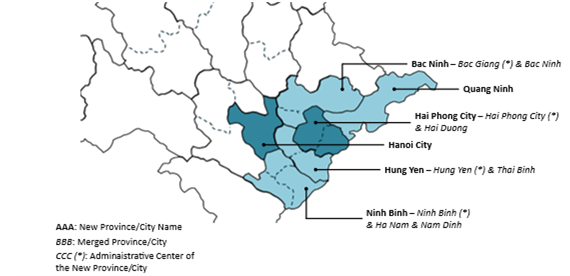
Source: B&Company
The Red River Delta is one of Vietnam’s two major economic centers alongside the Southeast region, contributing roughly 30% of Vietnam’s total GDP in 2024. After the merging, the region will host several of the nation’s top-performing local economies, including Hanoi, Hai Phong, Bac Ninh, and Quang Ninh. Despite global economic headwinds, the region sustained an impressive average GRDP growth rate of over 8%, with Hai Phong alone approaching 11% growth year-over-year.
GRDP of Red River Delta provinces after the 2025 administrative mergers in 2024
| No. | Provinces | Population
(Unit: Thousand people) |
Total Area (Unit: Km2) | GRDP
(Unit: Billion VND) |
Growth rate
(Unit: %) |
| 1 | Hanoi City | 8,718 | 3,360 | 1,426,000 | 6.5 |
| 2 | Hai Phong City | 4,103 | 3,195 | 658,381 | 10.7 |
| 3 | Bac Ninh | 3,509 | 4,719 | 439,000 | 9.6 |
| 4 | Quang Ninh | 1,397 | 6,208 | 347,500 | 8.4 |
| 5 | Ninh Binh | 3,819 | 3,943 | 268,345 | 9.7 |
| 6 | Hung Yen | 3,208 | 2,515 | 231,170 | 7.5 |
| Total | 24,754 | 23,938 | 3,374,396 | 8.2 | |
Source: Resolution No. 60-NQ/TW, Decision No. 759/QD-TTg, General Statistic Offices (GSO), Provincial Statistics Offices, B&Company synthesis
Regional Economic Characteristics and Investment Situation of the Red River Delta
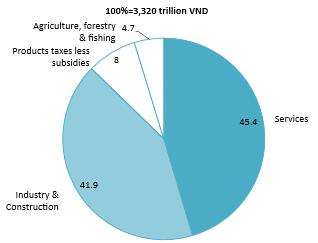
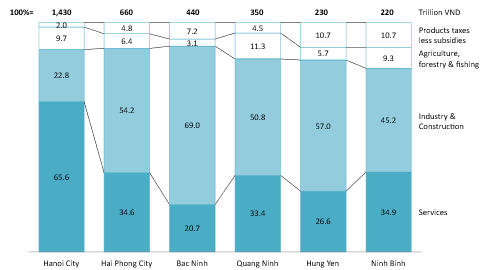
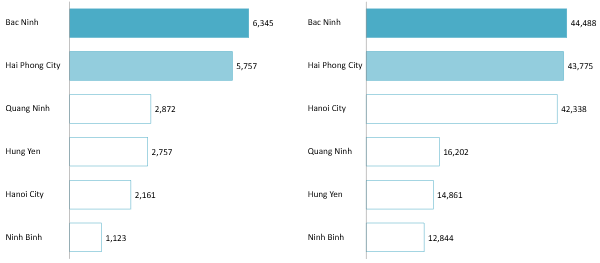
According to Resolution No. 30-NQ/TW[3], signed in 2022, the Red River Delta’s economic structure is set to become increasingly diversified, with a strong emphasis on the services sector and the industry and construction sector. While the recent administrative mergers may introduce new economic dynamics, the region’s overarching development orientation remains consistent:
Related article



































Log in / Register
Continue without an account
Log in / Register
SUBSCRIBE NEWSLETTER