

 English
  日本語
日本語  Tiếng Việt
  简体中文
简体中文  한국어
한국어 Vietnam is undergoing a major administrative overhaul, reducing its provincial-level units to 28 provinces and 6 centrally-governed cities.

06May2025
Latest News & Report / Vietnam Briefing
Comments: No Comments.
Vietnam is undergoing a major administrative overhaul, reducing its provincial-level units from 63 to 34 (28 provinces and 6 centrally-governed cities). This reform results in larger economic zones with similar development orientation, representing one of Vietnam’s boldest moves to date to boost efficiency and attract investment.
Economic Situation of Newly-merged Provincial-level Administrative Units
Vietnam’s economy is becoming more concentrated, and the proposed provincial mergers are set to enhance regional strengths by creating larger, more dynamic economic centers.
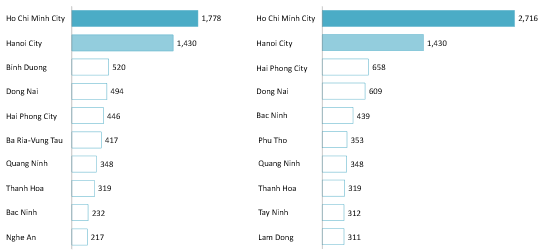
In 2024, Ho Chi Minh City and Hanoi led the country in GRDP with around 1,800 trillion and 1,400 trillion VND, representing around a third of Vietnam’s total GDP. On the other hand, other provinces’ GRDPs were below 500 trillion VND, with only ten surpassing the 200 trillion VND mark.
Top 10 Provinces by GRDP Before (left) and After (right) 2024 Administrative Mergers
Unit: Trillion VND
Source: Resolution No. 60-NQ/TW, Decision No. 759/QD-TTg, General Statistic Offices (GSO), Provincial Statistics Offices, B&Company synthesis
The consolidation plan further intensifies this concentration, especially in the case of Ho Chi Minh City, which is set to merge with Binh Duong and Ba Ria-Vung Tau, two other provinces with the highest GRDP. The new economic center of the Southern Vietnam is estimated to have a total GRDP of 2,716 trillion VND, or over 100 billion USD, which is twice the size of Hanoi’s GRDP and represents roughly one-quarter of Vietnam’s total economic output.
Other centrally-governed cities undergoing mergers, such as Hai Phong, Da Nang, and Can Tho, are also projected to experience significant economic growth, with estimated increases of 48%, 85%, and 112%, respectively. Meanwhile, Hue, despite becoming a centrally-governed city, will have the smallest GRDP among its peers at 80 trillion VND, ranking sixth-lowest nationally in economic size.
Foreign Investment Situation of Newly-merged Provincial-level Administrative Units
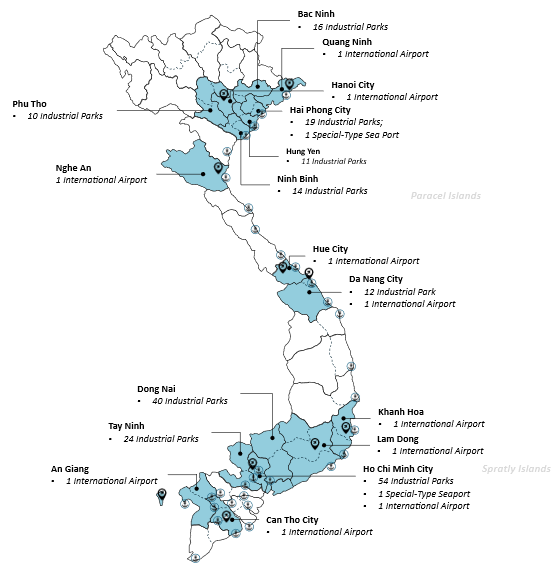
For foreign and domestic investors, the mergers signal a changing landscape of opportunities. Larger provinces with unified leadership can offer larger markets and more coherent development strategies. After the proposed merging, the FDI landscape of Vietnam remains highly concentrated in the Red River Delta and the Southeast region. Ho Chi Minh City, Bac Ninh, and Hai Phong City led in both registered FDI capital in 2024 and total accumulated FDI capital, with Ho Chi Minh City accounting for nearly 28% of Vietnam’s total inward capital since after merging with Binh Duong and Ba Ria-Vung Tau, two major regional FDI attraction provinces.
Registered FDI capital in 2024 (Left) and Total accumulated registered FDI capital since 1988 (Right) by provinces

Related article


























Log in / Register
Continue without an account
Log in / Register
SUBSCRIBE NEWSLETTER