

 English
  日本語
日本語  Tiếng Việt
  简体中文
简体中文  한국어
한국어 This article reviews the most significant deals of 2025 and examines how they have shaped Vietnam’s evolving M&A and investment narrative.

29Jan2026
Latest News & Report / Vietnam Briefing
Comments: No Comments.
Vietnam’s M&A market in 2025 showed strong resilience and strategic maturity, marking a transformative year in Southeast Asia’s investment landscape. A series of landmark transactions highlighted Vietnam’s growing role as a key destination for foreign direct investment, spanning sectors such as automotive, consumer goods, technology, real estate, healthcare, manufacturing, and renewable energy. This article reviews the most significant deals of 2025 and examines how they have shaped Vietnam’s evolving M&A and investment narrative.
Market Overview and Key Trends
At the end of the first 10 months of the year 2025, the Vietnam M&A market recorded 218 transactions worth USD 2.3 billion[1] compared to more than 220 transactions worth USD 3.2 billion in the same period in 2024[2]. In addition, according to Grant Thornton, in December 2025 alone, the market recorded a total of 31 transactions, with disclosed and estimated deal value reaching approximately USD 1,306 million[3]. Despite headwinds in Southeast Asia’s M&A landscape such as tighter financial conditions and heightened geopolitical risks, Vietnam has maintained steady momentum, supported by a pipeline of highly selective transactions.
Total Value and Total Volume of M&A Deals in Vietnam (2021 – 10M 2025)
Unit = Million USD
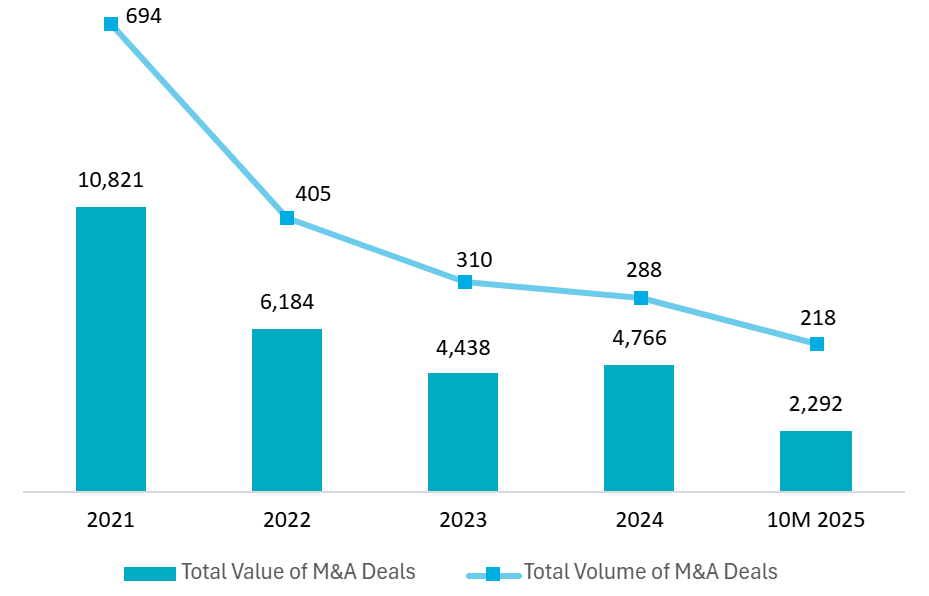
Source: Capital IQ, Refinitiv, KPMG
After the unusually high average deal size of USD 50.7 million in 2024, the average transaction value declined to USD 29.4 million in the first ten months of 2025, reflecting a return to more typical deal sizes and increased activity in the mid-market segment. The decline in average deal size signals not a slowdown in M&A activity, but a structural shift toward a more disciplined and selective market, where investors prioritize strategic fit, risk control, and sustainable value creation over large, opportunistic transactions.
Average disclosed transaction value
Unit: Million USD
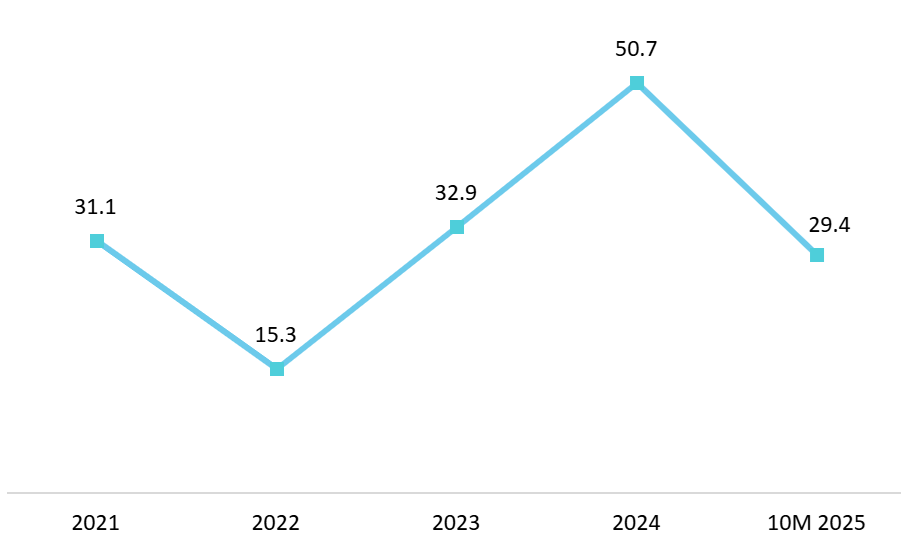
Source: Capital IQ, Refinitiv, KPMG
The decline in M&A deal volume and value in Vietnam in 2025 and recent years may be associated with global macroeconomic uncertainty. In this context, escalating trade tensions, including proposed reciprocal tariff measures under the Trump administration, are widely viewed as having affected investor sentiment and disrupted global M&A and IPO activity. In addition, higher financing costs and valuation uncertainty may have contributed to more cautious deal execution, resulting in the postponement or cancellation of certain transactions. At the same time, Vietnam’s M&A market is undergoing structural adjustment: while deal volume has declined compared to 2020-2022, transaction quality has improved. Foreign investors, especially from Japan, South Korea, and Singapore, continue to show strong interest in essential sectors such as healthcare, pharmaceuticals, renewable energy, and technology.
Domestic investors continued to play a pivotal role, contributing over 30 percent of total disclosed deal value, though the gap with foreign investors has narrowed meaningfully as Singapore accounted for roughly 27 percent, followed by Japan at 9 percent and the United States contributed significant capital flows[4]. Many large domestic private enterprises are forming group-style structures through M&A rather than organic growth, creating an increasingly strong domestic buyer base.
M&A Deal Value by Investor Origin (10M 2025)
100% = 2.3 billion USD
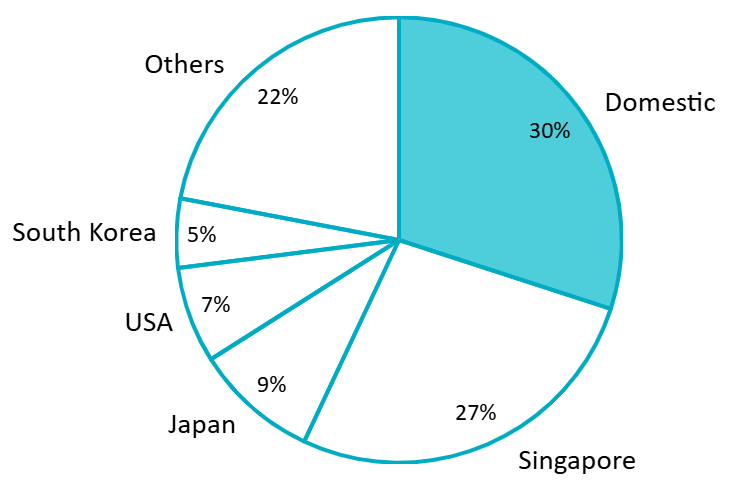
Source: Business Forum Magazine
Landmark transactions of 2025
Within this landscape, the consumer sector continued to lead the market, ranking first in both the number of deals and total disclosed value. Notable strategic transactions included Kokuyo’s acquisition of Thien Long and Thailand’s Fraser and Neave (F&N), further increasing its stake in Vinamilk. These deals clearly reflect an M&A trend focused on scale expansion and market position strengthening[5].
Summary of Major M&A Transactions in 2025
| Sector | Buyer / Investor | Seller | Estimated Deal Value (USD) | Ownership / Details |
| Retail & Consumer Goods | Kokuyo (Japan) | Thien Long Group | $178 million | 65.01% stake acquisition |
| Fraser and Neave (F&N) | Vinamilk | $228 million | Acquiring 4.6% more, total 24.99% stake | |
| Berli Jucker Public Company (BJC) | MM Mega Market | $715 million | 100% acquisition of ownership | |
| Pico Holdings | Nguyen Kim | $36 million | N/A | |
| Golden Gate Group | Viet Nam Tea & Coffee Services Trading | $108 million | 99.98% stake acquisition of The Coffee House | |
| Automotive | Pham Nhat Vuong (VinFast founder) | Novatech R&D JSC | $1.5 billion | VinFast retains 37.65% stake; R&D assets spin-off |
| Real Estate | Birch Real Estate | Eastern Real Estate (Masterise Group subsidiary) | $365 million | 100% acquisition of subsidiary |
| Three domestic investors | Vinaconex ITC (Vinaconex Group) | $250-300 million | 70% stake acquisition | |
| Gateway Thu Thiem JSC | South Rach Chiec City LLC | $99 million | 42% stake acquisition | |
| UOA Group | Ruby Strip Investment Company | $68 million | Acquire Prime HCMC real estate portfolio (2.000 m2) | |
| Materials
& Industrial |
Hyosung Vina 1st Co., Ltd. | Hyosung Vina Chemicals | $277 million | 49% stake transferred within group |
| HD Korea Shipbuilding | Doosan Vina (Doosan Enerbility) | $210 million | 100% acquisition of industrial manufacturer | |
| Energy | EnQuest PLC | Harbour Energy Vietnam business | $85.1 million | 53.12% stake in Chim Sao & Dua fields |
| Levanta Holding Pte. Ltd. | HBRE Gia Lai Wind Power JSC | $33.1 million | 80% stake from Super Energy Group | |
| OCI Holdings | Elite Solar Power Wafer | N/A | 65% stake acquisition | |
| Sumitomo | Cuu Long Power Engineering Consulting and Development | N/A | 49% stake acquisition | |
| Technology/AI | Rounds | Non-gaming applications in Vietnam | $20 million | Acquisition and support commitment |
| Appirits Inc. (Japan) | Bunbu Joint Stock Company | $241 million | 100% acquisition ($66.6M cash + $174.4M earn-out) | |
| Healthcare & Pharmaceutical | Livzon Pharmaceutical Group | Imexpharm (SK Group) | $220 million | 64.81% stake acquisition |
| Dale Investment Holdings | Tam Tri Medical | $31 million | 73.15% stake acquisition |
B&Company’s synthesis
Retail and Consumer Sector
Kokuyo’s acquisition of Thiên Long Group
In December 2025, Japanese stationery and office furniture conglomerate Kokuyo announced plans to acquire up to 65.01 percent of Thien Long Group Corporation for approximately $178 million, marking one of the most notable cross-border consumer goods acquisitions in Vietnamese history. The transaction involves Kokuyo acquiring all shares held by Thien Long An Thinh Investment JSC, which controls 46.82 percent of the group’s charter capital, alongside a public tender offer for an additional 18.19 percent of shares[6].
Founded in 1981, Thien Long has grown from a modest workshop into Vietnam’s leading stationery manufacturer, offering over 1,000 products under brands including Thien Long, FlexOffice, Colokit, and Flexio, with exports reaching 74 countries worldwide. For Kokuyo, this acquisition represents a strategic gateway to Southeast Asian markets and positions Thien Long as the fourth pillar of its overseas operations, complementing existing strongholds in Japan, China, and India. The deal aligns with Kokuyo’s strategic vision to become Asia’s leading stationery brand by 2030 and expand its Campus brand globally.
Central Retail Divests Nguyen Kim to Pico Holdings
Central Retail Corporation of Thailand, which signed an agreement to divest its entire stake in Nguyen Kim Trading Joint Stock Company, one of Vietnam’s longest-established consumer electronics retailers to Pico Holdings Joint Stock Company for an estimated USD 36 million. As a result, after investing more than USD 200 million over nearly a decade to acquire Nguyen Kim, Central Retail’s exit valuation amounted to only around one-sixth of its original investment[7].
Besides, Golden Gate Group acquired The Coffee House through the purchase of 99.98 percent of Viet Nam Tea & Coffee Services Trading JSC for approximately $108 million, bringing Vietnam’s prominent coffee chain fully into Golden Gate’s ecosystem.
Automotive Sector
VinFast’s Novatech Restructuring: The Year’s Largest Deal
One of the most significant transactions of 2025 was VinFast Auto Ltd.’s strategic restructuring involving Novatech Research and Development JSC, valued at approximately $1.5 billion. This landmark deal saw Vietnam’s electric vehicle manufacturer spin off its research and development assets into the newly formed Novatech entity, which was subsequently acquired by VinFast founder and CEO Pham Nhat Vuong in August 2025[8].
The restructuring carved Novatech out of VinFast Trading and Production JSC, with the new company holding assets associated with completed R&D projects and their intellectual property rights. VinFast retained a 37.65 percent stake in Novatech along with controlling voting rights, while VFTP continues to focus on electric vehicle manufacturing in Vietnam and future research initiatives. This transaction represents Vuong’s latest capital injection into the loss-making manufacturer, which has set ambitious targets to deliver 200,000 vehicles in 2025 and achieve breakeven by the end of 2026.
Real Estate Sector
Real estate emerged as the most active sector in 2025, rising from 36 percent of total deal value in 2024 to 44 percent in the first quarter of 2025, ultimately maintaining strong momentum throughout the year. The sector recorded the largest disclosed deal of the first ten months with Birch Real Estate (belonging to Singapore United Overseas Bank) acquiring Eastern Real Estate Investment and Trading LLC, a subsidiary of Masterise Group, for $365 million. This transaction underscores continued investor interest in high-quality land banks and premium development assets[9].
Other significant real estate transactions included Gateway Thu Thiem JSC’s acquisition of a 42 percent stake in South Rach Chiec City LLC for $99 million[10], and UOA Vietnam’s purchase of Ruby Strip Investment Company for $68 million in August 2025[11], adding prime Ho Chi Minh City assets to its portfolio. Additionally, Vinaconex Group sold a 70 percent stake in Vinaconex ITC to three domestic investors for an estimated $250-300 million in July[12]. The sector’s strong performance was supported by improving liquidity conditions, the implementation of the revised Land Law in 2024, and urbanization-driven demand for residential and commercial developments.
Technology and Digital Economy
The technology sector demonstrated significant growth momentum, accounting for 5 percent of deal value in the first quarter of 2025, up from just 2 percent in 2024. This expansion reflects Vietnam’s accelerating digital transformation and the government’s supportive regulatory framework, particularly the Law on Digital Technology Industry passed in June 2025.
In August 2025, Japanese company Appirits Inc. announced a transformative acquisition of 100 percent of Bunbu Joint Stock Company from individual shareholders for approximately $241 million, comprising $66.6 million in cash and $174.4 million in earn-out payments. Founded in 2010, Bunbu specializes in developing web, mobile, and AI systems for Japanese clients, having reported $105.5 million in revenue and $41 million in net profit in 2024[13]. Machine learning platform Rounds committed $20 million to acquire and support non-gaming applications in Vietnam throughout 2025, targeting the burgeoning mobile app market.
Energy Sector
The energy sector witnessed significant consolidation activity aligned with Vietnam’s commitment to achieving net-zero carbon emissions by 2050. In July 2025, EnQuest PLC completed the acquisition of Harbour Energy’s Vietnam business for a headline value of $85.1 million, with actual consideration paid of approximately $25.7 million after interim period cash flow adjustments. This acquisition provided EnQuest with a 53.12 percent equity stake and operatorship of the Chim Sao and Dua production fields[14].
In the renewable energy segment, South Korean conglomerate OCI Holdings acquired a 65 percent stake in Elite Solar Power Wafer, a solar wafer manufacturing project under development in Vietnam[15]. Levanta Holding Pte. Ltd. invested $33.1 million to acquire 80 percent of HBRE Gia Lai Wind Power JSC from Super Energy Group, while Sumitomo acquired a 49 percent stake in Cuu Long Power Engineering Consulting and Development JSC from GreenSpark Group. Sembcorp’s acquisition of a 49 megawatt hydropower plant through Sembcorp Solar Vietnam, part of a larger 245MW renewable portfolio purchased from Gelex Group JSC, has faced delays with government approvals expected by year-end 2025.
Healthcare and Pharmaceutical
Vietnam’s rapidly growing private healthcare and pharmaceutical sector, supported by more open policies, has attracted major deals and positioned the country on the regional healthcare M&A map. This is highlighted by Livzon Pharmaceutical Group signing an agreement to acquire 64.81% of the equity in Imexpharm from SK Group and two other shareholders, in a transaction valued at over USD 220 million in May 2025. In July, Dale Investment Holdings, a Singapore-based company affiliated with Quadria Capital (one of Asia’s largest healthcare-focused private equity funds) acquired 73.15% of the shares in the Tam Tri Medical hospital chain. The transaction included the purchase of 37.8% from VinaCapital’s Vietnam Opportunity Fund (VOF), with the remaining stake acquired from other shareholders[16].
Conclusion and Future Outlook
Vietnam’s M&A market in 2025 has shifted from volume-driven deals to more strategic, value-focused acquisitions. While average deal size moderated from 2024, transaction quality and strategic relevance improved, reflecting more mature investment behavior and greater investor sophistication. Looking ahead to 2026, growth is expected to be supported by patient capital, easing valuation gaps, succession needs among family-owned businesses, and ongoing SOE privatization, with healthcare, education, logistics, and other essential services remaining key focus sectors.
* If you wish to quote any information from this article, please kindly cite the source along with the link to the original article to respect copyright.
| B&Company
The first Japanese company specializing in market research in Vietnam since 2008. We provide a wide range of services including industry reports, industry interviews, consumer surveys, business matching. Additionally, we have recently developed a database of over 900,000 companies in Vietnam, which can be used to search for partners and analyze the market. Please do not hesitate to contact us if you have any queries. info@b-company.jp + (84) 28 3910 3913 |
[1] https://vcci.com.vn/news/xu-huong-nao-se-dinh-hinh-cac-hoat-dong-ma-trong-nam-2026
[2] https://diendandoanhnghiep.vn/tram-lang-sau-10-thang-2024-thi-truong-m-a-duoc-du-bao-se-soi-dong-tro-lai-10146319.html
[3] https://mekongasean.vn/von-ngoai-do-manh-vao-ma-viet-nam-trong-thang-cuoi-nam-2025-51064.html
[4] https://diendandoanhnghiep.vn/thi-truong-m-a-viet-nam-trien-vong-cung-cac-thuong-vu-lon-ty-do-10167188.html
[5] https://mekongasean.vn/von-ngoai-do-manh-vao-ma-viet-nam-trong-thang-cuoi-nam-2025-51064.html
[6] https://mekongasean.vn/von-ngoai-do-manh-vao-ma-viet-nam-trong-thang-cuoi-nam-2025-51064.html
[7] https://cafef.vn/dai-gia-thai-cat-lo-dau-don-sau-10-nam-mua-nguyen-kim-bi-dai-gia-viet-dien-may-xanh-fpt-shop-ep-nghet-tho-188251224003205766.chn
[8] https://www.dnse.com.vn/senses/tin-tuc/vinfast-va-gelex-hoan-tat-loat-thuong-vu-ma-lon-35129635
[9] https://vietstock.vn/2025/12/cach-uob-am-tham-nhay-vao-thi-truong-bat-dong-san-viet-nam-4222-1378975.htm
[10] https://vcci.com.vn/tin-tuc/ma-bat-dong-san-nua-dau-nam-no-nhieu-thuong-vu-lon-khoi-noi-dan-dat-thi-truong
[11] https://cafef.vn/thuong-vu-1700-ty-tai-loi-trung-tam-tphcm-cuoc-san-dat-vang-cua-dai-gia-bat-dong-san-malaysia-sau-su-xuat-hien-cua-cac-ga-khong-lo-bytedancemarvell-188250815234136123.chn
[12] https://cafef.vn/chi-trong-1-thang-gia-tri-mua-ban-sap-nhap-cac-du-an-bat-dong-san-ca-nuoc-dat-gan-nua-ty-do-188250814180212846.chn
[13] https://vietstock.vn/2025/09/18-thuong-vu-ma-viet-nam-trong-thang-8-tri-gia-hon-22-ty-usd-764-1353361.htm
[14] https://www.enquest.com/media/press-releases/article/acquisition-of-harbour-energys-vietnam-business-july-25?
[15] https://vcci.com.vn/news/loat-thuong-vu-lon-lam-nong-thi-truong-ma
[16] https://vietstock.vn/2026/01/ma-y-duoc-2025-lan-song-thau-tom-tu-cac-quy-tu-nhan-764-1387410.htm
Related article



























Log in / Register
SUBSCRIBE NEWSLETTER