

 English
  日本語
日本語  Tiếng Việt
  简体中文
简体中文  한국어
한국어 The nuclear power energy program of Vietnam is being actively revived to meet the country's rapid economic growth and energy needs.

12Dec2025
Latest News & Report / Vietnam Briefing
Comments: No Comments.
Vietnam’s nuclear power program is being actively revived to meet the country’s rapid economic growth and energy needs. After an earlier project was suspended, renewed government support and strategic plans have reinstated two major plants in the central coastal region of Ninh Thuan (now part of Khanh Hoa Province). These facilities aim to provide reliable, low-carbon baseload power to complement Vietnam’s growing renewables, reduce dependence on coal, and align with national climate commitments.
Vietnam’s imperatives for nuclear energy
Despite having no nuclear power reactor in operation until now, nuclear energy could play a strategic role for a rapidly growing economy with high development goals like Vietnam.
Rising electricity demand
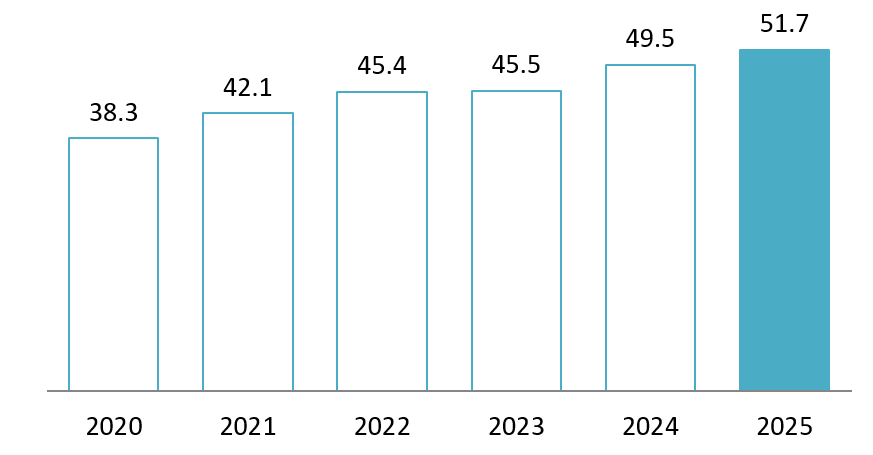
Vietnam has set its sights on two-digit economic growth in the coming years, which implies intensified industrialization, urbanization, and higher living standards. Such growth typically translates into surging electricity demand. Each year, the national power system sets a new record of daily electricity power: 2025’s peak was 51,672 MW, recorded on June 2[1].
Peak power of the National power system 2020 – 2025
Unit: thousand MW
Source: VnEconomy
Net-Zero commitments
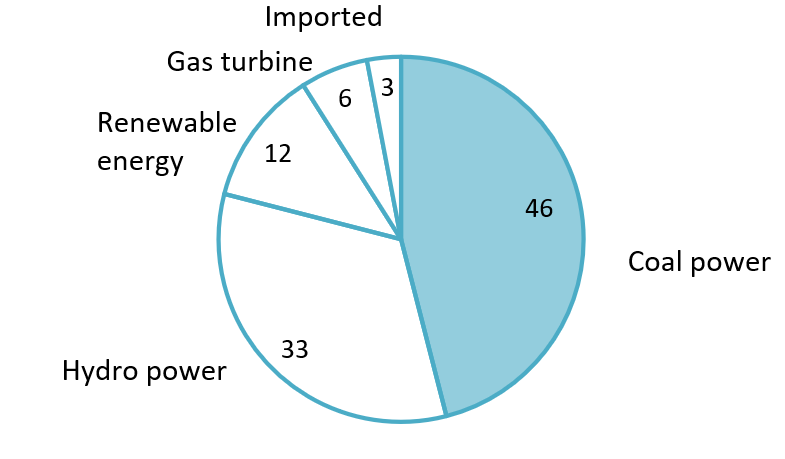
Today, coal-fired power remains the backbone of Vietnam’s electricity generation. According to recent data, in the first 10 months of 2025, coal-fired thermal power still supplied about 46.2% of all electricity generation. Heavy reliance on coal raises concerns about air pollution, carbon emissions, and long-term sustainability.
Vietnam Electricity Production in the first 10 months of 2025
%, 100% = 269 Billion kWh
Source: EVN
Additionally, Vietnam has committed under international agreements to reach net zero emissions in COP26, which aligns with global efforts toward decarbonization. Nuclear energy, with minimal direct CO₂ emissions during operation, offers an opportunity to decouple economic and industrial growth from fossil-fuel emissions. Alongside renewables (solar, wind, hydro), nuclear can help diversify the energy mix, reduce coal dependency, and support a smoother, more sustainable energy transition[2].
Nuclear energy in Vietnam
Vietnam first seriously considered nuclear power in the mid-1990s, and in 2009, the Vietnam Electricity Group (EVN) was assigned responsibility to develop two nuclear power plants in southern-central Vietnam’s Ninh Thuan Province. The plan envisaged two plants: Ninh Thuan 1 Nuclear Power Plant (with Russian involvement) and Ninh Thuan 2 Nuclear Power Plant (in cooperation with Japanese partners), with a total capacity of around 4,000 MW[3].
However, on 22 November 2016, the Vietnamese parliament adopted a resolution to suspend the plans indefinitely. The reasons included economic constraints, safety concerns, high investment costs, and shifts in global energy dynamics at that time[4].
After an eight-year hiatus, the program to build nuclear power plants in Ninh Thuan was revived. On 30 November 2024, the National Assembly of Vietnam unanimously passed a resolution approving the resumption of the nuclear project. The law on electricity was amended concurrently to reintegrate nuclear power in the national power plan[5].
Subsequently, on 5 February 2025, the government approved a comprehensive plan for the development and application of atomic energy through 2030 with a vision toward 2050. This plan sets out to build the necessary legal, institutional, research, human-resource, and infrastructure frameworks to support nuclear energy deployment[6].
Recent updates on the nuclear energy project
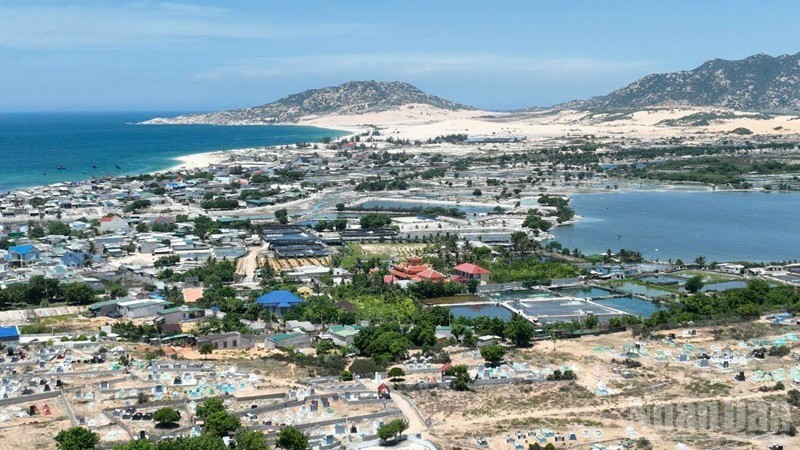
The responsibility for the implementation of the two nuclear energy plants has been assigned to state-owned companies: Vietnam Electricity Group (EVN) is the main investor for Ninh Thuan 1, while Petrovietnam (PVN) is responsible for Ninh Thuan 2. The plants are to be built in the central coastal area of what used to be Ninh Thuan Province; after the administrative reorganization, this area is now part of Khanh Hoa Province.
Phuoc Dinh Commune (Khanh Hoa) is chosen to build Ninh Thuan 1 Nuclear Power Plant
Source: Nhan Dan Newspaper
Vietnamese government and nuclear-energy experts favor Generation III+ reactor technology: a modern, safer, and more efficient design standard that many nuclear-power countries are currently using[7].
For Ninh Thuan 1, a huge step toward realization was taken recently: on 26 September 2025, Rosatom Energy International JSC (REIN JSC) signed a Memorandum of Understanding (MoU) with Vietnam’s consulting firm Power Engineering Consulting JSC 2 (PECC2) for cooperation on feasibility study update, site documentation, infrastructure planning, grid and logistics development, and human-resource training. This MoU paves the way for Rosatom to be the main foreign partner for Ninh Thuan 1[8]. As for Ninh Thuan 2, while the earlier 2009 plan envisioned cooperation with a Japanese firm, there is no publicly confirmed new official agreement with Japanese partners under the revived program until now. Vietnamese authorities still mention Japan among preferred potential collaborators.
As of October 2025, major preparatory activities are ongoing such as compensation and resettlement of affected communities, land clearance, credit negotiations, updating feasibility studies (pre-FS), site and environmental documentation, international cooperation agreements for technology selection, and human-resource training[9].
In November 2025, the Politburo of the Communist Party of Vietnam requested the construction of the Ninh Thuan nuclear power plant to begin at the start of 2026, as part of the government’s push to advance key infrastructure and energy projects[10]. Both plants are expected to be in operation in the period 2030-2035[11].
In early December 2025, the Vietnamese government initiated a comprehensive national infrastructure review ahead of the Ninh Thuan project. From December 1 to December 11, the review, conducted with the International Atomic Energy Agency (IAEA), will assess 19 key infrastructure areas, including regulatory, safety, grid, environmental, and human-resource readiness, as required under international nuclear deployment standards[12]
Conclusion
Vietnam’s nuclear development represents a long-term strategic commitment by the government to secure a stable and sustainable power supply to fuel its rapid economic growth. Given Vietnam’s limited domestic experience with nuclear technology, the government actively seeks partnerships with countries that are advanced in nuclear power to transfer expertise, support technology integration, and help build human resource capacity. This creates opportunities for foreign firms to collaborate through technology licensing, engineering, procurement, and construction contracts, as well as training programs focused on nuclear safety and operation.
* If you wish to quote any information from this article, please kindly cite the source along with the link to the original article to respect copyright.
| B&Company
The first Japanese company specializing in market research in Vietnam since 2008. We provide a wide range of services including industry reports, industry interviews, consumer surveys, business matching. Additionally, we have recently developed a database of over 900,000 companies in Vietnam, which can be used to search for partners and analyze the market. Please do not hesitate to contact us if you have any queries. info@b-company.jp + (84) 28 3910 3913 |
[1] Investment Newspaper, Electricity consumption nationwide and in the North set a new record even though it was only the beginning of summer. (https://baodautu.vn/tieu-thu-dien-toan-quoc-va-mien-bac-lap-ky-luc-moi-du-moi-dau-he-d295363.html)
[2] Electricity Authority of Vietnam, Nuclear power plays an important role in the development of renewable and sustainable energy. (https://www.eav.gov.vn/d/vi-VN/news-o/TS-Du-Van-Toan-Dien-hat-nhan-dong-vai-tro-quan-trong-trong-phat-trien-nang-luong-tai-tao-va-ben-vung-60-79-58416)
[3] Ministry of Industry and Trade, National Assembly decides to stop Ninh Thuan nuclear power project (https://moit.gov.vn/tin-tuc/thi-truong-nuoc-ngoai/quoc-hoi-quyet-dung-du-an-dien-hat-nhan-ninh-thuan.html)
[4] Vietnam Energy, Nuclear power development and plant safety issues (https://nangluongvietnam.vn/phat-trien-dien-hat-nhan-va-van-de-an-toan-nha-may-2179.html)
[5] Government News, Restarting Ninh Thuan Nuclear Power Plant: Vietnam Ready for a New Era (https://baochinhphu.vn/tai-khoi-dong-dien-hat-nhan-ninh-thuan-viet-nam-san-sang-cho-mot-ky-nguyen-moi-10224122522101908.htm)
[6] Government News, Planning for development and application of atomic energy until 2030, vision to 2050 (https://baochinhphu.vn/quy-hoach-phat-trien-ung-dung-nang-luong-nguyen-tu-thoi-ky-den-nam-2030-tam-nhin-den-nam-2050-102250206164026432.htm)
[7] Vietnam Energy, Ninh Thuan 1 and 2 Nuclear Power Project – Government considers experts’ proposed solutions (https://nangluongvietnam.vn/du-an-dien-hat-nhan-ninh-thuan-1-va-2-chinh-phu-xem-xet-giai-phap-de-xuat-cua-chuyen-gia-33962.html)
[8] Viet Nam News, Rosatom, PECC2 sign MoU on cooperation in nuclear power plant project
(https://vietnamnews.vn/economy/1726111/rosatom-pecc2-sign-mou-on-cooperation-in-nuclear-power-plant-project.html)
[9] Vietnam Energy, Update on investment preparation for Ninh Thuan 1 and 2 nuclear power projects (https://nangluongvietnam.vn/cap-nhat-tinh-hinh-chuan-bi-dau-tu-du-an-dien-hat-nhan-ninh-thuan-1-va-2-23102025-35048.html)
[10] Lao dong, The Politburo requested to start construction of international railway and nuclear power plant from early 2026. (https://laodong.vn/thoi-su/bo-chinh-tri-yeu-cau-khoi-cong-duong-sat-quoc-te-nha-may-dien-hat-nhan-tu-dau-nam-2026-1605955.ldo)
[11] Tuoi Tre, Politburo: Urgently deploy Ninh Thuan 1, 2 nuclear power project, operating 2030 – 2035 (https://tuoitre.vn/bo-chinh-tri-khan-truong-trien-khai-du-an-dien-hat-nhan-ninh-thuan-1-2-van-hanh-2030-2035-2025090318380243.htm)
[12] EVN, Comprehensive assessment of infrastructure, preparation for Ninh Thuan Nuclear Power Project (https://www.evn.com.vn/d/vi-VN/news/Danh-gia-toan-dien-co-so-ha-tang-chuan-bi-cho-Du-an-dien-hat-nhan-Ninh-Thuan-60-12-505875)
Related article














Sidebar:
SUBSCRIBE NEWSLETTER