

 English
  日本語
日本語  Tiếng Việt
  简体中文
简体中文  한국어
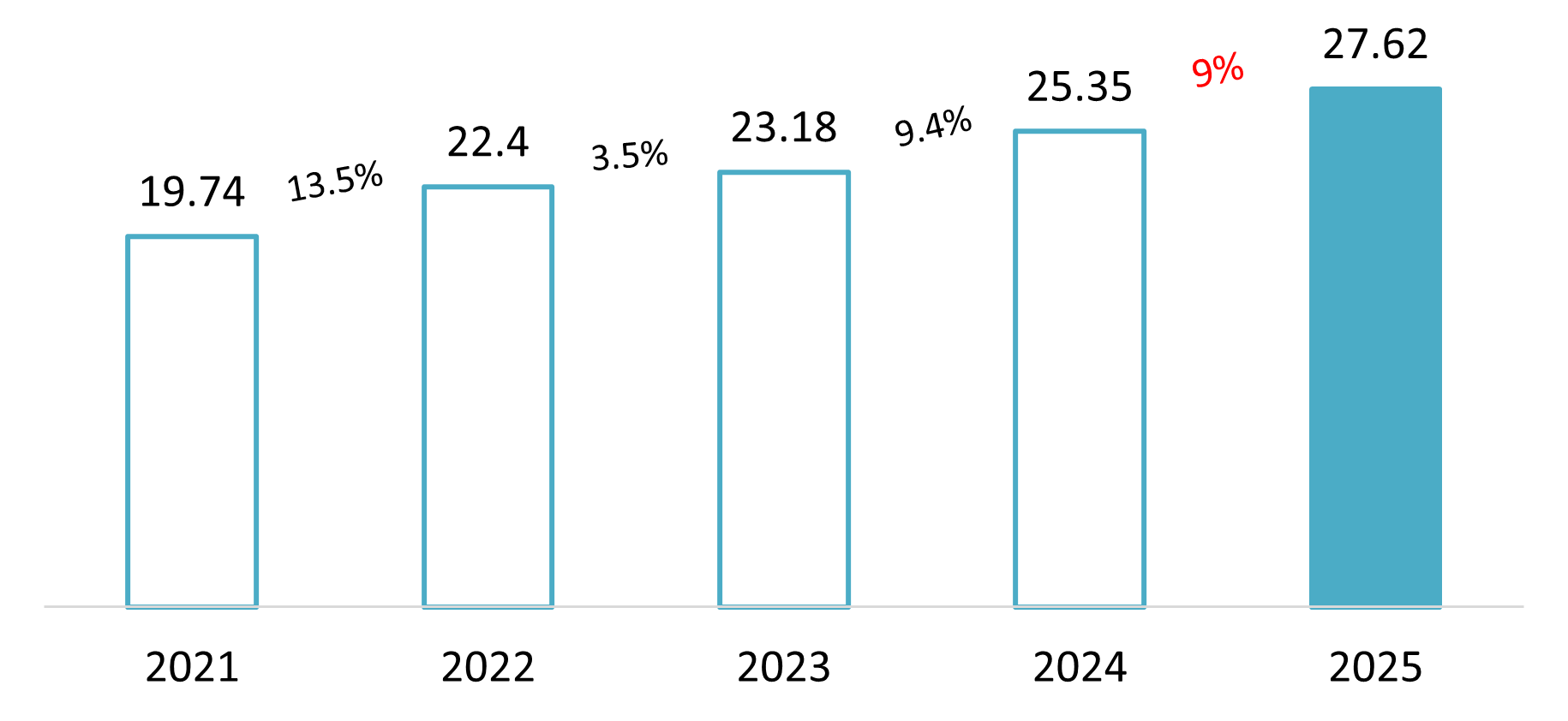
한국어 Disbursed FDI of Vietnam in 2025 was estimated at USD 27.62 billion, up 9% year-on-year, marking the highest level in the 2021–2025 period.
24Mar2026
Latest News & Report / Vietnam Briefing
Comments: No Comments.
Abstract
In 2025, Vietnam continued to demonstrate its attractiveness as a foreign direct investment destination despite a global environment marked by geopolitical uncertainty, trade tensions, and increasingly selective capital flows. While total registered FDI remained broadly stable, the stronger growth in disbursed capital and the continued expansion of existing investors suggest that foreign investment in Vietnam is becoming more resilient and implementation-oriented. At the same time, the sectoral and partner structure of FDI indicates that Vietnam is strengthening its role as both a manufacturing base in regional supply chains and a destination for long-term strategic projects.
Overview of the investment environment in 2025
In 2025, the global investment environment continued to be affected by multiple uncertainties, including US–China tensions, conflicts in Russia–Ukraine and the Middle East, geopolitical risks, climate change, and the global technology race. These developments caused international capital flows to shift more slowly and cautiously, while intensifying competition among countries to attract FDI. In this context, investors tended to prioritize destinations that are both politically stable and capable of participating more deeply in emerging supply chains, particularly in the Asia–Pacific region, especially India, ASEAN, and China[1].
Against this backdrop, Vietnam entered 2025 with a relatively positive domestic economic foundation, creating favorable conditions for attracting foreign investment. In 2025, GDP grew by 8.02%, total retail sales of goods and services increased by 9.2%, and total export turnover rose by 17% compared to the previous year, reflecting the resilience of the economy as well as Vietnam’s increasingly prominent role in regional trade and production networks[2]. On that basis, Vietnam continued to be regarded as an attractive destination for FDI flows seeking stability, competitive costs, and long-term growth potential.
Overview of FDI performance in 2025
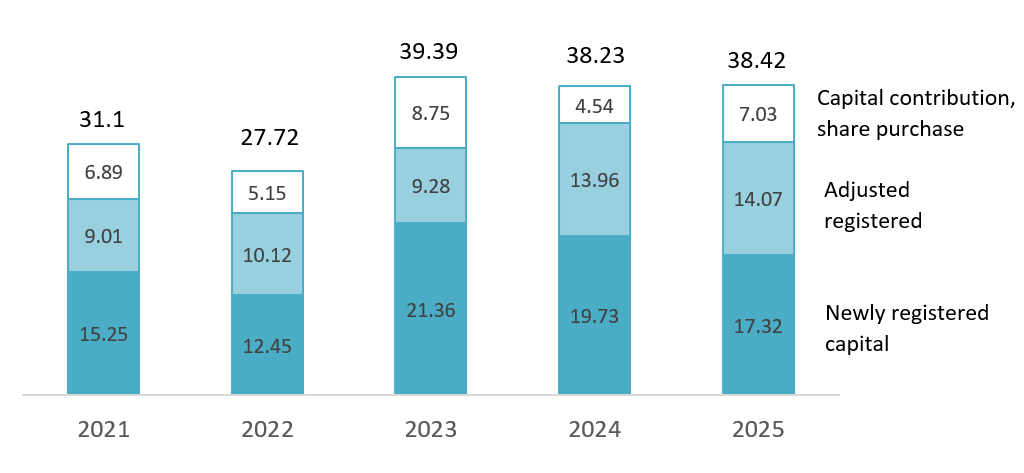
According to official data released by the General Statistics Office (Ministry of Finance), total registered foreign investment in Vietnam as of December 31, 2025, reached USD 38.42 billion, up 0.5% year-on-year. Notably, disbursed foreign direct investment (FDI) for the full year was estimated at USD 27.62 billion, up 9% compared to the same period last year, marking the highest level in the 2021–2025 period. In 2025, Vietnam basically achieved its FDI attraction targets, with total registered capital falling within the target range of USD 38–40 billion, while disbursed FDI also reached the target range of USD 27–28 billion[3].
Registered FDI in Vietnam, 2021–2025
Unit: USD billion
Source: Vneconomy
The structure of FDI inflows into Vietnam in the period after 2023 shows that capital flows are shifting from quantitative expansion to deeper consolidation. Although total registered capital in 2025 remained high at more than USD 38 billion, the main driver no longer came from newly licensed projects but increasingly from adjusted capital and capital contribution/share acquisition activities. Notable capital expansion cases in 2025 included Long Son Petrochemicals of Thailand[4], which added USD 400 million to the Southern Petrochemical Complex project, and Foxconn from Taiwan, which increased the adjusted capital of two projects in Quang Chau Industrial Park by a combined USD 320 million[5].
This indicates that existing investors are showing a greater tendency to strengthen their commitments and expand their presence in Vietnam, rather than entering only through large-scale new projects. In other words, the key feature of FDI in 2025 lies more in its sustainability and reinvestment confidence than in a surge of newly registered capital.
Disbursed FDI in the full year, 2021–2025
Unit: USD billion
Source: Vneconomy
The trend in disbursed FDI indicates that the quality of capital inflows into Vietnam is improving more clearly than registered capital. The continuous increase in disbursement throughout the 2021–2025 period, reaching its highest level in 2025, shows that investment commitments are being translated into actual implementation more effectively. This reflects not only the confidence of foreign investors but also the continued improvement in Vietnam’s capacity to absorb capital, implement projects, and maintain a favorable domestic investment environment. Therefore, the highlight of FDI in 2025 lies more in the effectiveness of execution and the sustainability of capital flows than in the growth rate of committed capital.
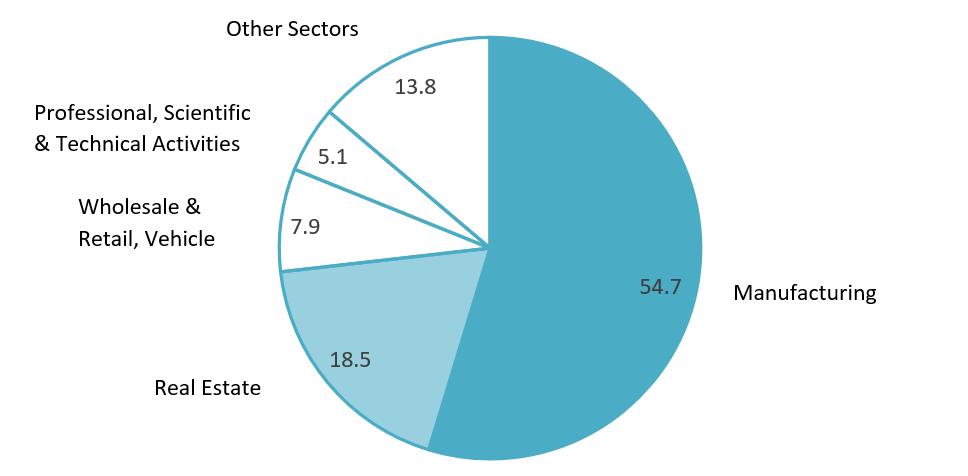
Breakdown of registered FDI in 2025 by sector
Unit: %, 100% = USD 38.42 billion
Source: FIA Vietnam
The sectoral structure of FDI in 2025 shows that Vietnam continues to attract investment mainly into sectors associated with its production base and tangible assets. Capital inflows remained heavily concentrated in manufacturing and processing, while real estate retained its role as the second key pillar. This indicates that Vietnam is still positioned primarily as a production base and a location for expanding operational capacity within regional supply chains, rather than as a prominent destination for knowledge-intensive service industries. More broadly, this structure reflects that Vietnam’s FDI attraction model still leans toward sectors with strong capital absorption capacity, the ability to create fixed assets, and a direct link to industrial growth.
Registered FDI in 2025 compared to 2024 by investment partner
Unit: USD billion
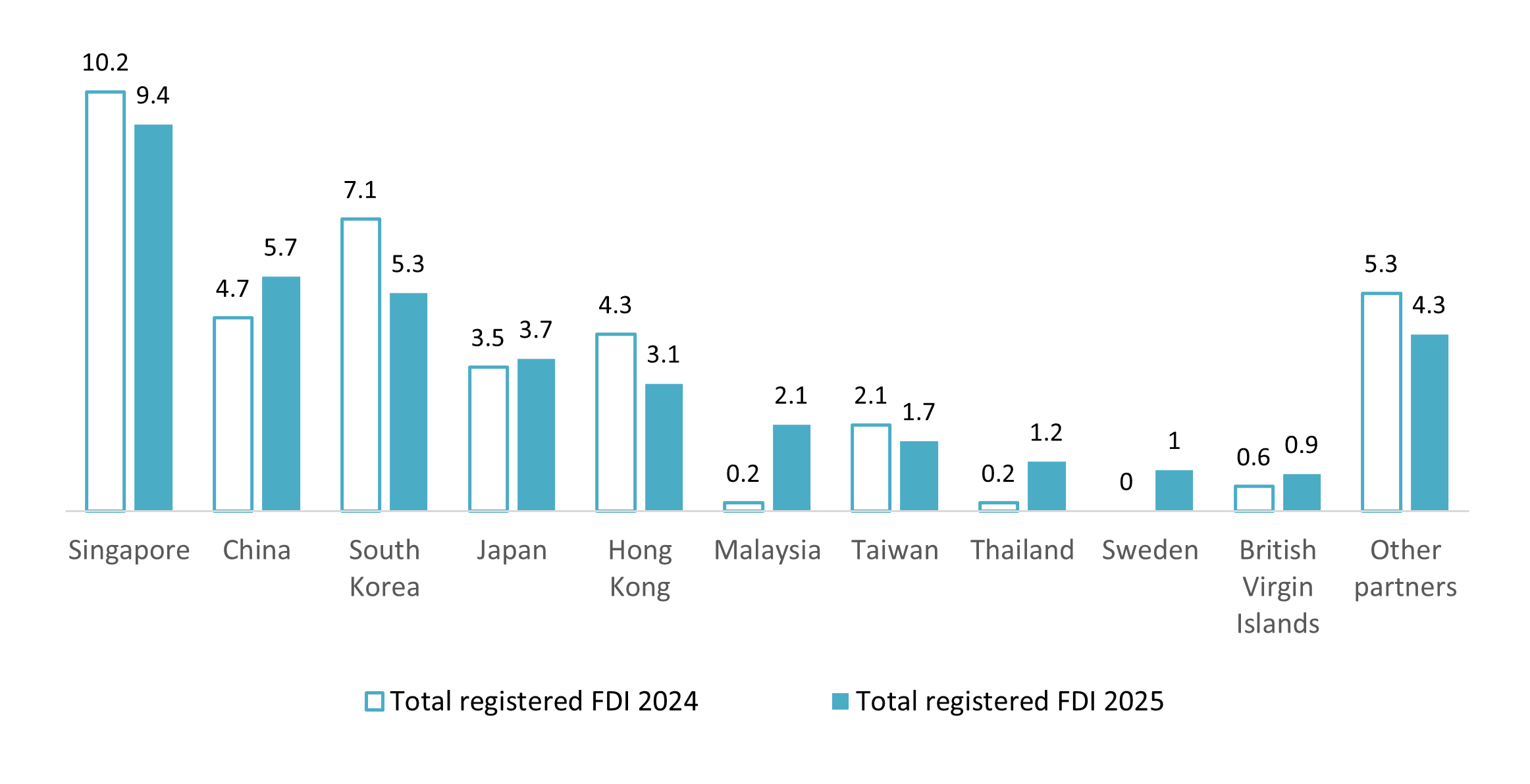
Source: FIA Vietnam
By investment partner, FDI in 2025 shows a fairly clear divergence among major investors. Singapore remained in the leading position, although its investment capital declined compared to 2024, while China recorded strong growth and rose to second place. In contrast, both South Korea and Hong Kong saw declines, whereas Japan posted a slight increase and maintained a stable investment trend, reflecting a cautious but sustainable approach. Among the remaining group, several partners such as Malaysia, Thailand, and Sweden grew rapidly from a low base, indicating a certain degree of diversification in Vietnam’s investor structure.
Some notable FDI projects launched in 2025
The table below presents some of the notable FDI projects launched in Vietnam in 2025 across different sectors.
| No. | Project | Investor | Country | Sector | Capital | Location |
| 1 | Trump International Hung Yen | Trump Organization, Kinh Bac City | USA | Real estate, tourism, golf | USD 1.5 billion | Hung Yen |
| 2 | Victory Giant Technology Vietnam Factory | Victory Giant Technology | China | High-tech electronics, PCB manufacturing | USD 520 million | Bac Ninh |
| 3 | Green Precision Manufacturing Vietnam Factory | Green Precision Manufacturing | China | Precision components for consumer electronics | USD 121 million | Bac Ninh |
| 4 | Mapletree Logistics Park Tam An 1 | Mapletree | Singapore | Logistics, warehousing | USD 101.1 million | Dong Nai |
| 5 | North Hanoi Smart City | BRG Group, Sumitomo Corporation | Japan | Smart city, real estate, urban development | USD 4.2 billion | Hanoi |
| 6 | HiteJinro Vietnam Soju Factory | HiteJinro Holdings | Korea | Alcoholic beverages | USD 100 million | Thai Binh |
Source: B&Company’s Synthesis
FDI projects launched in Vietnam in 2025 not only span a wide range of sectors but also clearly reflect two major trends: the growing presence of high-tech projects and the continued attractiveness of large-scale real estate and urban development projects. While projects such as Victory Giant and Green Precision indicate that Vietnam continues to be chosen as a manufacturing base within the technology supply chain, projects such as North Hanoi Smart City and Trump International Hung Yen reflect investors’ confidence in the long-term growth potential of the domestic market. In terms of investor origin, Asia continues to play a prominent role, particularly Japan, China, Korea, and Singapore, while the presence of US investors suggests that the source structure of FDI is becoming more diversified. Overall, these projects show that FDI in 2025 is not only aimed at large capital scale, but is increasingly associated with long-term market commitment and higher value-added activities in Vietnam.
Outlook for 2026
Entering 2026, the first two months show that Vietnam’s FDI picture remains positive, although there is some divergence among its components. Total newly registered capital, adjusted capital, and capital contributions/share purchases reached over USD 6 billion, down 12.6% year-on-year; however, newly registered capital rose sharply to more than USD 3.5 billion, up 61.5%, with 620 new projects, an increase of 20.2%. Meanwhile, realized FDI was estimated at over USD 3.2 billion, up 8.8% and marking the highest level for the same period in the past five years, indicating that foreign investors’ confidence in Vietnam’s investment environment remains intact. In terms of structure, capital inflows continued to be concentrated mainly in processing and manufacturing, accounting for more than 73% of total registered capital in the first two months of the year[6].
Opportunity
Vietnam’s FDI outlook for 2026 is supported first by strong disbursement momentum and the continued rise in newly registered projects at the beginning of the year, indicating that the country remains an attractive destination amid the ongoing regional supply chain restructuring. In addition, the investment policy framework is being further improved, with the 2025 Investment Law[7] taking effect from March 1, 2026, creating more favorable conditions for attracting large-scale, high-tech, and strategic projects. Another positive factor is Vietnam’s stronger positioning in high-tech industries, with the groundbreaking of the country’s first chip plant in Hoa Lac helping reinforce expectations for further inflows into semiconductors, technology, and innovation[8]. This Viettel’s chip plant is expected to complete construction in 2027 and begin pilot production using the 32 nm process, with the 2028–2030 period focused on refining and optimizing processes and improving production-line efficiency in line with industry standards[9].
In addition, FPT announced the establishment of an advanced semiconductor testing and packaging plant in January 2026. This project, along with Viettel’s chip manufacturing plant project, is expected to create a practical domestic environment for training, developing, and retaining semiconductor engineers, while also showing that Vietnam’s semiconductor ecosystem is gradually taking shape across the full chain from training and design to fabrication, testing, packaging, and commercialization[10].
Challenges
However, Vietnam’s FDI environment in 2026 is also likely to face greater pressure, particularly from global trade uncertainty and tariff negotiations with the United States, Vietnam’s largest export market. At the same time, global minimum tax rules reduce the effectiveness of tax-based incentives for large multinationals. Vietnam’s FDI competitiveness will increasingly depend on non-tax factors such as approval speed, policy predictability, skilled labor, power reliability, and industrial-logistics readiness. Vietnam has started to respond through the Investment Support Fund, which provides direct cash support for training, R&D, fixed assets, high-tech production, and selected semiconductor/AI R&D projects, and through the 2025 Law on Investment, which aims to shorten market entry and licensing time through simpler procedures, greater decentralization, and broader special investment procedures.
Therefore, the competition for FDI will increasingly depend on institutional quality, administrative efficiency, infrastructure, and post-licensing support for investors. At the broader FDI-environment level, the biggest bottlenecks remain administrative efficiency and policy consistency, as reflected in JETRO’s FY2025 survey of Japanese firms in Vietnam[11], where 67.5% cited time-consuming administrative procedures, and 58.7% cited unclear local policy management as major risks. In high-tech sectors, Vietnam also faces pressure to upgrade its human resources, R&D capacity, and the participation of domestic firms if it aims to retain more high-value-added projects.
Conclusion
Overall, Vietnam’s FDI performance in 2025 suggests that the country remained attractive to foreign investors, not only in terms of capital scale but also in terms of implementation and long-term commitment. Looking ahead to 2026, Vietnam is still well positioned to attract FDI, especially in manufacturing and high-tech sectors, but sustaining this momentum will increasingly depend on policy execution, institutional quality, and the ability to meet the rising expectations of global investors.
Read more
Japanese FDI in Vietnam 2025: Highest profit outlook in 15 years – Is expansion next?
* If you wish to quote any information from this article, please kindly cite the source along with the link to the original article to respect copyright.
| B&Company
The first Japanese company specializing in market research in Vietnam since 2008. We provide a wide range of services including industry reports, industry interviews, consumer surveys, business matching. Additionally, we have recently developed a database of over 900,000 companies in Vietnam, which can be used to search for partners and analyze the market. Please do not hesitate to contact us if you have any queries. info@b-company.jp + (84) 28 3910 3913 |
[1] https://fdi.gov.vn/pages/chitiettin.aspx?idTin=185&idcm=9
[2] https://www.nso.gov.vn/du-lieu-va-so-lieu-thong-ke/2026/01/bao-cao-tinh-hinh-kinh-te-xa-hoi-quy-iv-va-nam-2025/
[3] https://baochinhphu.vn/nghi-quyet-cua-bo-chinh-tri-ve-dinh-huong-nang-cao-chat-luong-hieu-qua-hop-tac-dau-tu-nuoc-ngoai-den-nam-2030-102260386.htm
[4] https://baodautu.vn/500-trieu-usd-dau-tu-them-vao-to-hop-hoa-dau-mien-nam-se-tieu-ra-sao-d258379.html
[5] https://bacninh.gov.vn/news/-/details/37632/pho-thu-tuong-thuong-truc-chinh-phu-nguyen-hoa-binh-du-hoi-nghi-xuc-tien-au-tu-trao-quyet-inh-chap-thuan-chu-truong-au-tu-tai-bac-ninh-11471501
[6] https://fdi.gov.vn/Pages/chitiettin.aspx?idTin=1202&idcm=9
[7] https://thuvienphapluat.vn/van-ban/Dau-tu/Luat-Dau-tu-2025-so-143-2025-QH15-681550.aspx
[8] https://en.baochinhphu.vn/viet-nams-journey-towards-making-silicon-chips-111260204124613094.htm
[9] https://xaydungchinhsach.chinhphu.vn/khoi-cong-xay-dung-nha-may-che-tao-chip-ban-dan-dau-tien-tai-viet-nam-119260116110735241.htm
[10] https://fpt.com/vi/tin-tuc/tin-fpt/fpt-cong-bo-thanh-lap-nha-may-kiem-thu-va-dong-goi-tien-tien-chip-ban-dan
[11] https://www.jetro.go.jp/ext_images/en/reports/survey/pdf/2025/EN_Asia_and_Oceania_2025_r.pdf
Related article



















Sidebar:
SUBSCRIBE NEWSLETTER