
 English
  日本語
日本語  Tiếng Việt
  简体中文
简体中文  한국어
한국어 
15Nov2020
Industry Reviews
Comments: No Comments.
Recent developments surrounding Industry 4.0 and Internet of Things (IoT) have found traction and interest in the smart home market in Vietnam. The dramatically accelerating pace of technological innovation has resulted in the rising trend of owning a smart home in many developed countries around the world. With its two largest metropolises among top 10 fastest growing cities in terms of economic and real estate development (as listed in the City Momentum Index 2020 by Jones Lang Lasalle – JLL), Vietnam’s smart home market, though still in its infancy, possesses promising investment opportunities thanks to the rapid urbanization and the boom of megacities in the country.
Smart Home Market Revenue is expected to significantly increase in Vietnam
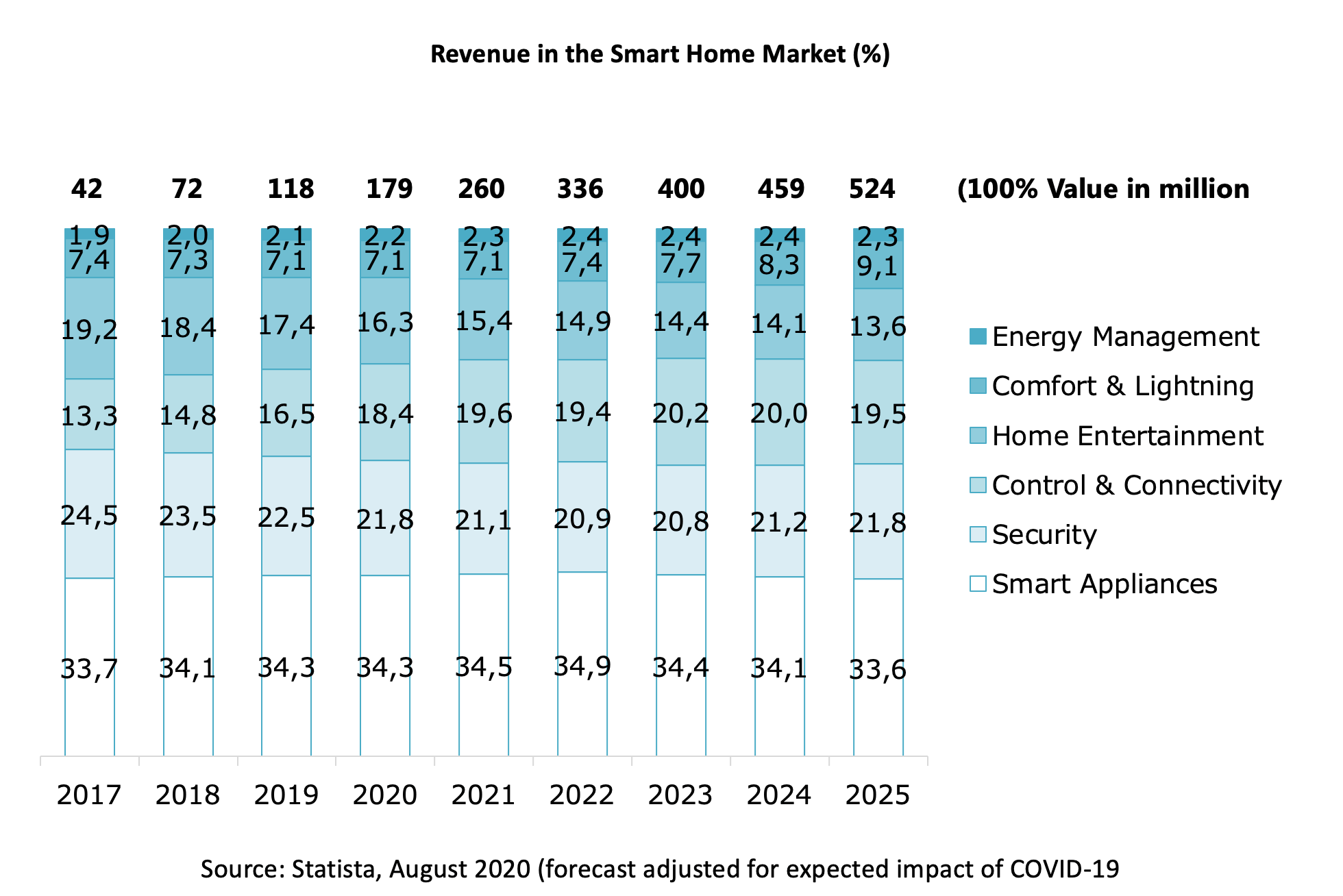
According to Statista, up to August 2020, the Vietnamese smart home market has reached revenue of about 179 million USD and experts predict this figure to reach 524 million USD in 2025 with a CAGR (2020-2025) of 23.9%. Of the total number of smart home product sales value in all 6 segments including control and connectivity, security, smart appliances, energy management, comfort and lighting, and home entertainment, major contributors to revenue are the first three in the list, accounting for more than 70% of total sales value over the researched period. In particular, “control and connect” is forecast to be the segment with most increase in market share over the next 5 years, followed by “comfort & lightning” and “energy management” despite being at a much smaller scale.
In terms of revenue growth, after the dramatic boom in the past 3 years with the peak of 70% growth rate in 2018, the smart home market is expected to slowly reach its stable growth period in the next 5 years at 14%. Remarkable drop point in the revenue growth rate is predicted to follow the impact of COVID-19. “Comfort & Lightning”, “Home Entertainment” and “Security” are the three segments with least growth rate drop.
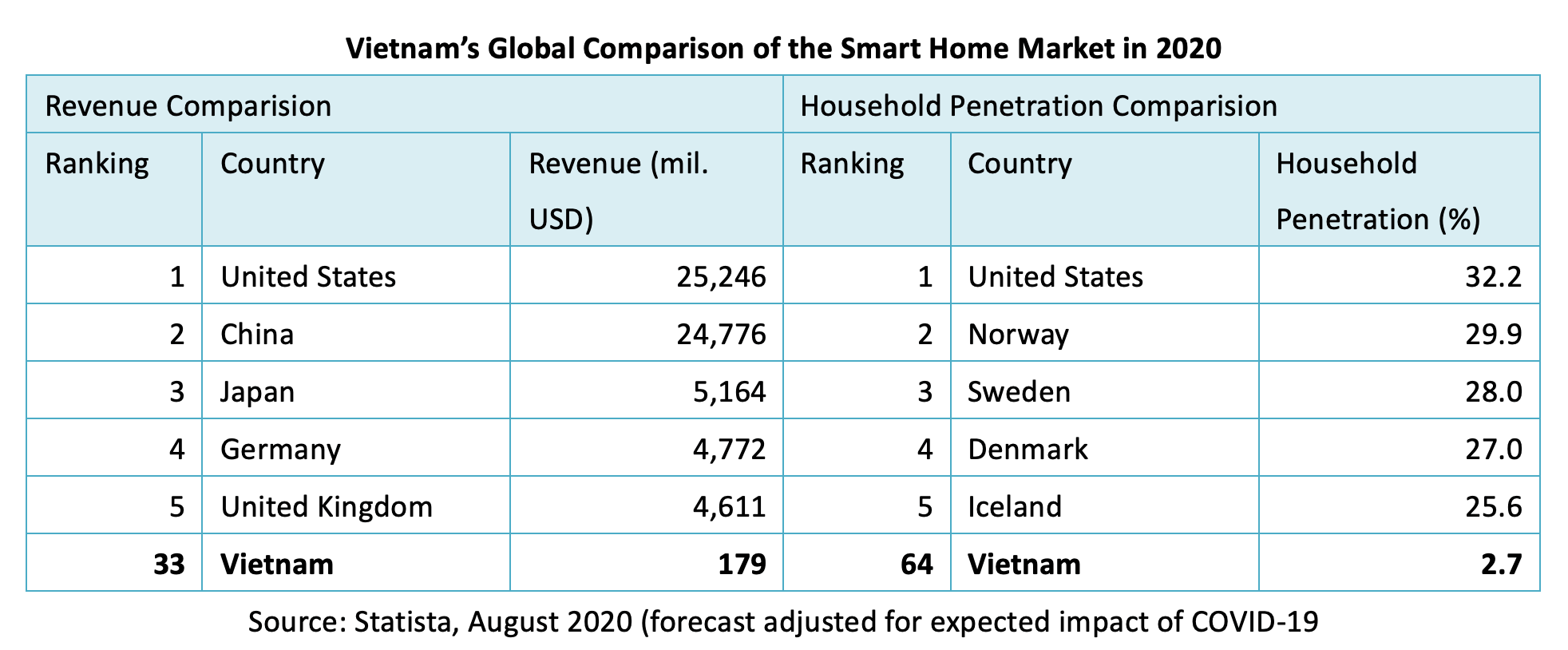
On the global aspect, the smart home market in Vietnam remains quite premature compared to other countries. According to statistics from Statista, by August 2020, Vietnam ranks 33 in terms of revenue and 64 in terms of household penetration. According to Vietnam Investment interview (VIR), Vietnam is still in the phase of “paving the way” for smart home market development, which is the time for customers to become familiar with smart home applications. As a result, investors and customers mainly choose basic solutions, such as a management system for air conditioning, lighting, and electricity. Only after stable demand is established, more advanced and specialized solutions might be able to integrate with the existing ones.
Residential developers of new urban projects to be the pioneers for smart home installation
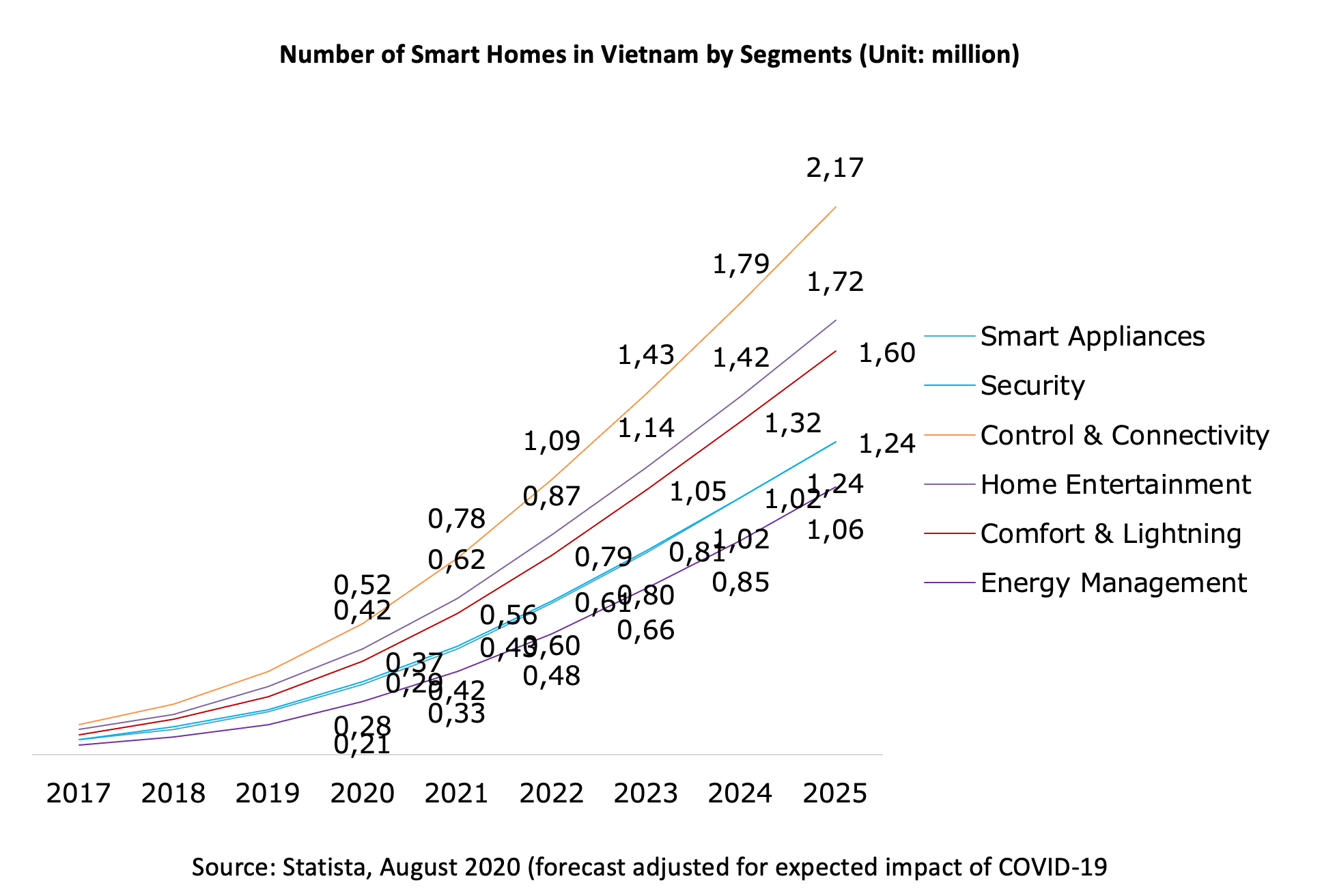
According to Statista, the total number of smart homes in Vietnam in 2020 is about 0.6 million. This number is relatively small compared to the total number of more than 26.8 million households (General Statistic Office, 2019) in Vietnam. Moreover, as stated by JLL Vietnam, most smart homes are developed in the residential sector of newly built or still under construction projects located mainly in the two most urbanized cities of Vietnam – Hanoi and Ho Chi Minh city. However, installing smart technologies would result in a higher price tag for the properties, which would likely limit the target market to the high-end segment. This consequently explains one of the reasons why it was slow in the first phase to penetrate smart home market in Vietnam. Nonetheless, the potential for market growth is still high as many developers have become more proactive in integrating the concept of smart home in their projects and offering smart techs as extras in a promotion or free experience program.
Particularly, when looking at the six key segments of smart home application, even though not accounting for the highest in terms of revenue as stated above, “control and connectivity”, “home entertainment” and “comfort & lightning” are the most application for smart homes in Vietnam. It can be deduced that the ability to “control and connect” as well as entertainment and comfortness factors are the focal points of the smart home concept which is supposed to bring most added values for the daily life. In addition, integrated devices that can connect to another device will dominate the stand-alone devices because of its usability and functional diversity (Amazon’s Alexa Echo Dot, Hikvision’s Smart Camera, Yale’s Key can be integrated into the smart home system of Lumi Vietnam). Most of the households equipped with smart appliances will be high-end apartments with modern electrical systems.
Players landscape
As the development of smart homes becomes an indispensible trend, many international technology giants have established affliates in Vietnam. Along with the growth of the market is the launch of different brands in various segments to meet diverse users’ demand. The Smart Home market is divided into two groups including foreign brands: Siemens (Germany), Schneider (France), Smartg4 (USA), Gamma (Germany), Fibari (Poland), and well-known domestic brands such as BKAV Smarthome, FPT, Lumi, Acis, etc. Despite major concerns about the quality of domestic smart home products as they are mostly newly developed and not tested much, products by domestic players seem to be highly appreciated for their friendly features and affordable price. Moreover, according to analysis by Vietnam Investment Review, an obstacle for foreign smart home solutions is that they are not really compatible with the infrastructure and the development of the construction sector in Vietnam.