

 English
  日本語
日本語  Tiếng Việt
  简体中文
简体中文  한국어
한국어 B&Company was recently interviewed by VTV’s Vietnam Today about the current landscape of Vietnam’s smart home market.

08Jan2026
Announcement / Highlight content / Highlight Content JP / Highlight content vi / Latest News & Report
Comments: No Comments.
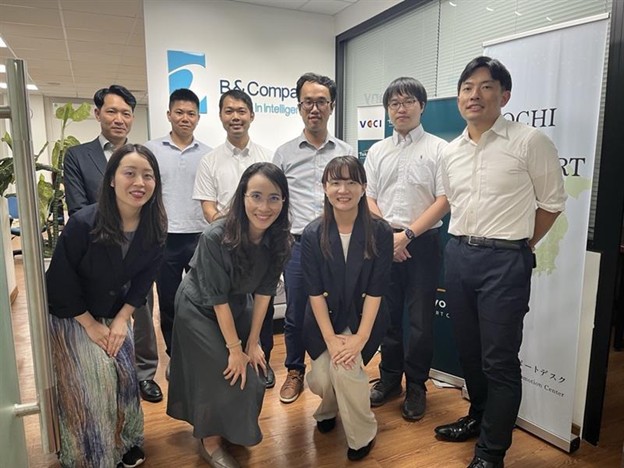
B&Company was recently interviewed by VTV’s Vietnam Today about the current landscape of Vietnam’s smart home market. The program was published on January 3, 2026, with Ms. Duong (Senior Manager) representing B&Company.
Key takeaway (in brief)
From B&Company’s perspective, Vietnam’s smart home market is moving from early adoption to accelerated scaling. Demand is expanding beyond single-device purchases toward integrated ecosystems, driven by rising digital readiness, increasing urban middle-class spending, and stronger interest in safety and convenience. Please read the full content of B&Company interview below to grasp market insights about smart home market information in Vietnam.
B&Company on Bizline (Vietnam Today) about smart home market

Source: VTV Go
Founded in Japan in 2001 as a market research and overseas investment consulting company based in Tokyo, we have expanded into Vietnam since 2008 with 2 offices in Hanoi and Ho Chi Minh City. For 2 decades, we have been supporting many clients from various economic sectors in making strategic investment decisions. If you are planning to enter or grow in Vietnam’s smart home ecosystem, we are ready to support with our services such as market research, market entry consulting, and business matching.
Interview content about the Vietnam smart home market
Questions 1: How would you assess the development of Vietnam’s smart home market? What notable trends do you see?
Answers
Ms. Duong Nguyen – Senior Research Manager at B&Company

Source: B&Company
Based on B&Company’s analysis, Vietnam’s smart home market is in a phase of rapid growth while still having significant headroom. The market size in 2024 is estimated at over USD 350 million and is expected to surpass USD 500 million by 2028, with a double-digit CAGR.
In terms of trends, we observe three key highlights.
– First is the shift from standalone products to integrated ecosystems, especially in device groups such as central control, security, and energy management.
– Second is the increasingly important role of energy saving and safety, as consumers are paying more attention to electricity costs, fire prevention, and remote monitoring.
– Third, digital infrastructure, particularly 5G and IoT, is enabling smart home solutions to operate more stably, with faster response times, and to expand into more advanced applications such as energy management and smart security.
Question 2: Some reports suggest the smart home market is starting to reach Vietnam’s middle-class customers. What is B&Company’s view on this?
Answers:
In B&Company’s view, this observation is well-founded. According to the WTO, Vietnam’s middle class is expanding rapidly and is projected to account for around one-third of the population by 2026. As a result, growth momentum is no longer driven mainly by high-income consumers but is shifting toward the urban middle class—especially young households living in apartments and townhouses in Hanoi and Ho Chi Minh City. This group has stable income, is comfortable with technology, and is willing to pay for convenience, safety, and a better living experience.
Statistics from Statista show that the share of households using smart home devices in Vietnam is currently only around 15%, but it could approach 25–26% within the next 3–4 years.
In addition to local brands such as Lumi and FPT Smart Home—which offer products and solutions aligned with household needs—Vietnam has also seen telecom operators such as VNPT, MobiFone, and Viettel incorporate smart home into bundled service models with broadband internet and television services to serve household customers, including the middle class. This indicates that smart home is not only a trend for high-income groups but is being “democratized” to reach a broader audience.
However, to truly win this segment, businesses need to clearly understand consumer behavior, willingness to pay, and specific barriers across different middle-class groups—from those living in mid-range apartments to townhouse households. This is why market research plays a critical role in helping companies build an effective market entry strategy.
Question 3: What are the key factors that are helping smart homes expand their middle-class customer base in Vietnam?
Answer:
B&Company identifies three key factors.
– First, prices have decreased significantly. Today, many basic smart home devices cost only a few hundred thousand VND to around VND 1 million, while a relatively complete solution package for a middle-class household is around VND 15–20 million, which is affordable for this segment. Competition between international and local brands has created more options at suitable price points.
– Second, devices are increasingly user-friendly and easier to install, no longer requiring complex technical customization. App-based control, voice control, and open ecosystems make it more convenient for users to adopt.
– Third, consumer perceptions have changed. Smart home is no longer viewed as “premium high-tech gadgets,” but as a practical solution to save electricity, increase safety, and optimize daily routines. After COVID-19, Vietnamese consumers have become more attentive to living space, home security, and energy saving. Being able to monitor the home remotely, control air conditioning to save electricity, or automate devices is no longer a luxury—it has become a real need. In addition, the development of internet infrastructure and 4G/5G, along with Vietnam’s high smartphone ownership rate, also creates favorable conditions for smart home deployment.
Question 4: Beyond cost, what are the biggest barriers that are preventing smart homes from becoming more widely adopted by Vietnamese households?
Answer:
Based on customer insight research conducted by B&Company, we identify several major barriers:
– First is ecosystem fragmentation, which makes consumers worry about compatibility among devices from different brands. There are too many platforms and protocols in the market, leading consumers to ask: if they buy device A, will it connect with device B? And if a brand stops operating, will the device still function?
– Second is the reluctance to change the structure of the home (infrastructure barrier). Most Vietnamese people live in completed homes (older houses). A major psychological barrier is the assumption that installing smart home means breaking walls, rewiring, or changing the home’s structure. The complexity of deploying smart solutions on older infrastructure discourages many consumers from the outset.
– Third is concern about reliability and cybersecurity. Consumers worry about personal data being collected, cameras being hacked, or devices breaking with no clear place to repair them. Negative cybersecurity stories on social media further increase these concerns.
These factors lead many middle-class consumers to remain in an “observe and wait” mindset before making deeper investments.
Question 5: In your opinion, what additional conditions are needed for smart homes to become a mainstream choice in Vietnam?
Answer:
To make the smart home a mainstream choice, B&Company believes several conditions need to come together.
– First is infrastructure and technology standards. For smart homes to become mainstream, easy connectivity and interoperability among devices from different brands are essential.
– Second is flexible solutions for existing housing. Integrating smart home into a newly built house is far easier than upgrading an occupied home (normal home/old house). However, most potential customers live in traditional homes. Therefore, to scale adoption, the market needs “non-invasive” installation solutions (e.g., wireless technology, devices that directly replace existing switches/outlets) that can convert a normal home into a smart home without breaking walls or changing the existing electrical infrastructure.
– Third, to become mainstream in Vietnam, the market must address consumer concerns about reliability and security thoroughly. This requires transparency in data collection and protection, commitments to comply with local regulations, and clear, easy-to-understand security standards. In parallel, building brand credibility, trustworthy endorsements, and transparent local warranty/maintenance systems will reduce the concern of “it breaks and I don’t know where to fix it.” When users feel their data is protected and devices are supported long-term, smart homes can be more widely accepted.
– Fourth is rigorous market research to better understand Vietnamese consumer behavior, willingness to pay, and psychological barriers to new technology. This is a point B&Company would like to emphasize—companies, especially international brands entering Vietnam, need to invest in deep research on local consumers. Every market has its own characteristics; what works in the US, Korea, or Japan may not necessarily fit Vietnam.
– For example, Vietnamese consumers care a lot about saving electricity, but they are also very practical—they want to see a concrete savings figure after one month of use. Also, Vietnamese households often live with grandparents, so the interface needs to be simple enough for older people to use.
– This, in turn, helps companies choose an appropriate business model—for example partnering with real estate developers or telecom operators, or selling through service bundles rather than selling devices alone.
In practice, we find that companies—especially foreign brands—that invest seriously in market research and entry strategy often have clearer advantages in product development, pricing, and selecting distribution channels that fit the Vietnamese market.
* If you wish to quote any information from this article, please kindly cite the source along with the link to the original article to respect copyright.
| B&Company
The first Japanese company specializing in market research in Vietnam since 2008. We provide a wide range of services including industry reports, industry interviews, consumer surveys, business matching. Additionally, we have recently developed a database of over 900,000 companies in Vietnam, which can be used to search for partners and analyze the market. Please do not hesitate to contact us if you have any queries. info@b-company.jp + (84) 28 3910 3913 |
Related article

































Sidebar:
SUBSCRIBE NEWSLETTER