

 English
  日本語
日本語  Tiếng Việt
  简体中文
简体中文  한국어
한국어 Cooperation between Vietnam and Japan is expanding into high-tech sectors, such as semiconductor, AI, and digital transformation.

29Jun2026
Latest News & Report / Vietnam Briefing
Comments: No Comments.
In recent years, Japanese companies have gradually viewed Vietnam not only as a low-cost manufacturing base, but also as a growth market and a strategic link in their Asian business networks. Along with this trend, cooperation between the two countries is expanding into high-tech sectors such as semiconductors, artificial intelligence, and digital transformation. In this context, where does Vietnam stand in the semiconductor value chain, and in which stages can Japanese companies participate effectively?[1]
Vietnam’s Semiconductor Industry in 2026: Current Position and Gaps in the Value Chain
Major Developments in the First Five Months of 2026 include:
– In May 2026, Vietnam and Japan launched five joint research projects on 3D ICs, new semiconductor materials, sensors, RISC-V-based AI SoCs, and power electronics.[2]
– By March 2026, Vietnam had more than 50 chip design companies, around 7,000 engineers, and 241 FDI projects worth over USD 14.2 billion, mainly in assembly, packaging, and testing.[3]
– In Q1 2026, Samsung established Samsung Vietnam Semiconductor in Thai Nguyen and launched a chip testing plant project worth around USD 1.5 billion, expected to begin operations in November 2027.[4] [5]
– In late January 2026, FPT announced the first advanced chip testing and packaging plant owned by a Vietnamese company, with six testing lines planned for 2026–2027.[6]
– On January 16, 2026, Viettel began construction of Vietnam’s first chip fabrication plant in Hoa Lac on a 27-hectare site, aiming to build domestic chip production capacity[7].
– On January 7, 2026, the Ministry of Science and Technology established the National Chip Prototyping Support Center, providing design tools, IP libraries, and connections between stages of the production chain.[8]
Semiconductor Value Chain in Vietnam
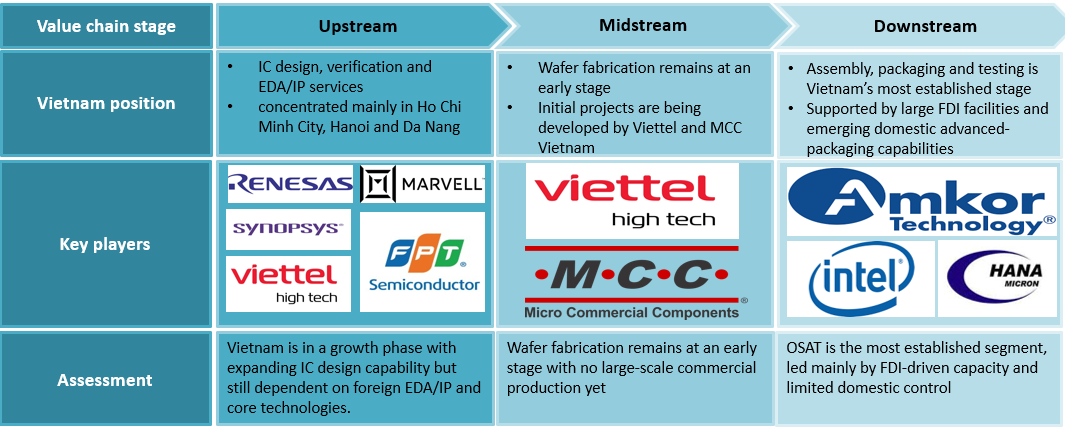
B&Company’s synthesis
Vietnam has built a relatively clear foundation in IC design and especially in packaging and testing, while wafer fabrication remains at an early stage. Therefore, its ability to move up the value chain will depend on how well it uses its current advantages and addresses remaining bottlenecks.
Vietnam’s advantages include a young workforce with a STEM background, a large electronics manufacturing base, and proximity to major semiconductor hubs in Asia. Its open economy, broad FTA network, and strong government policy commitment also make it a suitable destination for global supply chain diversification.[9]
However, the industry still lacks experienced engineers, R&D experts, and infrastructure for chip design, prototyping, and fabrication. Supply chains for materials, equipment, and specialized logistics remain weak, while many high-tech components still depend on imports, limiting domestic value added and the commercialization of research results.[10]
The footprint of Japanese companies in Vietnam’s semiconductor ecosystem
While U.S. firms like Intel and Amkor focus mainly on large-scale assembly, packaging, and testing, Japanese companies in Vietnam are more present in specialized segments such as chip design, materials, components, manufacturing equipment, and technical support. The table below summarizes key Japanese companies and cooperation programs in Vietnam’s semiconductor ecosystem.
Selected Japanese Companies and Cooperation Programs in Vietnam’s Semiconductor Ecosystem
| Segment | No. | Japanese players | Year of establishment / program launch in Vietnam | Activities in Vietnam |
| Chip Design & R&D | 1 | Renesas Design Vietnam | 2004 | Designs and verifies SoCs, hardware and software for applications such as automotive systems and home appliances
Cooperates with Vietnamese universities on workforce training Continues to operate its design center in Ho Chi Minh City |
| 2 | Sanei Hytechs Vietnam | Has operated an engineering center in Da Nang since 2015.
Provides semiconductor IC design, electrical circuit design, data processing and software development. |
||
| Semiconductor Materials & Component | 3 | Tokuyama Vietnam | 2024 | Conducts the final processing stage and sales of semiconductor-grade polysilicon, a key input material for wafer production. |
| 4 | Kyocera Vietnam | 2011 | Manufactures ceramic packages and other semiconductor-related components at its Vietnam plant
latest strategy includes expanding Vietnam capacity and developing ceramic substrates for chiplet packages |
|
| Semiconductor Equipment, Testing & Supporting Industries | 5 | RORZE Robotech | 1996 | Manufactures robots and motor-control equipment for semiconductor production. Expanding its Hai Phong manufacturing capacity through a major investment plan |
| 6 | Advantest Vietnam | 2011 | Supplies semiconductor automated test and measurement systems
Provides local sales, customer service and technical support from Ho Chi Minh City |
|
| Research Collaboration & Workforce Development | 7 | JST / NEXUS and Japanese partner universities
|
2025 | Co-funds five 42-month projects on 3D ICs, advanced materials, sensors and power electronics.
Supports Vietnamese early-career researchers and launched a second semiconductor research call in 2026. |
| 8 | Vietnam Japan University and Japanese academic partners | 2025 | Operates a 4.5-year bilingual engineering program in Semiconductor Chip Technology
Covers IC design, fabrication, testing and packaging, with laboratory training and internship opportunities in Japan |
B&Company’s synthesis
Japanese companies’ strengths in Vietnam clearly lie in highly specialized segments, including IC design and verification, semiconductor materials, ceramic packages, robots for manufacturing equipment, and testing systems. Renesas’ long-term presence, together with Tokuyama and RORZE’s manufacturing projects and research cooperation under NEXUS, shows that Japanese companies can combine technology, manufacturing, and workforce training to participate more deeply in Vietnam’s ecosystem.
However, current projects remain fragmented and have not formed an integrated supply chain led by Japanese companies in Vietnam. Among the companies reviewed, no Japanese company operates a wafer fabrication plant or a large-scale packaging and testing facility. Except for RORZE, most equipment companies are present mainly through sales, maintenance, and technical support, while investment in materials is concentrated in a few specific products.
Many Japanese companies are still studying the market due to concerns about experienced human resources, conditions for foreign experts, and the predictability of the legal environment. This indicates significant room for expansion into local equipment manufacturing, advanced packaging, testing, supplier development, and applied R&D.[11]
How Are Vietnam’s Policies Driving the Market?
To complete the missing links in the ecosystem, Vietnam has issued the Semiconductor Industry Development Strategy to 2030, with a vision to 2050. Targets for 2030 include at least 100 design companies, one small-scale fabrication plant, and 10 packaging and testing plants, gradually expanding from downstream activities to design, fabrication, and specialized chips.[12]
Human resources are a pillar of this strategy. The Government aims to train at least 50,000 university-level or higher personnel by 2030 through new training, reskilling, cooperation among the Government, universities, and businesses, and international exchange and expert attraction programs.[13]
At the same time, Vietnam is investing in research and prototyping infrastructure, including shared laboratories at national and university levels. The National Chip Prototyping Support Center was established in early 2026 and officially launched in June 2026 to provide design tools, software libraries, technical support, and links between domestic designers and fabrication, packaging, and testing facilities.[14]
The investment environment is also supported by the Digital Technology Industry Law, the Investment Support Fund, and incentive mechanisms for high-tech, R&D, training, and semiconductor manufacturing projects. Incentives are determined by sector, scale, and project conditions rather than the investor’s nationality.[15]
Therefore, Japan is considered an important partner in semiconductor research and workforce development in Vietnam. The two countries are promoting the NEXUS program, scholarships and expert training, university cooperation, and joint research projects in areas such as new materials, AI SoCs, and power electronics.
Opportunities for Japanese Companies in Vietnam’s Semiconductor Industry
Vietnam’s semiconductor policy favors gradual ecosystem building, with near-term focus on design, selected manufacturing, and packaging/testing rather than immediate large-scale advanced wafer fabrication. Therefore, Japanese opportunities are most relevant where Vietnam’s policy priorities, Japan’s strengths, and Vietnam’s supply-chain gaps overlap, include:
– Design and applied R&D: Japanese companies can expand IC design, verification, and R&D for specialized chips in fields such as automotive electronics, industrial equipment, energy systems, connected devices, and AI. This matches Vietnam’s policy focus on specialized semiconductor products and builds on existing Japanese design players in Vietnam.
– Prototyping and commercialization support: Japanese companies, universities, and research institutes can support IP/design tools, verification, MPW coordination, testing know-how, and joint applied research. This links with Vietnam’s National Chip Prototyping Support Center, which supports the process from design to prototyping, packaging, testing, and commercialization.
– Equipment, automation, and technical services: Japan can provide testing systems, packaging equipment, automation solutions, process engineering, installation, maintenance, and quality-control support. These are practical opportunities as Vietnam targets 10 packaging and testing plants by 2030.
– Selected materials and components: Japanese firms can supply or gradually localize materials and components where they already have strong capabilities, such as ceramic packages/substrates, packaging-related materials, and back-end components. This should be positioned as a response to Vietnam’s current shortage of specialized suppliers.
Conclusion
Vietnam benefits from a young workforce, a well-established electronics manufacturing base, and a clear policy direction, but it still lacks advanced technology, specialized materials and equipment, and deep manufacturing expertise. These gaps align closely with Japan’s strengths in semiconductor materials, equipment, components, and research, creating a solid foundation for long-term cooperation between the two countries. In the short to medium term, the most practical opportunities lie in chip design, materials and equipment, packaging and testing, workforce development, and joint research.
Read more
Vietnam’s Semiconductor Ambition: Where Japanese Firms Fit in the Value Chain
* If you wish to quote any information from this article, please kindly cite the source along with the link to the original article to respect copyright.
| B&Company
The first Japanese company specializing in market research in Vietnam since 2008. We provide a wide range of services including industry reports, industry interviews, consumer surveys, business matching. Additionally, we have recently developed a database of over 1,000,000 companies in Vietnam, which can be used to search for partners and analyze the market. Please do not hesitate to contact us if you have any queries. info@b-company.jp + (84) 28 3910 3913 |
[1] https://english.vov.vn/en/economy/japanese-firms-bet-on-vietnam-as-a-strategic-growth-hub-post1294695.vov
[2] https://beta-en.mic.gov.vn/ministry-of-science-and-technology-of-viet-nam-launches-five-viet-nam-japan-semiconductor-research-projects-197260503002539217.htm
[3] https://baochinhphu.vn/di-dung-huong-va-buoc-dau-hinh-thanh-nen-tang-phat-trien-cong-nghiep-ban-dan-10226031018055547.htm
[4] https://nhadautu.vn/samsung-viet-nam-tiep-tuc-la-cu-diem-loi-nhuan-cua-tap-doan-han-quoc-d105262.html
[5] https://www.reuters.com/world/asia-pacific/samsung-plans-15-billion-chip-testing-plant-vietnam-document-shows-2026-05-27/
[6] https://fpt.com/vi/tin-tuc/tin-fpt/fpt-cong-bo-thanh-lap-nha-may-kiem-thu-va-dong-goi-tien-tien-chip-ban-dan
[7] https://baochinhphu.vn/thu-tuong-nha-may-che-tao-chip-ban-dan-cong-nghe-cao-la-mat-xich-then-chot-ma-viet-nam-con-thieu-102260116112848429.htm
[8] https://baochinhphu.vn/thanh-lap-trung-tam-quoc-gia-ho-tro-san-xuat-thu-chip-ban-dan-102260107153643401.htm
[9] https://baochinhphu.vn/thanh-lap-trung-tam-quoc-gia-ho-tro-san-xuat-thu-chip-ban-dan-102260107153643401.htm
[10] https://beta-en.mic.gov.vn/viet-nam-seeks-to-build-semiconductor-ecosystem-197260128112652201.htm
[11] https://english.vov.vn/en/economy/japanese-firms-bet-on-vietnam-as-a-strategic-growth-hub-post1294695.vov
[12] https://datafiles.chinhphu.vn/cpp/files/vbpq/2024/9/1018-ttg.signed.pdf
[13] https://datafiles.chinhphu.vn/cpp/files/vbpq/2024/9/1017-ttg.signed.pdf
[14] https://baochinhphu.vn/thanh-lap-trung-tam-quoc-gia-ho-tro-san-xuat-thu-chip-ban-dan-102260107153643401.htm
[15] https://baochinhphu.vn/danh-nhung-co-che-ho-tro-uu-dai-dac-biet-cho-cong-nghiep-ban-dan-102251217212936394.htm
Related article
































Log in / Register
SUBSCRIBE NEWSLETTER