

 English
  日本語
日本語  Tiếng Việt
  简体中文
简体中文  한국어
한국어 Fuel price in Vietnam continues to fluctuate sharply recently, reflecting global energy market disruptions and ongoing geopolitical tensions.

22Apr2026
Highlight content / Highlight Content JP / Highlight content vi / Latest News & Report / Vietnam Briefing
Comments: No Comments.
Fuel prices in Vietnam have continued to fluctuate sharply in recent weeks, reflecting global energy market disruptions and ongoing geopolitical tensions. As an import-dependent economy, Vietnam’s gasoline and diesel prices are highly sensitive to international crude oil movements, making fuel cost changes a critical variable for businesses.
Recent global developments, particularly supply risks and logistics disruptions, have reinforced the importance of closely tracking fuel price trends in Vietnam, as these directly affect operating costs, pricing strategies, and overall market stability.
Latest fuel price in Vietnam (Updated: 21 April 2026)
As of 21 April 2026, the latest fuel price in Vietnam is approximately:
|
Some fuel prices in Vietnam (from 29 Jan to 21 Apr, 2026)
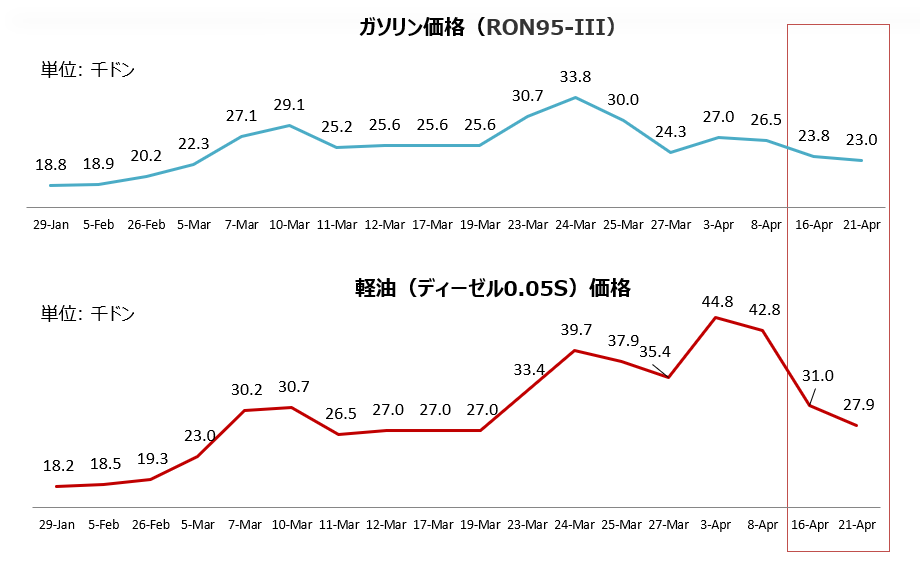
Fuel prices are adjusted periodically by the Ministry of Industry and Trade of Vietnam in coordination with the Ministry of Finance
Thanks to the simultaneous implementation of a series of solutions, domestic gasoline and diesel prices have fallen sharply from the peak, thereby stabilizing market sentiment and controlling inflation.
According to Resolution No. 19/2026/QH16, from April 16, 2026 to June 30, 2026, taxes such as environmental protection tax, VAT, and special consumption tax on gasoline, diesel, and aviation fuel will be significantly reduced, with some reaching 0%, aiming to stabilize fuel prices and support businesses and the economy in the face of fluctuations.
Specifically, the environmental protection tax rate for gasoline (excluding ethanol), diesel fuel, kerosene, fuel oil, and aviation fuel is 0 VND/liter.
Regarding VAT, gasoline, oil, and aviation fuel are exempt from declaration and payment of VAT, but input VAT is still deductible according to regulations. Notably, the special consumption tax rate for all types of gasoline is also applied at 0%.
Business implications: From cost pressure to supply chain risk
Logistics and Transportation cost escalation
Rising diesel prices are significantly increasing transportation costs, especially in Vietnam where road freight dominates. Logistics providers are increasingly applying fuel surcharges, leading to higher overall distribution expenses.
As observed in previous global disruptions, fuel price increases tend to amplify across the entire logistics chain, affecting not only direct transport costs but also routing decisions and delivery timelines.
Read more:
Impact on export-oriented industries
Export-driven sectors such as agro-processing and seafood are particularly exposed, as they rely heavily on cold chain logistics and international shipping. In this context, rising fuel costs can have a more immediate and substantial impact than demand fluctuations, directly affecting profit margins and competitiveness.
This highlights the growing importance of cost control and supply chain optimization for Vietnamese exporters.
Read more:
Inflationary pressure and consumer market effects
Rising fuel prices act as a key transmission channel for inflation in Vietnam, as higher energy costs quickly feed into transportation, production, and retail prices. As observed in previous global shocks, increases in oil prices can push inflation toward higher levels in the short term, creating broader cost pressures across the economy.
Beyond direct impacts, higher logistics and distribution costs are gradually passed on to consumers, particularly in essential goods such as food and daily necessities. This erodes purchasing power and may lead to more cautious spending behavior, potentially slowing demand recovery if fuel price volatility persists.
Read more:
Navigating market change with B&Company
In a market environment shaped by rapid cost fluctuations and external shocks, timely insights are critical for effective decision-making. B&Company, the first Japanese company specializing in market research in Vietnam, supports businesses in monitoring market developments, assessing cost impacts, and adapting strategies to changing conditions. Through local expertise and data analysis, we help clients navigate uncertainty and identify sustainable growth opportunities in Vietnam’s evolving business landscape.
* If you wish to quote any information from this article, please kindly cite the source along with the link to the original article to respect copyright.
| B&Company
The first Japanese company specializing in market research in Vietnam since 2008. We provide a wide range of services including industry reports, industry interviews, consumer surveys, business matching. Additionally, we have recently developed a database of over 900,000 companies in Vietnam, which can be used to search for partners and analyze the market. Please do not hesitate to contact us if you have any queries. info@b-company.jp + (84) 28 3910 3913 |
Related article
































Log in / Register
SUBSCRIBE NEWSLETTER