

 English
  日本語
日本語  Tiếng Việt
  简体中文
简体中文  한국어
한국어 The Mekong Delta is currently facing severe impacts from climate change, directly threatening the livelihoods of its residents.

03Jun2025
Latest News & Report / Vietnam Briefing
Comments: No Comments.
The Mekong Delta, known as the “rice bowl” (vựa lúa) of Vietnam, is a vital region contributing 60% of the country’s agricultural land and nearly 16% of aquaculture land. However, the region is currently facing severe impacts from climate change, directly threatening the livelihoods of its residents. This article explores the significant effects of climate change in the Mekong Delta, potential solutions, and the implications for foreign investment in the region.
Climate change situation and its effects
The Mekong Delta plays a critical role in Vietnam’s agricultural economy, contributing 55% of its rice production, including 90% of its exports. Additionally, the region provides over 60% of the country’s aquatic products and more than 70% of its fruit production. However, climate change is becoming a challenging factor for these key industries. The region is experiencing extreme weather events, including droughts, saltwater intrusion, floods, and rising sea levels.
In the first five months of 2024, drought and saltwater intrusion caused over 50,000 households to face water shortages, and nearly 1,000 roads, homes, and bridges were damaged due to subsidence and erosion[1]. The region loses 300 to 500 hectares of land annually, with Ca Mau alone losing more than 5,300 hectares of land and mangrove forests since 2011[2]. Furthermore, drought has caused the canal and river system in hundreds of thousands of hectares of forest to dry up, leading to a significant risk of forest fires[3].
Number of landslides in Mekong Delta by province (at the end of 2024) (%)
100% = 743 landslides
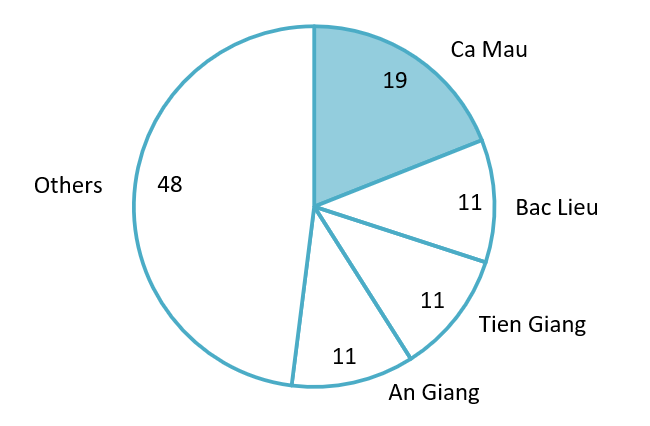
Source: Southern Institute of Water Resources Research
Drought and saltwater intrusion are becoming severe in many areas of the Mekong Delta. The dry-season saltwater intrusion for 2023-2024 has arrived earlier and deeper than the average of previous years[4]. Experts suggest that the causes of drought and saltwater intrusion in the Mekong Delta are due to the influence of the El Niño phenomenon, with prolonged sunny days leading to a large amount of surface water in fields, canals, rivers, and lakes evaporating[5]. Besides natural factors, human activities also contribute significantly to saltwater intrusion. The situation is further exacerbated by excessive groundwater extraction and riverbed sand mining[6].
Erratic flooding is also causing major difficulties for the Mekong Delta. In the past 10 years, the trend of larger and average floods has gradually decreased, while smaller floods have increased[7]. This means that floods in the Mekong Delta are gradually decreasing over the years[8]. The reduction in floods leads to several negative environmental and ecological consequences, including fewer fish and increased erosion due to the lack of water and sediment[9].
Moreover, the rising sea levels increase the risk of flooding and have a significant impact on land resources and infrastructure. In the past 20 years, the average sea level has risen by 2-3 mm per year[10]. It is forecast that the sea level will rise by 0.5-1 meter by the end of the 21st century[11]. It is estimated that hundreds of thousands of hectares of land will be submerged, and millions of people may lose their homes[12]. The rising sea level also puts the sea dyke system at risk of overflowing and breaking, even without large storms[13].
Solutions to Address Climate Change Challenges
Related article
















Log in / Register
Continue without an account
Log in / Register
SUBSCRIBE NEWSLETTER