

 English
  日本語
日本語  Tiếng Việt
  简体中文
简体中文  한국어
한국어 Following the 2025 provincial-level unit mergers, the Southeast of Vietnam is entering an era of enhanced regional coordination.
30May2025
Latest News & Report / Vietnam Briefing
Comments: No Comments.
The Southeast region of Vietnam is the country’s most dynamic economic zone, driving industrial output, export growth, and foreign investment. Following the 2025 provincial-level administrative unit mergers, the Southeast is entering a new era of streamlined governance and enhanced regional coordination, laying the groundwork for a more cohesive economic strategy.
Overview of the Southeast after the 2025 Administrative Unit Mergers
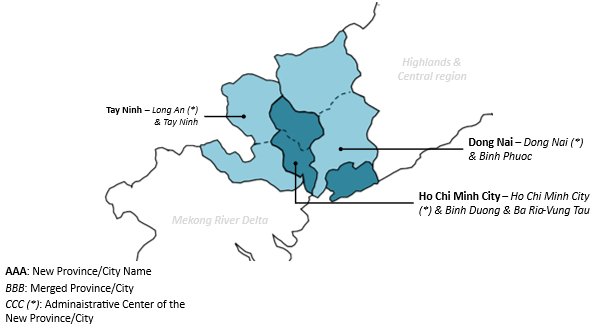
Vietnam’s Southeast region, the country’s burgeoning industrial and urban centers, is undergoing a major administrative restructuring to enhance regional coordination and economic efficiency. Under Decision No. 759/QĐ-TTg[1], 6 provincial-level units will be consolidated into one centrally governed city (Ho Chi Minh City) and two provinces (Dong Nai and Tay Ninh)[2]. This new structure, set to take effect on August 15 per Conclusion No. 157-KL/TW[3], signed on May 25, is expected to streamline governance, optimize infrastructure planning, and create a more attractive environment for investors.
The Southeast’s provincial-level administrative units after the 2025 mergers
Source: B&Company Vietnam
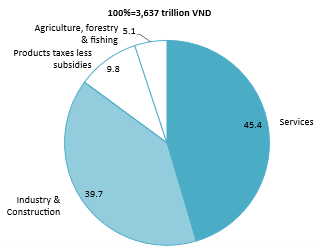
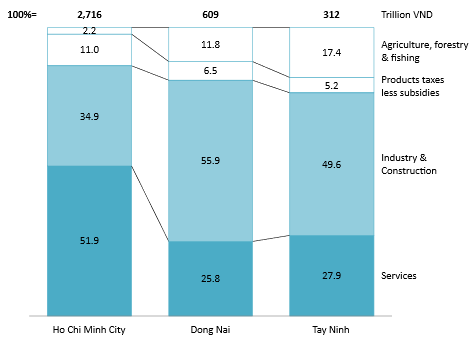
Alongside the Red River Delta, the Southeast region is one of Vietnam’s two major economic centers. In 2024, it recorded the highest GDP among the country’s six key economic zones, exceeding 3,600 trillion VND, representing nearly one-third of the national total. Following the administrative merger, the newly expanded Ho Chi Minh City incorporates Binh Duong and Ba Ria–Vung Tau, which were previously Vietnam’s third- and sixth-largest provincial economies. As a result, the new HCMC alone now contributes over 20% of the country’s GDP, solidifying its position as Vietnam’s dominant economic center. The post-merger Dong Nai and Tay Ninh are also set to see significant economic expansion, with both expected to rank among the top ten provincial economies nationwide in terms of GRDP.
Socio-economic indicators in 2024 of the Southeast’s provinces after the administrative mergers
| No. | Provinces | Population
(Unit: Thousand people) |
Total Area (Unit: Km2) | GRDP
(Unit: Billion VND) |
Growth rate
(Unit: %) |
| 1 | Ho Chi Minh City | 13,609 | 6,773 | 2,715,780 | 8.0 |
| 2 | Dong Nai | 4,428 | 12,737 | 609,176 | 8.3 |
| 3 | Tay Ninh | 2,959 | 8,537 | 312,464 | 7.5 |
| Total | 20,996 | 28,047 | 3,637,420 | 8.0 | |
Source: Resolution No. 60-NQ/TW, Decision No. 759/QD-TTg, General Statistic Offices (GSO), Provincial Statistics Offices, B&Company synthesis
Regional Economic Characteristics and Investment Situation of the Southeast
The Southeast region holds a highly strategic position that drives its economic development. It borders the Mekong Delta, Vietnam’s leading hub for agriculture and aquaculture; the South-Central Coast, with access to key maritime economic centers; and the Central Highlands, a major source of industrial crop materials. The region is positioned near the core of ASEAN and lies along vital international maritime and aviation routes. This prime location enables the Southeast to emerge as a major industrial powerhouse driven by foreign investment while also serving as a booming national and international center for logistics, finance, and high-value services.
Related article




















Log in / Register
Continue without an account
Log in / Register
SUBSCRIBE NEWSLETTER