
2050년까지 베트남 반도체 산업 전략: 목표, 기회 및 과제

베트남의 반도체 산업은 초기 개발과 상당한 외국인 투자가 혼합된 중요한 전환점에 서 있습니다.
Semiconductor Vietnam

0310월2024

B&Company

최신 뉴스 및 보고서 / 베트남 브리핑

댓글: 댓글 없음.

*이 칼럼에서 “베트남 브리핑“"B&Company의 젊은 연구원들이 베트남의 산업 동향, 소비자 동향 및 사회 운동에 대한 시의적절한 정보를 제공할 것입니다.".

원본 정보의 정확성을 보장하기 위해 최선을 다하고 있지만, 각 정보는 개별적으로 확인해 주시기 바랍니다. 해석 및 향후 전망은 각 연구자의 개인적인 의견입니다.

Current Situation of the Vietnamese Semiconductor Industry

Vietnam’s semiconductor industry is at a pivotal juncture, characterized by a blend of nascent development and substantial foreign investment. Currently, the country serves predominantly as an assembly hub for international technology companies, including giants like Intel, Samsung, and Foxconn. These firms have established operations primarily focused on the assembly and packaging of semiconductor components, positioning Vietnam as a vital link in the global supply chain.

Vietnam’s expansion and investment in new projects have led to an increasing number of foreign enterprises investing in the semiconductor sector. In 2024, Vietnam continues to attract many FDI projects in the semiconductor field from various countries around the world. Notable examples include several names as follows:

Some FDI investment projects in the semiconductor sector since the beginning of 2024

회사 Investment Capital Investment Location
BE 반도체 산업 NV 4.9 million USD 호치민시
앰코테크놀로지 1.6 billion USD Bac Ninh Province
Coherent Corp 127 million USD 동나이성
시그네틱스 1억 달러 Vinh Phuc Province

출처 : B&Company의 종합

Statista Market Insights forecasts that Vietnam’s semiconductor revenue will achieve a compound annual growth rate (CAGR) of 11.6% during the period from 2023 to 2027, reaching $31.28 billion by 2027. Among these, integrated circuits—the most important segment in the semiconductor industry—are expected to be valued at $16.44 billion by the end of 2024[1]. The market has expanded significantly due to Vietnam’s strategic location, competitive labor costs, and favorable investment climate. However, while these factors have attracted major players, the country still lags in high-end manufacturing and design capabilities, making it heavily dependent on foreign technology and expertise.

Moreover, the Vietnamese workforce, while abundant, lacks specialized skills in semiconductor design and advanced manufacturing processes. Although there are educational institutions focusing on technology and engineering, the curriculum often does not meet the specific needs of the semiconductor industry. Consequently, the current state of Vietnam’s semiconductor sector can be summarized as an assembly-centric model with limited local R&D and production capabilities.

Government’s Policies and Strategic Vision for the Semiconductor Industry

In response to the challenges and opportunities presented by the semiconductor sector, the Vietnamese government has launched a comprehensive strategy aimed at fostering the growth of the industry. Prime Minister Pham Minh Chinh has just signed Decision No. 1018/QĐ-TTg dated September 21, 2024, issuing the Strategy for the Development of Vietnam’s Semiconductor Industry by 2030 and a Vision for 2050. The strategy outlines the development path for Vietnam’s semiconductor industry from now until 2030, with a vision for 2050, following this formula:

C = SET + 1

Of which: C stands for Chip, S stands for Specialized; E stands for 전자제품; T stands for Talent and + 1 stands for Vietnam (Vietnam is the new safe destination for the global semiconductor supply chain).

This strategy outlines a roadmap divided into three phases with specific objectives as follows:

The Government’s development goals for the semiconductor industry
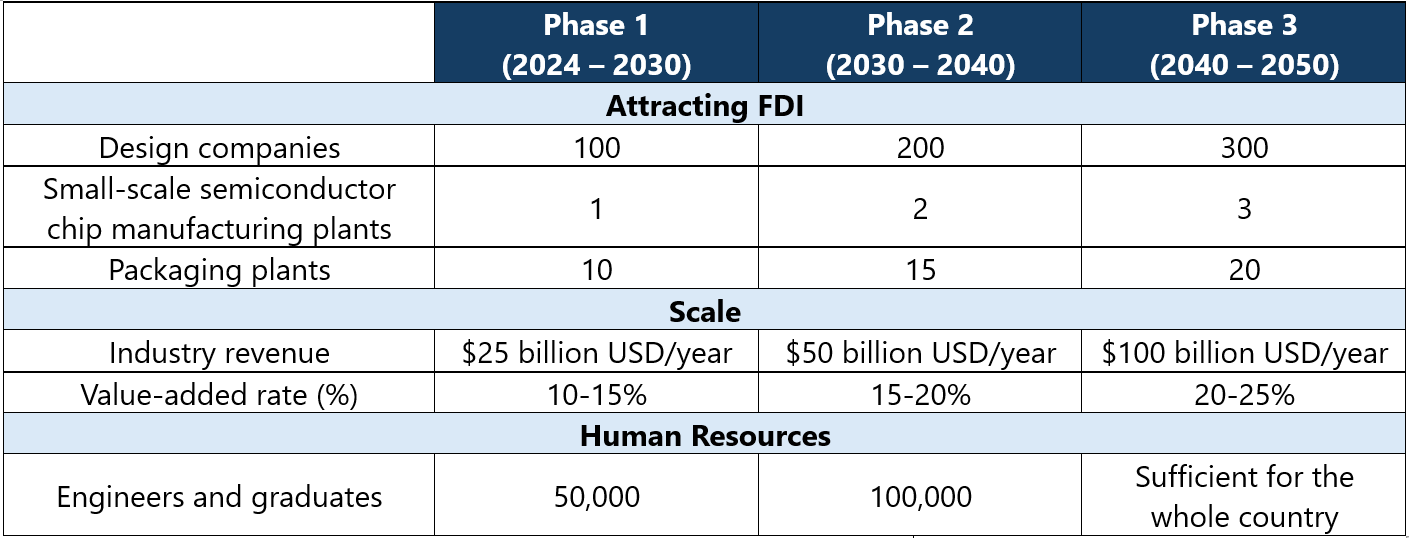
The Government’s development goals for the semiconductor industry

Source: Decision 1018/QĐ-TTg[2]

Opportunities for Semiconductor Industry

Vietnam’s strategic vision for the semiconductor industry presents numerous opportunities. One of the most significant opportunities lies in the global demand surge for semiconductors. The market is projected to grow significantly, driven by advances in technology such as artificial intelligence, IoT, and 5G. As companies seek to diversify their supply chains, Vietnam has the potential to become a preferred destination for semiconductor manufacturing.

Additionally, the presence of major multinational corporations has already laid the groundwork for a more robust semiconductor ecosystem. During the state visit of U.S. President Joe Biden to Vietnam on September 10-11/2023, the Joint Statement between Vietnam and the United States indicated that both sides will cooperate extensively in the field of science and technology. FPT Corporation – one of the biggest corporations specializing in semiconductor in Vietnam – has proposed that the U.S. support the training of 30,000 to 50,000 semiconductor specialists through investment in FPT University, aimed at enhancing workforce capabilities. Additionally, FPT also shared that the corporation plans to invest $100 million and nearly 1,000 personnel in the U.S. by the end of 2023[3].

FPT Chairman discussing with US businessmen

FPT Chairman discussing with US businessmen

FPT Press release, 2023 (원천)

Continued foreign investment can accelerate technology transfer and facilitate the establishment of advanced manufacturing facilities. The Vietnamese government’s commitment to developing the semiconductor industry creates a favorable environment for growth. The combination of strategic infrastructure investment and human resource development can position Vietnam as a key player in the regional semiconductor landscape. Furthermore, as a member of various trade agreements, such as the Comprehensive and Progressive Agreement for Trans-Pacific Partnership (CPTPP) and the Regional Comprehensive Economic Partnership (RCEP), Vietnam has access to a broader market, enabling it to attract more investment and foster collaboration in the semiconductor sector.

Challenges for Semiconductor Industry

However, Vietnam must contend with significant challenges. One major obstacle is the technological gap that the country faces in comparison to more established semiconductor hubs. Vietnam currently lacks advanced manufacturing technology and expertise, which are essential for moving beyond assembly to high-value production. The shortage of skilled labor in semiconductor design and advanced manufacturing remains a pressing issue as well. While educational initiatives are underway, it will take time to cultivate a workforce capable of meeting the industry’s demands.

Additionally, while plans for industrial parks are promising, the actual implementation of infrastructure projects may lag behind. Delays in developing necessary facilities could hinder the growth of the semiconductor sector. Finally, Vietnam must confront fierce competition from established semiconductor leaders such as Taiwan and South Korea. These countries have well-established supply chains, advanced technology, and highly skilled workforces, making it imperative for Vietnam to carve out a niche and differentiate itself.

결론

Vietnam’s strategic vision for developing its semiconductor industry by 2030 and beyond represents a critical step toward establishing a sustainable and competitive technological ecosystem. While the current state of the industry is largely assembly-focused, government initiatives aimed at infrastructure development, human resource training, and investment in R&D hold promise for transformative growth. The opportunities presented by a growing global demand for semiconductors and favorable government policies offer a pathway for Vietnam to position itself as a significant player in the semiconductor market.

However, addressing challenges such as technological gaps, talent shortages, and fierce regional competition will be essential to realizing this vision. As Vietnam navigates the complexities of the semiconductor landscape, the outcomes of these efforts will not only influence the country’s economic trajectory but also contribute to the broader technological advancement of Southeast Asia. With a clear vision and determined execution, Vietnam can emerge as a pivotal hub in the global semiconductor industry, fostering innovation and driving economic growth for years to come.


[1] VnEconomy (2024). With a revenue of $31.28 billion, Vietnam has the potential to become the new semiconductor manufacturing hub of the world. <평가하다>

[2] Government Document (2024). Issuing the Strategy for the Development of Vietnam’s Semiconductor Industry by 2030 and a Vision for 2050. <평가하다>

[3] Economic and Forecast Magazine (2024). Opportunities for semiconductor industry development in Vietnam. <평가하다>


B&Company, Inc.

2008년부터 베트남에서 시장 조사 전문 기업으로 활동해 온 최초의 일본 기업입니다. 산업 보고서, 업계 관계자 인터뷰, 소비자 설문 조사, 비즈니스 매칭 등 폭넓은 서비스를 제공합니다. 또한, 최근에는 베트남 기업 90만 개 이상의 데이터베이스를 구축하여 파트너 발굴 및 시장 분석에 활용하고 있습니다.

문의 사항이 있으시면 언제든지 저희에게 문의해 주세요.

info@b-company.jp + (84) 28 3910 3913


다른 기사도 읽어보세요

 

계속 읽으려면 로그인하거나 무료로 회원가입하세요.

관련기사

뉴스레터 구독