

 English
  日本語
日本語  Tiếng Việt
  简体中文
简体中文  한국어
한국어 Education system in Vietnam is structured as a comprehensive, multi-pathway framework from early childhood education to doctoral studies.

29Dec2025
Latest News & Report / Vietnam Briefing
Comments: No Comments.
Vietnam’s national education system is structured as a comprehensive, multi-pathway framework spanning early childhood education through doctoral studies, complemented by lifelong and continuing education. The system consists of public institutions with increasing private and foreign participation. With a large student population, rising middle-class demand, and diversified higher education institutions, Vietnam’s education sector presents significant opportunities for investment across formal schooling, vocational training, and international education collaboration.
Structure of the National Education System
Vietnam’s education system is governed by a unified National Education System Framework, established by Decision No. 1981/QĐ-TTg (2016) issued by the Prime Minister. This framework defines the structural layout of education from early childhood through to doctoral studies and ensures a coordinated system of learning pathways[1]. Alongside formal higher education, continuing education plays a key role in enabling lifelong learning, professional upskilling, career transition, and self-employment across all age groups.
Educational institutions can be classified according to their ownership, including Public schools, Community-founded schools (which only exist in early childhood education), and Private schools[2]. Within the private education segment, the engagement of foreign investors is significant. Foreign investors may participate in the Vietnamese education market through several forms, such as establishing foreign-invested schools at various levels, jointly operating integrated education programs with Vietnamese partners, and creating branch campuses or representative offices[3].
Vietnam National Education System
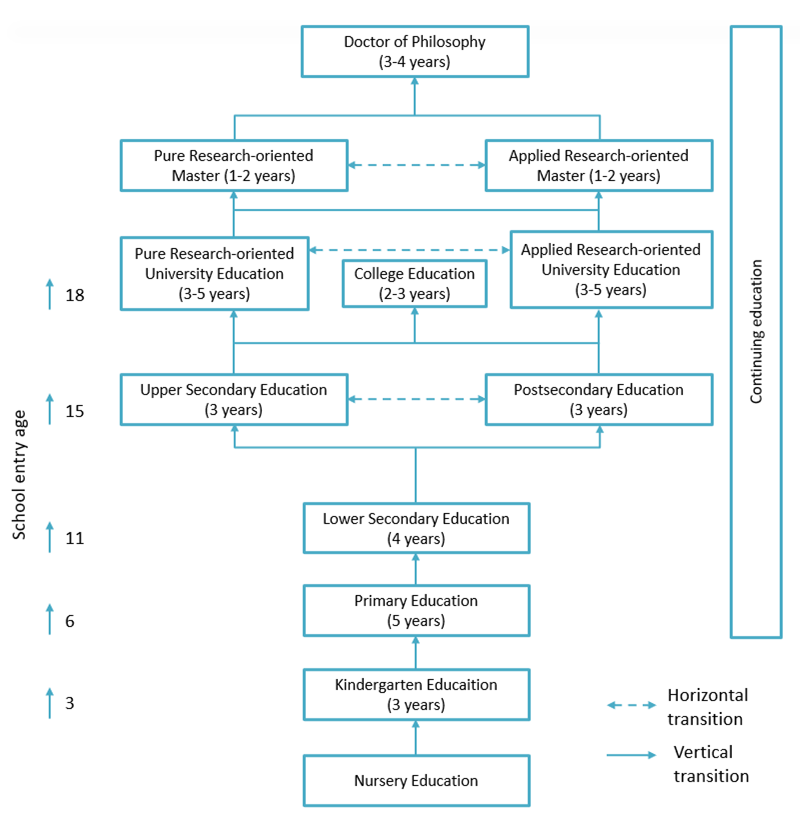
Source: Decision No. 1981/QD-TTg
Early Childhood Education
Early childhood education includes nurseries and kindergartens, providing care, nurturing, and education for children from three to six years old. By the school year of 2023-2024, there are 12,062 nurseries and kindergartens nationwide, of which 79.4% are state-owned institutions. The remaining 20.6% are non-state-owned[4].
Recently, innovative, child-centered teaching methods such as Montessori and Reggio Emilia have been gradually introduced alongside the national preschool curriculum. Those new teaching methods replace traditional, teacher-centered learning with experiential learning. These approaches emphasize children’s autonomy, creativity, sensory exploration, and learning through play, with Reggio Emilia in particular highlighting the role of the learning environment and project-based activities. Although the number of institutions fully applying these methods remains relatively small, adoption is steadily increasing, especially among foreign-invested and international preschools in major cities like Hanoi and Ho Chi Minh City[5].
General Education
General education in Vietnam spans 12 years, beginning with primary school and continuing through lower and upper secondary school. The system is compulsory and universal, designed to equip students with foundational knowledge in language, mathematics, social sciences, natural sciences, and life skills before they transition to specialized or higher learning paths.
In Vietnam, the number of upper secondary schools are noticeably fewer than the 2 previous school levels, because students can choose other options once finishing lower secondary schools. The proportion of private (non-public) schools is much higher in upper secondary schools, indicating a strong potential for the participation of private/foreign investors.
Schools in General Education level by ownership (school year 2024-2025)
Unit: %
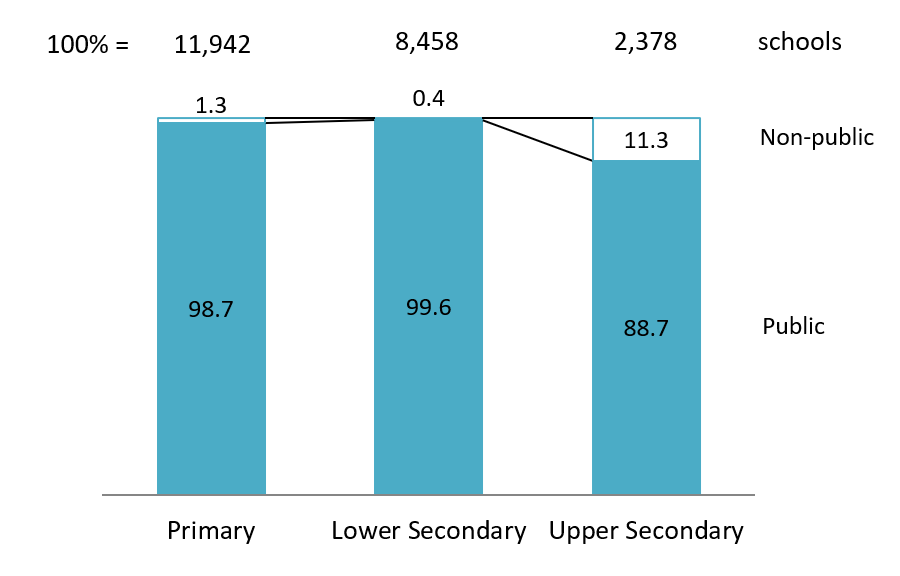
Source: National Statistics Office
Schools in Vietnam are offering international and integrated curricula, combining the national program with international elements such as the International Baccalaureate and Cambridge, and enhanced foreign language learning. This trend responds to rising parental demand for global competencies and overseas university pathways. While fully international schools remain limited and concentrated in major cities, integrated programs are increasingly implemented in both private and selected public schools, often with foreign teachers or international partners[6].
Furthermore, STEM education has emerged as a priority, promoting hands-on learning linked to real-world problem solving. STEM activities are now included across all general education levels through classroom projects, clubs, competitions, and innovation festivals[7]. In some urban areas, schools are piloting bilingual STEM programs that integrate English and digital technologies such as coding, robotics, and AI basics[8].
Vocational Education & Training
Parallel to general secondary education is the vocational education and training pathway, encompassing programs at postsecondary and college levels. This system focuses on hands-on skills and practical competencies for specific industries. To enter this education path, learners are often required to have at least graduated from lower secondary schools. In 2023, there are 1520 vocational training institutions, of which 61.7% are state-owned.
Vocational training institutions are increasingly adding programs for new and emerging fields to respond to labor market needs, including logistics, energy transition technologies, semiconductor production, AI-related skills, and advanced technical domains. Recently, the national strategy for vocational education emphasizes training for the digital era and Industry 4.0 by modernizing curricula to include digital skills, automation, IT, cybersecurity, and emerging tech competencies, as well as soft skills like critical thinking and teamwork[9].
Moreover, the adoption of international and industry-driven training is promoted, particularly through cooperation with foreign governments, development agencies, and multinational companies. Vietnam has partnered with countries such as Germany, Australia, Japan, and South Korea to introduce dual training systems and internationally recognized occupational standards[10]. These programs combine classroom learning with paid, on-the-job training in enterprises, helping align skills training more closely with real labor market demand.
Higher Education
In 2023, there were 243 higher education institutions across Vietnam, 72.4% of which are state-owned. Higher education in Vietnam encompasses undergraduate, master’s, and doctoral programs. As the most advanced level of education, it prepares students for professional careers, research, and leadership roles across sectors. Undergraduate and master’s education follow two main tracks: research-oriented and application-oriented, while doctoral education is research-focused.
As the industrial and technological development is accelerating globally, higher education leads in STEM expansion and applied research to support industrial modernization, digital transformation, and national innovation capacity. Government plans emphasize developing national key universities in STEM fields and aligning programs with industrial and technological priorities[11].
Higher education institutions are increasingly integrating internationally, giving students more access to advanced professional careers and international academic mobility. Vietnam’s education strives for global academic standards to gain extensive research networks and globally recognized degrees through partnerships, joint research collaborations, and English-taught curricula. Besides student exchange or signing cooperation agreements, universities also include global elements into every activity, including curriculum design, research, innovation, and university governance[12].
A Vietnamese university signed cooperation agreements with Japanese companies
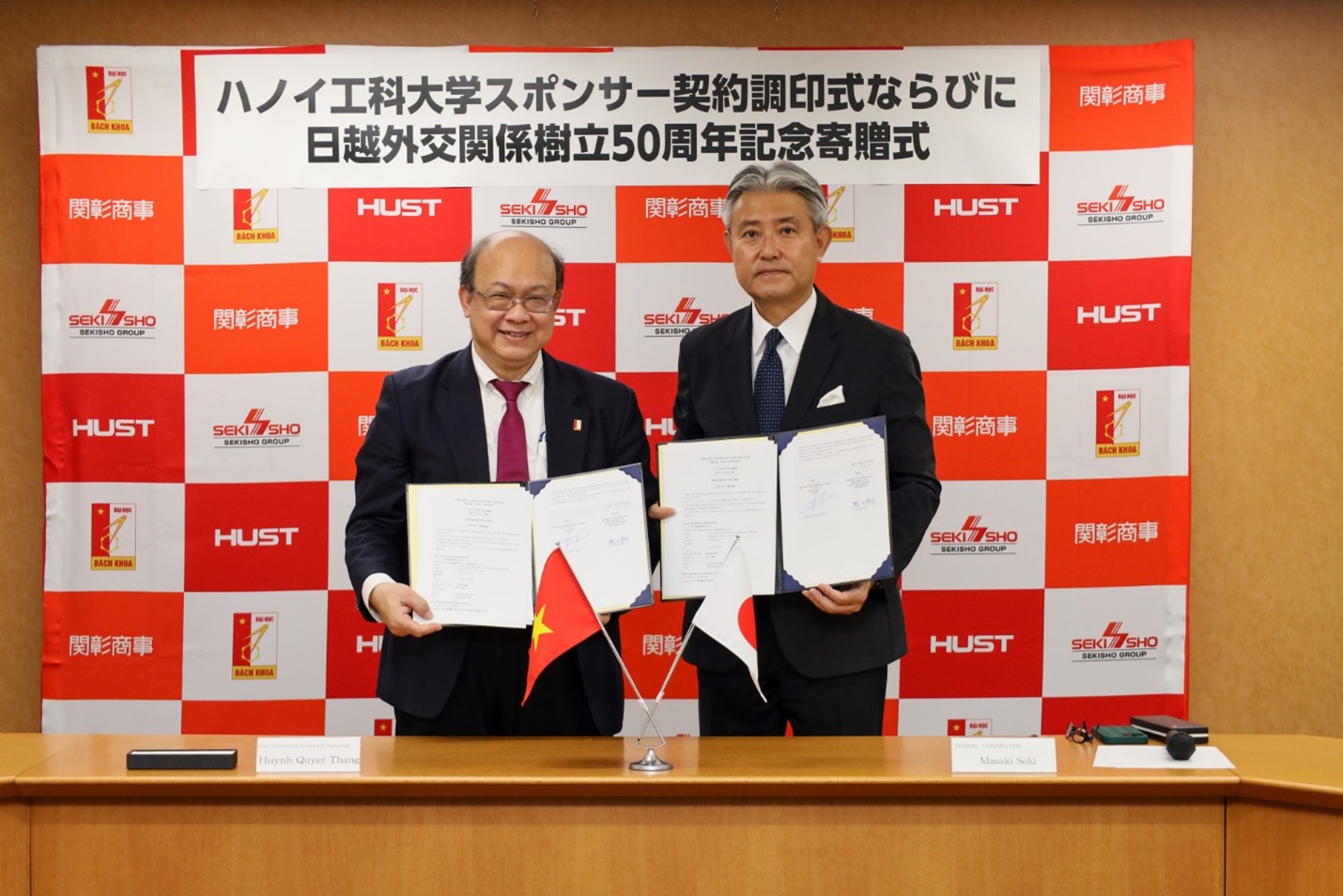
Source: Hanoi University of Science and Technology
Moreover, to widen the accessibility for students from diverse backgrounds, postgraduate education and lifelong learning, Vietnam’s higher education is embracing digital transformation by adopting blended and online learning models. This not only supports flexibility but also enhances resilience during disruptions and equips students with digital competencies relevant to the modern workforce. Well-established digital infrastructure allows better access to international programs, opening wider opportunities for Vietnamese learners[13].
Strategic Implications and Opportunities for Foreign Investors
Across all levels of Vietnam’s education system, some key trends emerge
– Internationalization across education levels: Vietnam’s education system is increasingly integrating international curricula, foreign languages, global standards, and cross-border partnerships, particularly in private and higher education institutions.
– Shift toward quality, innovation, and skills relevance: By introducing STEM in general education and further pronouncing industry-relevant skills in vocational training and higher education, education is becoming more closely aligned with economic modernization and labor market needs.
– Digital transformation and lifelong learning: Blended learning, online education, and digital platforms originally emerged as a solution for disruption, now are expanding to support flexibility, accessibility, and lifelong learning.
– Growing role of private and foreign participation: While public institutions remain dominant, private and foreign-invested schools play a leading role in introducing new models and international practices.
For foreign investors, these trends translate into targeted and differentiated entry opportunities rather than a one-size-fits-all approach.
At the early childhood and general education levels, rapid urbanization, demographic concentration in major cities, and rising household incomes have driven demand for high-quality private and international schools. Foreign-invested institutions offering international curricula benefit from growing interest from both expatriate families and Vietnamese parents seeking global education pathways.
In vocational education and training, Vietnam’s industrialization and participation in global supply chains create strong demand for practice-oriented, industry-aligned skills. Investors can engage through private training institutions, public-private partnerships, or curriculum and certification services that support workforce upskilling in emerging sectors such as advanced manufacturing, logistics, digital technology, and energy transition.
In higher education, the most strategic opportunities lie in long-term collaboration, particularly through partnerships with universities, joint academic programs and research collaboration, such as partnerships with domestic universities on dual-degree programs, joint research and innovation hubs, and Technical and STEM-focused education.
Furthermore, digital platforms and remote instruction are increasingly relevant. They provide learning management and skill certification, suitable for the context of blended and lifelong learning models.
For foreign investors, success also depends on aligning with national development priorities, ensuring regulatory compliance, and delivering internationally benchmarked quality. By combining institutional partnerships, applied research, and digital learning solutions, investors can contribute meaningfully to Vietnam’s education ecosystem while securing sustainable returns.
* If you wish to quote any information from this article, please kindly cite the source along with the link to the original article to respect copyright.
| B&Company
The first Japanese company specializing in market research in Vietnam since 2008. We provide a wide range of services including industry reports, industry interviews, consumer surveys, business matching. Additionally, we have recently developed a database of over 900,000 companies in Vietnam, which can be used to search for partners and analyze the market. Please do not hesitate to contact us if you have any queries. info@b-company.jp + (84) 28 3910 3913 |
[1] Vietnam Government Portal, Decision No. 1981/QĐ-TTg (https://vanban.chinhphu.vn/default.aspx?pageid=27160&docid=187037)
[2] Vietnam Government Portal, Education Law (https://vanban.chinhphu.vn/default.aspx?pageid=27160&docid=197310)
[3] Vietnam Government Portal, Decree No. 86/2018/ND-CP (https://vanban.chinhphu.vn/?pageid=27160&docid=193897)
[4] National Statistics Office, Number of schools, classes, teachers and children of kindergartens as of 30 September(*) by type (https://www.nso.gov.vn/px-web-2/?pxid=V1302&theme=Gi%C3%A1o%20d%E1%BB%A5c)
[5] Znews, 5 notable Montessori schools in Ho Chi Minh City (https://znews.vn/5-truong-montessori-dang-chu-y-tai-tphcm-post1606672.html)
[6] Thanh nien, International integration education: Leveraging students’ strengths. (https://thanhnien.vn/giao-duc-hoi-nhap-quoc-te-phat-huy-the-manh-cua-hoc-sinh-185230808202144983.htm)
[7] Vietnam.vn, Improving the quality of STEM education in general education.(https://www.vietnam.vn/en/nang-cao-chat-luong-giao-duc-stem-trong-giao-duc-pho-thong)
[8] Vietnam Education, Ho Chi Minh City will implement bilingual STEM education in the new school year. (https://giaoduc.net.vn/thanh-pho-ho-chi-minh-se-trien-khai-giang-day-stem-song-ngu-trong-nam-hoc-moi-post253959.gd)
[9] Vietnam.vn, Vocational education in the 4.0 era: Change to achieve breakthroughs.(https://www.vietnam.vn/en/giao-duc-nghe-nghiep-thoi-4-0-thay-doi-de-but-pha)
[10] Vietnam Education, What can be done to boost foreign investment in vocational education? (https://giaoduc.net.vn/lam-gi-de-day-manh-thu-hut-dau-tu-nuoc-ngoai-trong-linh-vuc-giao-duc-nghe-nghiep-post254450.gd)
[11] Vietnam News Agency, University network planning: Establishing national key universities in STEM fields. (https://chinhsachcuocsong.vnanet.vn/quy-hoach-mang-luoi-dai-hoc-xay-dung-cac-truong-trong-diem-quoc-gia-linh-vuc-stem/57225.html)
[12] Hanoi University of Science and Technology, HUST is ready to integrate into the world. (https://hust.edu.vn/vi/news/hoat-dong-chung/bach-khoa-ha-noi-san-sang-hoi-nhap-the-gioi-655665.html)
[13] University of Economics HCMC, Innovation in international accreditation is to assist Vietnamese higher education in keeping up with world trends (https://future.ueh.edu.vn/en/year-en/2025-en/innovation-in-international-accreditation-is-to-assist-vietnamese-higher-education-in-keeping-up-with-world-trends/)
Related article










Sidebar:
SUBSCRIBE NEWSLETTER