

 English
  日本語
日本語  Tiếng Việt
  简体中文
简体中文  한국어
한국어 Market research helps companies move beyond headline figures and design investment strategies that fit Vietnam’s specific market conditions.
30Sep2026
Latest News & Report / Vietnam Briefing
Comments: No Comments.
Vietnam has become one of Southeast Asia’s most attractive investment destinations, supported by strong economic growth, increasing foreign investment, and deeper integration into global supply chains. However, attractive macroeconomic indicators alone do not guarantee investment success. Differences in consumer behavior, competitive dynamics, regulatory implementation, and local business conditions mean that investors need more than country-level data before committing capital. Market research helps companies move beyond headline growth figures, identify realistic opportunities, reduce uncertainty, and design investment strategies that fit Vietnam’s specific market conditions.
Vietnam’s growth story creates opportunities, but also increases investment complexity
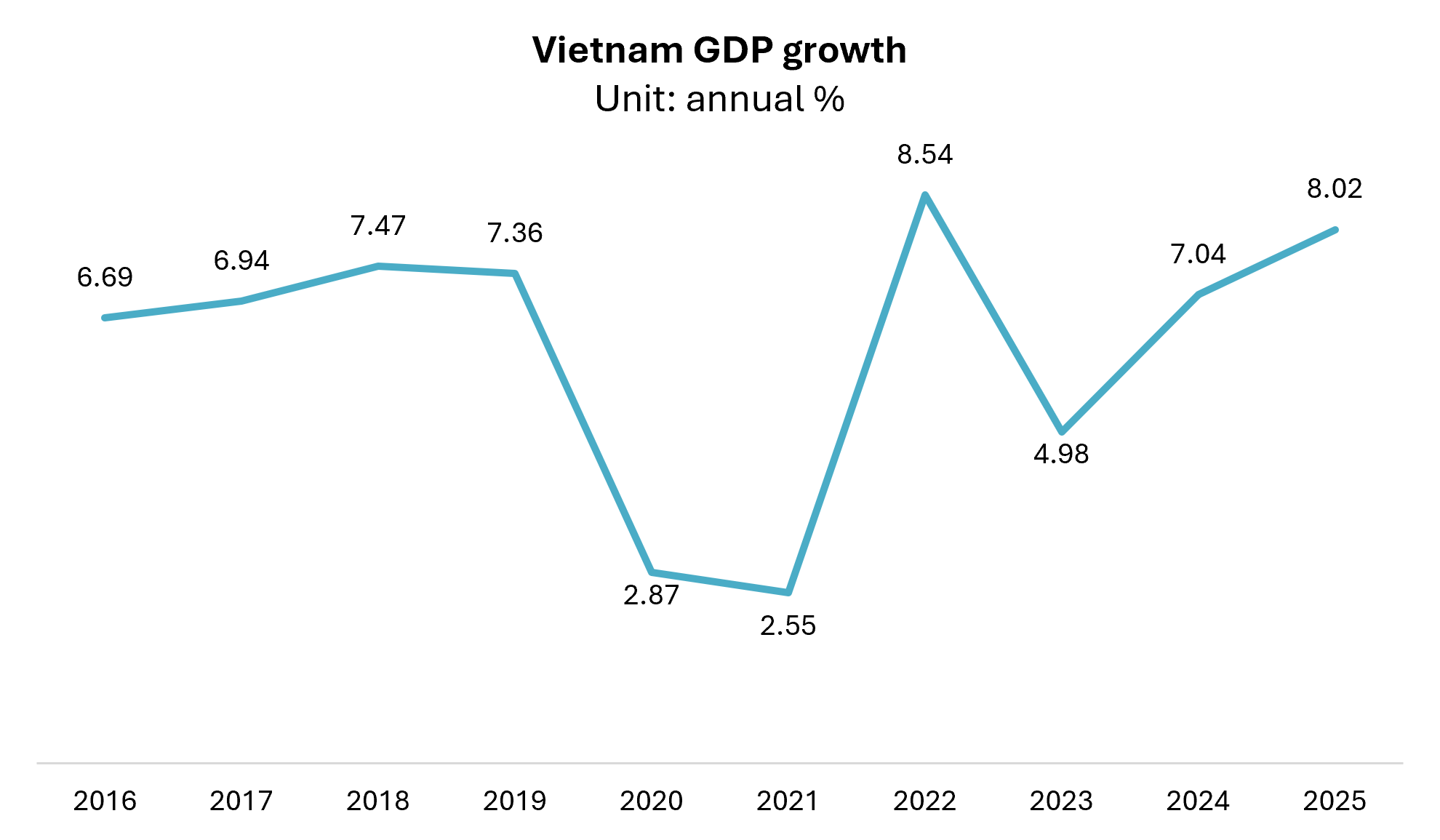
Vietnam has maintained strong economic momentum over the past decade, reinforcing its position as an attractive destination for foreign investment. According to the World Bank’s World Development Indicators, GDP growth remained close to 7% during 2016-2019 before slowing to 2.87% in 2020 and 2.55% in 2021 during the pandemic. The economy then rebounded strongly to 8.54% in 2022 and, after moderating in 2023, accelerated again to 7.04% in 2024 and 8.02% in 2025. [1]
Source: World Bank, World Development Indicators
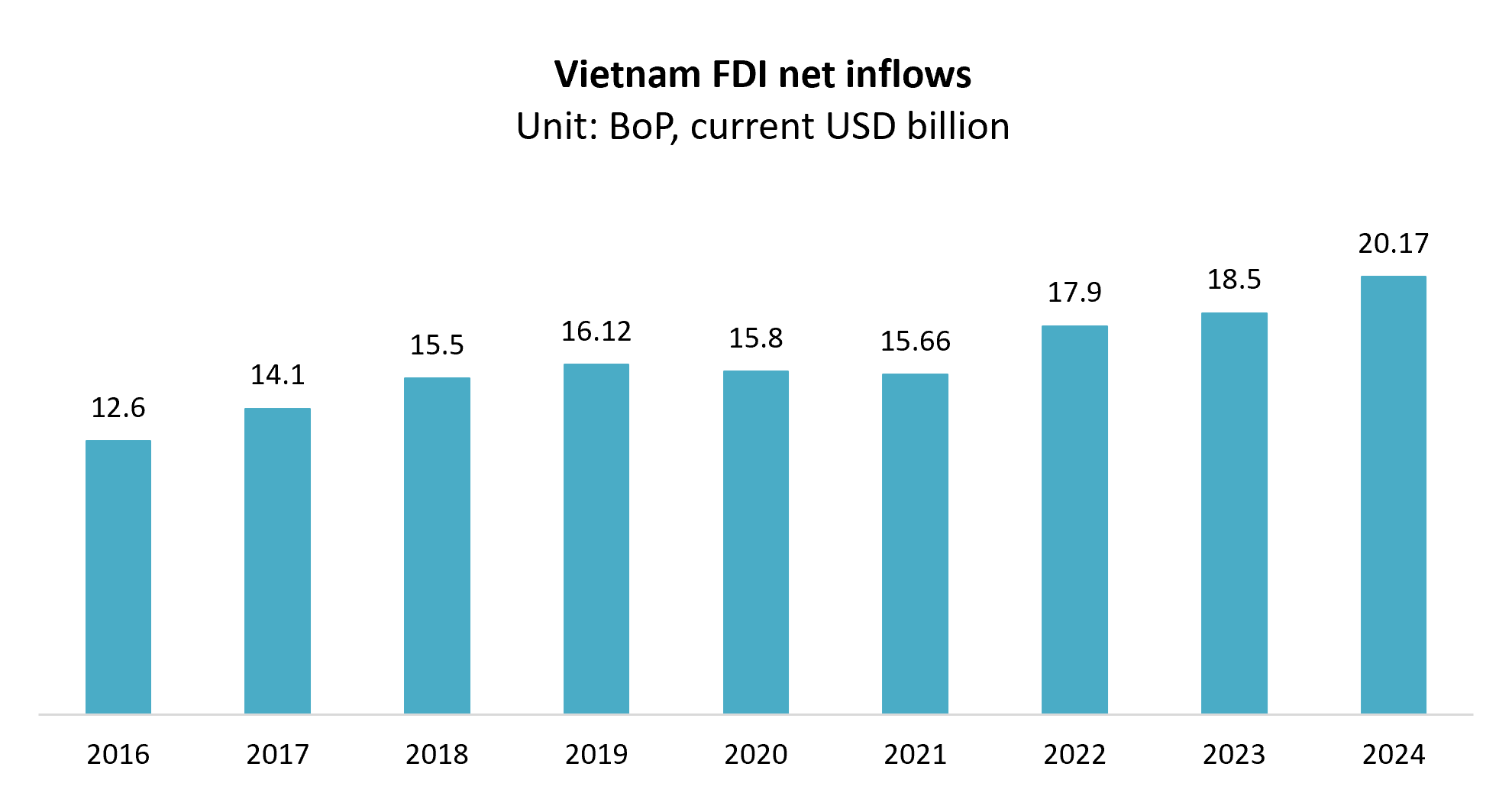
Foreign investment has followed a similarly resilient trend. World Bank data shows that FDI net inflows increased from USD 12.6 billion in 2016 to USD 20.17 billion in 2024. Although inflows fluctuated over the period, including during the pandemic, they remained substantial and reached their highest level in the period shown in 2024. [2]
Source: World Bank, World Development Indicators
For investors, macroeconomic strength should therefore be treated as a starting point rather than proof that a specific investment will succeed. GDP and FDI trends show that Vietnam is attractive at the national level, but they do not reveal which sectors still offer room for entry, which locations provide the best operating conditions, or whether a particular business model can generate sustainable returns.
Why desk research alone is not enough
Vietnam’s strong economic growth and rising foreign investment demonstrate its attractiveness as an investment destination. However, country-level indicators alone cannot explain the factors that determine whether a specific investment will succeed. Companies need deeper local market understanding to evaluate consumer behavior, competitive dynamics, and the practical impact of regulations and business conditions.
Consumer behavior and competitive dynamics cannot be understood from market size alone
Market statistics can show the size and growth of an industry, but they cannot explain how customers make purchasing decisions or how companies compete in practice. Consumer preferences in Vietnam vary significantly depending on product category, income level, region, and purchasing channels.
This gap between market potential and market reality has contributed to challenges faced by several foreign companies entering Vietnam.
Market exits and Competitive lessons
| Brand (Country) | Industry | Exit / Status | Market Research Lesson |
| Baemin (South Korea) | Food Delivery | Exited 2023 | The food delivery market requires careful assessment of competitive intensity, customer acquisition costs, and the ability to achieve sustainable profitability in a market dominated by large platforms. |
| Parkson (Malaysia) | Modern Retail | Bankrupt 2023 | Retail investors need to continuously evaluate changing consumer preferences, store-format suitability, and competition from emerging retail concepts. |
| Auchan (France) | Supermarkets | Exited 2019 | Foreign retailers need to understand local purchasing behavior, price expectations, and existing retail ecosystems before scaling operations. |
Source: B&Company synthesis
What these cases have in common: All three companies had capital, brand recognition, and prior international experience. None of that substituted for local insight into competitive structure (Baemin), format market fit (Parkson), or consumer purchasing behavior (Auchan). Each exit took multiple years and, based on disclosed figures, several million to tens of millions of dollars in accumulated losses before the company acted on what local market conditions were already signaling.
These cases do not indicate a lack of market opportunities in Vietnam. Instead, they highlight that understanding how the market works locally is as important as understanding its overall size.
Business conditions vary significantly by location and require local analysis
National level indicators provide useful context for investors evaluating Vietnam’s overall business environment. However, these indicators cannot fully explain the conditions that affect a specific investment project, as regulatory implementation, infrastructure availability, administrative efficiency, and business support can differ significantly across locations.
The World Bank’s Business Ready (B-READY) 2025 report[3] provides an overview of Vietnam’s business environment across different dimensions. Vietnam achieved relatively strong scores in areas such as utility services, financial services, and business entry, while areas including taxation, dispute resolution, market competition, and business insolvency remain more challenging.
B-READY 2025 Score in Vietnam
Unit: Score (1-100)
| Area | Score | Interpretation |
| Utility Services | 90 | Strong infrastructure and service availability |
| Financial Services | 80 | Relatively developed access to financial services |
| Business Entry | 77 | Investment entry procedures are relatively supportive |
| Labor | 70 | Competitive workforce environment |
| International Trade | 62 | Supports export-oriented investment |
| Business Location | 60 | Location selection remains important |
| Taxation | 59 | Requires detailed tax planning |
| Dispute Resolution | 56 | Legal enforcement requires attention |
| Market Competition | 48 | Competitive pressure remains significant |
| Business Insolvency | 36 | One of the weakest areas |
Source: World Bank Group
Note: Higher scores indicate a more favorable business environment in each area.
However, national-level indicators only provide a broad picture. For investors, the actual feasibility of a project often depends on where the investment is located. Factors such as land access, administrative procedures, transparency, and local business support can vary considerably between provinces.
The Provincial Competitiveness Index (PCI) provides additional insight by measuring differences in provincial business environments. PCI evaluates factors including market entry, land access, transparency, administrative costs, competition, and legal institutions, helping investors assess location-specific conditions before selecting an investment site
Selected PCI Indicators for Investment Location Assessment
Unit: Score (1-10)
| Province | Market Entry | Land Access | Transparency | Administrative Cost | Ranking Group |
| Bac Ninh | 8.20 | 6.09 | 7.07 | 8.93 | Good |
| Hai Phong | 7.53 | 6.44 | 7.43 | 8.66 | Good |
| Dong Nai | 8.05 | 6.20 | 7.07 | 8.35 | Fairly Good |
| Ho Chi Minh City | 7.29 | 6.28 | 6.93 | 7.52 | Fairly Good |
| Hanoi | 6.96 | 6.69 | 6.06 | 7.77 | Average |
Source: Vietnam Chamber of Commerce and Industry (VCCI)
Note: Higher scores indicate more favorable provincial business conditions in each evaluated area. The index is used as a reference for assessing local investment environments.
The differences in PCI scores show why investors need to look beyond national indicators when choosing an investment location. However, even provincial-level data cannot fully explain the conditions affecting a specific project. For example, PCI scores may highlight differences in land access or administrative procedures, but they cannot determine whether suitable industrial land is available for a particular factory or how local requirements will affect its establishment.
This is where market research becomes essential. By combining existing data with interviews, field visits, and industry-specific analysis, investors can assess actual business conditions and identify potential barriers before committing capital.
How market research helps companies
Market research bridges the gap between general market information and practical business decisions. While secondary data provides an overview of market opportunities and business conditions, primary research helps companies verify assumptions and obtain information specific to their products, industries, and investment plans.
Before entering Vietnam, research helps companies assess market potential, understand customer needs, evaluate competitors, identify suitable investment locations, and find potential business partners. For example, interviews with local businesses and relevant stakeholders can help verify information about distribution channels, supplier availability, and practical market-entry requirements that published statistics may not fully capture.
After entering Vietnam, ongoing research helps companies respond to changing consumer preferences, monitor competitors, improve business strategies, and identify new opportunities or partners for expansion.
A practical illustration comes from B&Company’s work with a Japanese tea brand evaluating entry into Vietnam. The company had strong confidence in its premium product quality. However, structured interviews with Vietnamese food and beverage wholesalers surfaced two problems invisible from market size data alone: the tea’s flavor profile was considered too mild for local taste preferences, and its price sat significantly above comparable products already in the market[5]. These helped the company refine its market entry strategy before making a larger investment. Instead of relying only on the assumption that premium quality would generate demand, the company could evaluate different options, including product adaptation, pricing adjustments, and repositioning for a more suitable customer segment.
How B&Company can support investors in Vietnam
Successful market entry requires different types of local understanding at each stage of the investment journey. B&Company supports foreign companies by combining market research expertise, proprietary data, and on-the-ground networks in Vietnam.
| Investment stage | B&Company support |
| Understanding the market before investment | Market research & data analysis: Industry research, consumer research, competitor analysis, quantitative and qualitative research, and interviews with consumers, business leaders, distributors, industry experts, and other local stakeholders. |
| Developing market entry strategy | Market entry & expansion strategy: Feasibility studies, M&A advisory, business due diligence, and support in developing business and marketing plans based on local market conditions. |
| Finding local opportunities and partners | Business matching & partnership support: Partner search, supplier screening, business matching, networking support, and initial partner evaluation using B&Company’s local network and business database. |
| Expanding and operating in Vietnam | Operational support: Local coordination, procedural and administrative support, HR support, and on-site assistance to help companies manage day-to-day business challenges. |
Read more
Manufacturing in Vietnam – A guide to industries, locations and sourcing
* If you wish to quote any information from this article, please kindly cite the source along with the link to the original article to respect copyright.
| B&Company
The first Japanese company specializing in market research in Vietnam since 2008. We provide a wide range of services including industry reports, industry interviews, consumer surveys, business matching. Additionally, we have recently developed a database of over 1,000,000 companies in Vietnam, which can be used to search for partners and analyze the market. Please do not hesitate to contact us if you have any queries. info@b-company.jp + (84) 24 3978 5165 |
References:
[1] https://data.worldbank.org/indicator/NY.GDP.MKTP.KD.ZG?locations=VN
[2] https://data.worldbank.org/indicator/BX.KLT.DINV.CD.WD?locations=VN
[4] https://pcivietnam.vn/report-2025
[1] https://data.worldbank.org/indicator/NY.GDP.MKTP.KD.ZG?locations=VN
[2] https://data.worldbank.org/indicator/BX.KLT.DINV.CD.WD?locations=VN
[3] https://openknowledge.worldbank.org/server/api/core/bitstreams/77ab6e06-9934-435c-a84e-03a4c99bbe48/content
[4] https://pcivietnam.vn/report-2025
[5] https://b-company.jp/how-bcompany-helps-food-and-beverage-businesses-succeed-in-vietnam-a-japanese-tea-case-study/
Related article












滋賀県ベトナムビジネス・サポートデスク-12.jpg)

















Log in / Register
SUBSCRIBE NEWSLETTER