

 English
  日本語
日本語  Tiếng Việt
  简体中文
简体中文  한국어
한국어 Vietnam's solar cell manufacturing market is witnessing a significant transformation, largely driven by foreign investments.
06Mar2025
Latest News & Report / Vietnam Briefing
Comments: No Comments.
Vietnam’s solar cell manufacturing market is witnessing a significant transformation, largely driven by foreign investments. With a growing demand for renewable energy solutions, Vietnam is positioning itself as a key player in the solar energy sector in Southeast Asia. This article examines the situation of the solar cell manufacturing market and recent investment activities, particularly focusing on Japan-invested companies.
The Rise of Solar Energy in Vietnam
Vietnam is undergoing a significant transition towards renewable energy as it moves away from fossil fuels dependency. Under the Power Development Plan VIII (PDP8), the country aims to reduce its reliance on fossil fuels while dramatically increasing the share of renewable energy in its power generation mix. In 2023, the total capacity of renewable energy sources in Vietnam was about 22 GW (accounting for 27%) of the total power source capacity [1]. Of which, wind power is 5 GW [2], solar power is 16.5 GW, biomass power is 0.4 GW [3]. By 2030, Vietnam targets renewables to account for over 50% of its total power capacity, with further expansion planned to reach nearly 70% by 2050 [4]. This shift is essential for meeting the nation’s commitment to achieving net-zero carbon emissions by mid-century. Among the various renewable sources, solar power has emerged as a key driver of this transformation.
Vietnam’s power sources by types in 2023
100%= 80.7 gigawatt
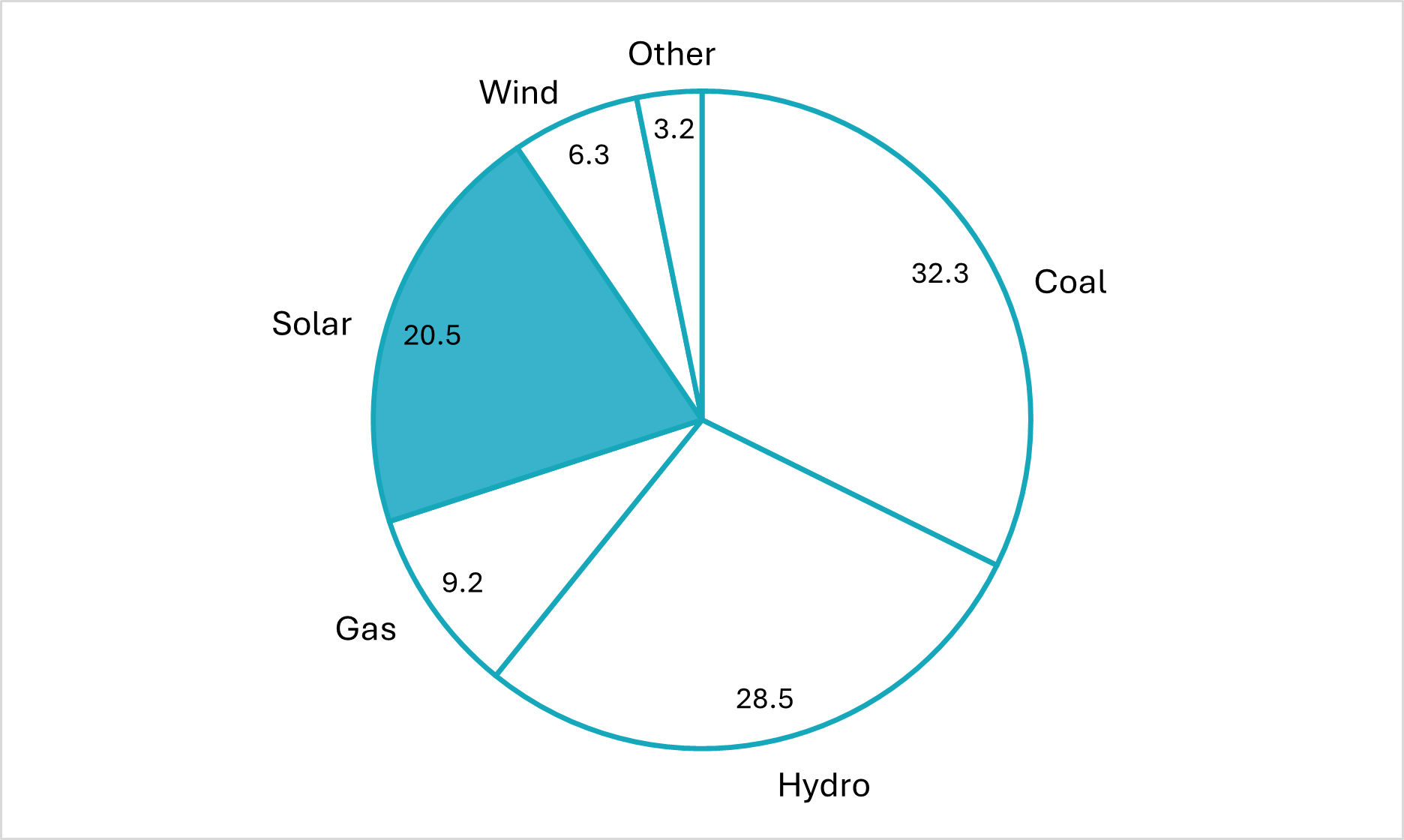
Source: vneconomy
Vietnam’s solar energy sector has experienced exponential growth in recent years, positioning the country as a major player in the global renewable energy landscape. In 2018, solar power generation was almost negligible, but government incentives such as feed-in tariffs and tax benefits spurred rapid investment. By the end of 2023, the total solar power capacity in Vietnam will reach about 16.6 GW, of which rooftop solar power accounts for more than 9 GW, contributing about 20.5% to the country’s total electricity. [5]. Looking ahead, PDP8 outlines plans to increase solar capacity to 34 GW by 2030, with projections reaching 189 GW by 2050. These ambitious targets highlight the immense growth potential of Vietnam’s solar power industry and, by extension, the solar cell manufacturing market.
As demand for solar energy continues to rise, Vietnam is also seeing increased solar panel production and installation. The country’s strategic location, abundant sunlight, and strong government backing make it an attractive destination for solar manufacturing investments. With expanding domestic and international demand, Vietnam has the opportunity to become a regional hub for solar panel and solar cell production, further reinforcing its role in the global renewable energy transition.
Main players in Vietnam’s solar cell manufacturing market
| Company Name | Country of origin | Main business activities | Factory Location |
| Trina Solar | China | · Manufacturing photovoltaic (PV) products, including wafers, solar cells, and modules. | Bac Giang Province
Thai Nguyen Province |
| JA Solar | China | · Production of solar cells, modules, and other PV products. | Bac Giang Provine
|
| Vinasolar | China | · Production of solar modules and photovoltaic cells. | Bac Giang Provine |
| First Solar | USA | · Manufacturing thin-film solar modules. | Ho Chi Minh city |
| Canadian Solar | Canada | · Manufacturing solar photovoltaic modules and provision of battery energy storage solutions. | Hai Phong City |
In general, China currently dominates Vietnam’s solar cell manufacturing market. These companies have positioned Vietnam as a key manufacturing hub, benefiting from the country’s favorable investment policies and growing demand for renewable energy.
Most solar cell factories in Vietnam are concentrated in the northern part of Vietnam particularly Bac Giang Province, where companies like Trina Solar, JA Solar, Vina Solar operate large-scale production facilities.
Related article


































Log in / Register
Continue without an account
Log in / Register
SUBSCRIBE NEWSLETTER