

 English
  日本語
日本語  Tiếng Việt
  简体中文
简体中文  한국어
한국어 Vietnam has emerged as one of the fastest–growing AI markets in Southeast Asia, ranking 5th in ASEAN in AI readiness with a score of 54.5.

22Jan2026
Latest News & Report / Vietnam Briefing
Comments: No Comments.
Vietnam has emerged as one of the fastest–growing AI markets in Southeast Asia, ranking 5th in ASEAN in AI readiness with a score of 54.5 according to Oxford Insights. Over the year, the market experienced a strong transition from AI experimentation toward practical and commercial execution, supported by two key forces: the arrival of high-quality foreign direct investment (FDI) in AI research and development, and the Government’s efforts to standardize and regulate AI and data usage.
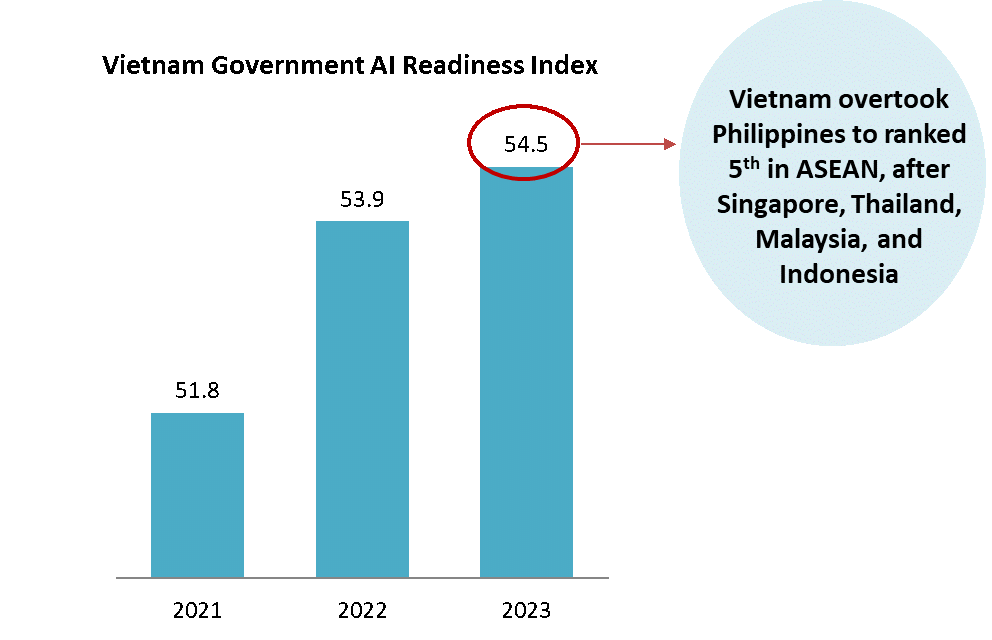
Source: Oxford Insights
Major milestones in 2025 included Qualcomm’s deepened AI R&D presence, the expansion of SAP Labs Vietnam into a regional AI hub, the passage of the Personal Data Protection (PDP) Law, and the approval of Vietnam’s first AI Law. These developments proved that Vietnam is ready to shift toward an AI–focused ecosystem with more opportunities for foreign investors.
Market Context & Domestic Status
Market Size and Growth Outlook
By 2024, Vietnam’s AI market was valued at approximately USD 0.75 billion and is widely expected to reach around USD 2.0 billion by 2030, implying a compound annual growth rate (CAGR) of roughly 15% from 2025 onward. This growth has been driven by increasing business digitalization, expanding e-government initiatives, and the steady advancement of domestic technology capabilities.
Business AI Adoption in Vietnam
Based on the Vietnam AI Adoption Status and IT Hiring Insight 2025 report by ITviec, AI adoption at the enterprise level in Vietnam has moved firmly into the mainstream. By 2025, 73% of Vietnamese companies had adopted AI in some form, confirming that AI has been widely applied across industries. However, the adoption rate is still fluctuating, as only 13.8% of firms had deployed AI at scale, while the majority were still operating at pilot or limited-production stages. Despite strong adoption momentum, companies still need more time and experience to expand their application of AI into their core business strategy. Only 36.5% of companies had a documented AI strategy, while talent shortages represented the most critical constraint (46.4% of companies lacked sufficient internal AI skills).
Against these limitations of enterprises’ AI readiness, 2025 marked a significant year for transition, characterized by the convergence of high-quality foreign investment and decisive government action to standardize Vietnam’s AI landscape.
2025 Timeline: A Year of Transformation
Q1/2025 – Standardization and Early Trust-Building
In March–April 2025, Vietnam’s Ministry of Science and Technology (MOST) initiated the evaluation and ranking of Vietnamese large language models. This marked one of the Government’s first concrete steps toward setting technical benchmarks for domestic AI systems.

Related article





































Log in / Register
Continue without an account
Log in / Register
SUBSCRIBE NEWSLETTER