

 English
  日本語
日本語  Tiếng Việt
  简体中文
简体中文  한국어
한국어 Since resuming ODA to Vietnam in 1992, Japan has built one of the most consistent and multi-layered investment relationships in the country.
13Aug2026
Latest News & Report / Vietnam Briefing
Comments: No Comments.
Since resuming Official Development Assistance (ODA) to Vietnam in 1992, Japan has built one of the most consistent and multi-layered investment relationships in the country, evolving from public infrastructure financing into a diversified partnership spanning manufacturing, energy, finance, retail and, increasingly, high-technology cooperation. This article organizes the current state of that relationship into four analytical pillars — (1) institutions and the investment environment, (2) infrastructure and energy, (3) human capital, and (4) operating enterprises — and closes with an assessment and set of recommendations grounded in the gaps identified within each pillar.
Institutions and investment environment
Japan’s engagement with Vietnam was built on a government-to-government foundation. Between 1992 and 2012, Vietnam received approximately JPY 2,084 billion in Japanese ODA, creating institutional and physical conditions that later supported private investment[1]. By 31 March 2026, Japanese investors operated 5,760 active projects in Vietnam with cumulative registered capital of about USD 79 billion, ranking third among 154 investing countries and territories[2].
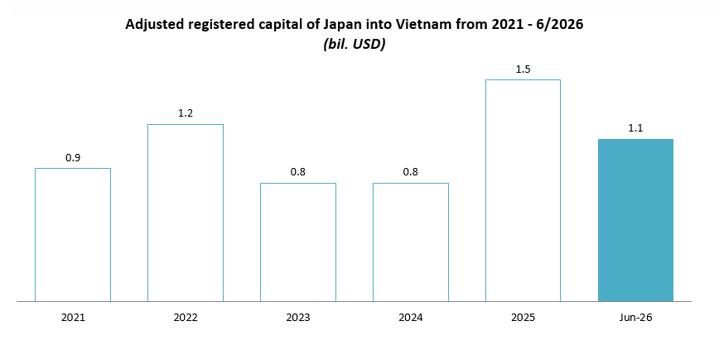
Source: NSO — Adjusted registered capital of Japan into Vietnam, 2021–6/2026
Reinvestment into existing projects has grown from USD 0.8 billion in 2024 to USD 1.5 billion in 2025, with a further USD 1.1 billion added in the first half of 2026, showing that Japanese firms are deepening rather than merely maintaining their presence. This is corroborated by the JETRO Survey 2025, in which 56.9% of Japanese companies in Vietnam said they plan to expand operations over the next one to two years, the highest share in ASEAN for a second consecutive year, while only 4.2% planned to downsize and 0.7% considered relocating[3].
The institutional relationship was formally upgraded during Japanese Prime Minister Takaichi Sanae’s official visit to Vietnam in May 2026, when both governments agreed to organize future cooperation around four strategic pillars: (1) high-tech industries and a new growth model, (2) energy security and strategic infrastructure, (3) diplomacy and security, and (4) people-to-people exchanges. Pillar 3 specifically commits both governments to sustained high-level dialogue aimed at building a predictable, secure environment for resilient supply chains, critical technologies, and regional stability[4].
However, the operating environment still carries friction that the institutional framework has not fully resolved. According to the JETRO Survey 2025, administrative procedures remain the top concern for Japanese firms — companies cite increasingly complex licensing and approval processes, frequent regulatory changes, inconsistent implementation across local authorities, and delays in work permits and VAT refunds. 58.7% of respondents considered Vietnam’s legal system incomplete or insufficiently transparent[5].
Infrastructure & Energy
In the earlier stages of the relationship, Vietnam–Japan cooperation centered heavily on public infrastructure. Between 1992 and 2012, Japan provided approximately JPY 2,084 billion in ODA, with 43% allocated to transport infrastructure — funding landmark projects such as National Highways No.5, No.10 and No.18, Hai Phong Port Rehabilitation, and the Saigon East–West Highway, alongside smaller allocations to healthcare, water and environment, mining, and agriculture[6].
The current phase extends this foundation into energy transition and strategic infrastructure under Pillar 2 of the May 2026 framework. Japan proposed upgrading the Asia Zero Emission Community (AZEC) into AZEC 2.0 to expand regional cooperation on decarbonization and energy security, introduced the POWERR Asia (Asia Energy and Resource Supply Chain Resilience Partnership) initiative to strengthen regional supply chain resilience, and committed USD 10 billion in loans to support Asian countries facing rising energy costs[7].
| Area | Current position | Direction / target |
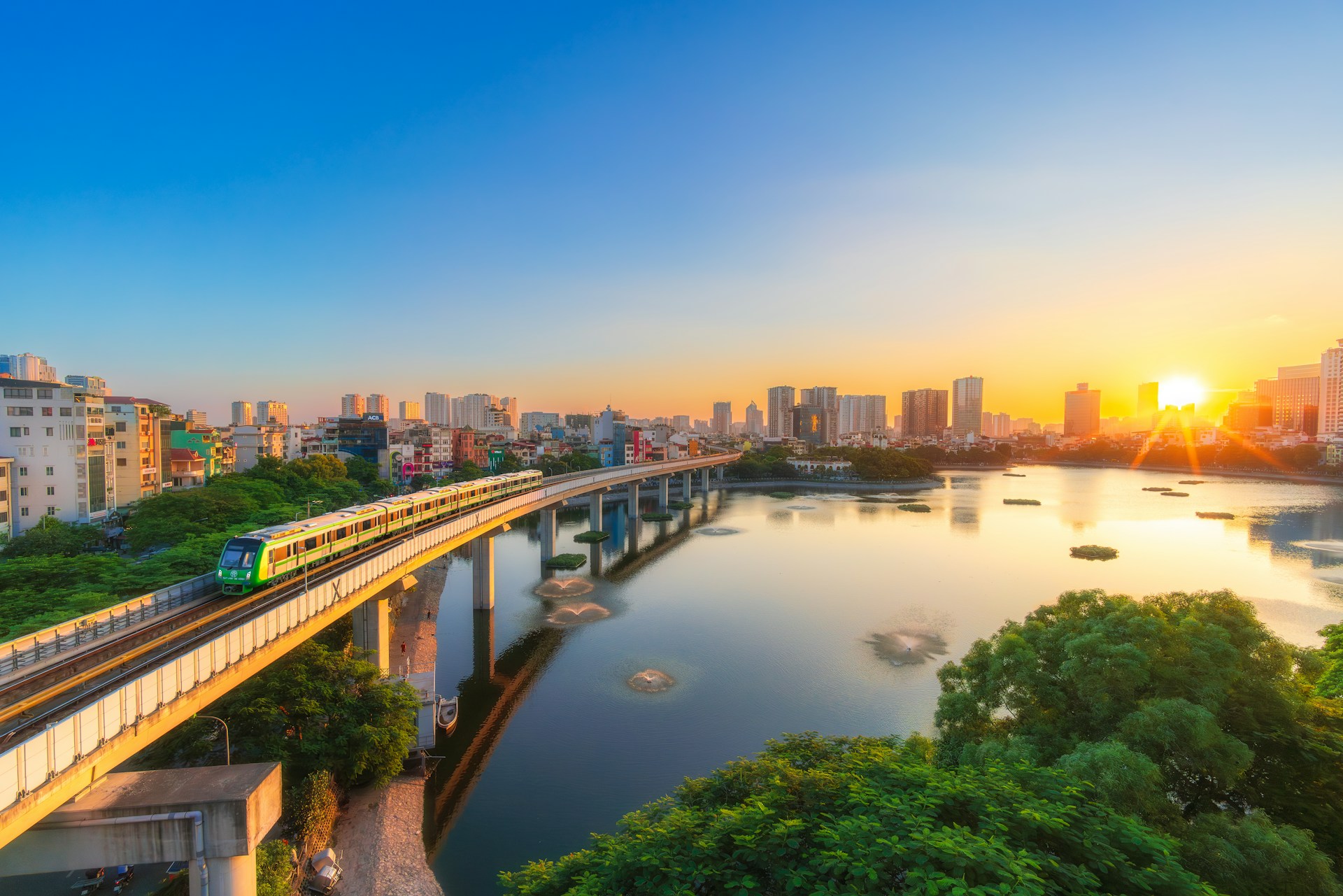
| Urban rail | – HCMC Metro Line 1, largely financed by JICA, entered commercial operation in December 2024[8].
– Japan has also supported Hanoi Metro Line 2, although implementation has faced prolonged delays[9]. |
Move from individual ODA-funded lines toward integrated urban transport networks, with stronger project preparation and land-clearance capacity. |
| Industrial development | Sumitomo is expanding from industrial parks into large-scale urban development, including North Hanoi Smart City and new or expanded industrial-park projects in several provinces[10]. | Link industrial parks with logistics, utilities, green infrastructure and urban services rather than developing isolated production sites. |
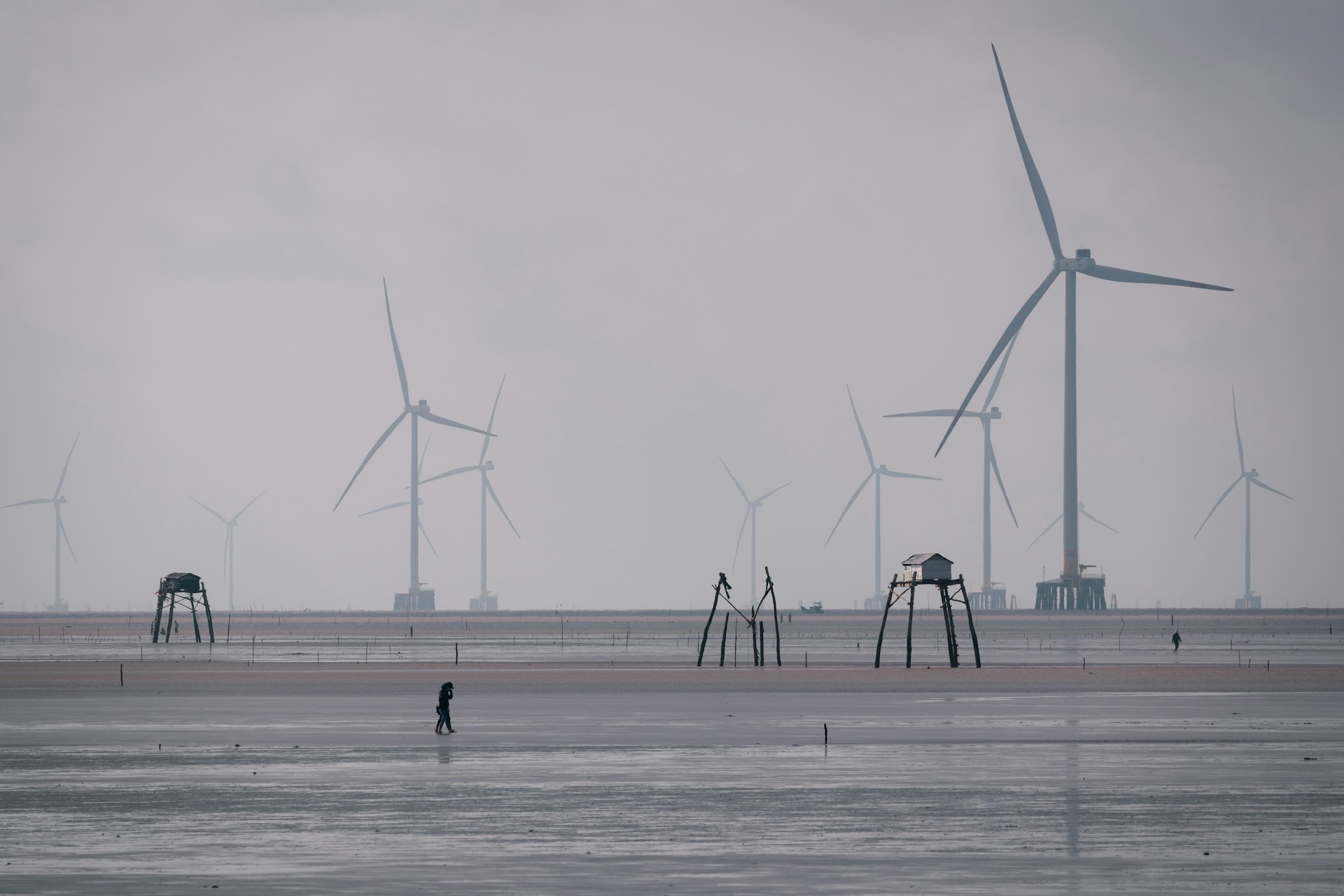
| Clean energy | Japanese institutions and companies have discussed a portfolio of renewable energy, grid, semiconductor and data-center projects under AETI/AZEC-related cooperation[11]. | Develop a clearer pipeline of bankable renewable-energy, grid-modernization and decarbonization projects that can absorb Japanese capital and technology. |
B&Company’s synthesis
Investment is moving to integrated, large-ticket projects: recent flagship investments (North Hanoi Smart City, Sumitomo’s expanding industrial-park portfolio) combine urban development, industrial parks and green infrastructure within single multi-billion-dollar projects, consistent with the four-pillar framework’s “new growth model” direction — with Sumitomo emerging as the most active single Japanese infrastructure investor across several provinces at once.
Human capital
As Japanese investment has moved toward higher-value activity, workforce quality has become the binding constraint. 48.2% of Japanese companies reported difficulties recruiting qualified employees in the JETRO Survey 2025[12].
At the Vietnam–Japan Government–Business Dialogue in July 2026, the Japanese Chamber of Commerce and Industry in Vietnam (JCCI) highlighted a growing shortage of experienced engineers, maintenance specialists and quality management professionals needed to support higher-value industries such as electronics and semiconductors, alongside limited local supplier technology capabilities and R&D depth[13].
Existing cooperation channels are already in place to address this: institutions such as Vietnam Japan University have been positioned to build long-term technological capacity, and joint initiatives include training semiconductor experts and joint research projects between the two countries[14].
Beyond Vietnam Japan University, both governments have launched targeted programs in recent years to achieve the goal of developing in technology, semiconductor, and AI sectors:
| Project | Sponsor | Recent Detail | Focus |
| NEXUS Program (Japan–ASEAN Science, Technology & Innovation Cooperation) | Government of Japan | Announced during the Japanese PM’s 2025 visit; Japan to accept 250 Vietnamese PhD candidates; ~USD 100m total budget for 2024–2029 across ASEAN[15]. | Semiconductor R&D talent, doctoral-level training |
| Vietnam–Japan Joint Semiconductor Research Tasks | Ministry of Science & Technology (Vietnam) with Japanese universities | 5 joint research tasks approved and launched Jul 2026, pairing VNU-HCM with Japan’s University of Electro-Communications (UEC), and Hanoi National University of Education with Hiroshima University[16]. | 3D integrated circuits, AI chips, sensors — joint university-to-university R&D |
B&Company’s synthesis
Operating enterprises
Japanese enterprise activity in Vietnam is concentrated in four sectors that were built up sequentially over three decades:
| Sector | Representative Investment | Entry Year | Contribution |
| Manufacturing | Toyota Vietnam | 1995 | One of Vietnam’s earliest automotive manufacturing bases; developed local supplier networks[17]. |
| Honda Vietnam | 1996 | Expanded motorcycle and automobile production; grew supporting industries[18]. | |
| Thang Long Industrial Park | 1997 | Attracted Japanese manufacturers; strengthened industrial clustering in northern Vietnam[19]. | |
| Canon Vietnam | 2001 | Developed Vietnam into a global production hub for printers and imaging products[20]. | |
| Panasonic Vietnam | 2005 | Expanded electronics manufacturing and technology transfer[21]. | |
| Energy | Nghi Son 2 Thermal Power Plant | 2013 | Increased power generation capacity, supported industrial development[22]. |
| Van Phong 1 BOT Thermal Power Plant | 2018 | Strengthened electricity supply in south-central Vietnam[23]. | |
| Retail | AEON Vietnam | 2011 | Accelerated modernization of Vietnam’s retail market[24]. |
| Finance | MUFG – VietinBank strategic partnership | 2013 | Strengthened banking cooperation, improved access to long-term corporate financing[25]. |
| Mizuho – Vietcombank strategic partnership | 2011 | Supported corporate banking services and Japanese business expansion[26]. | |
| SMBC – FE Credit / VPBank cooperation | 2021 | Expanded consumer finance and diversified financial services[27]. |
B&Company’s synthesis
Despite the increasing emergence of the Japanese private sector in Vietnam, the competitive pressure on this base is rising. Domestic Vietnamese companies are now the main competitors for Japanese firms across most sectors, followed by Japanese, Chinese, and South Korean companies. In manufacturing specifically, the share of Japanese manufacturers identifying Chinese companies as their main competitor increased from 24.6% in 2024 to 30.8% in 2025[28]. Local supply chain integration also remains shallow relative to the scale of Japanese FDI. JCCI noted in July 2026 that local supplier participation in Japanese supply chains remains limited despite growing demand for local procurement, identifying materials, components, precision manufacturing and specialized industrial services as the sectors with the strongest growth potential, contingent on stronger local technology capability, quality certification and R&D[29].
Recommendations
Across all four pillars, strategic ambition (formalized in the May 2026 framework) is running ahead of on-the-ground implementation. Building on the analysis above, the following recommendations are addressed directly to Japanese investors and companies operating in or entering Vietnam:
– Institutions & Investment Environment: with 58.7% of Japanese firms still flagging legal-system opacity despite strong expansion intent, investors should front-load regulatory due diligence and engage early through the Pillar 3 government-to-government dialogue channel to lock in predictable terms — particularly for projects in the strategic sectors (semiconductors, AI, energy transition) most likely to receive fast-track treatment.
– Infrastructure & Energy: given 17-18-year delivery timelines on urban rail and an as-yet-undecided technology partner for the North–South High-Speed Railway, investors should prioritize phased, bankable sub-projects aligned with AZEC 2.0/POWERR Asia financing over long-horizon megaproject bids, and move early on industrial-park-linked urban development — following Sumitomo’s model — before competitors secure the best sites.
– Human Capital: since the skills shortage is concentrated in engineers and quality-management roles rather than labor supply generally, investors should co-invest directly in talent pipelines — scholarships, joint research, technical training — tied to their own hiring needs, rather than relying solely on government programs like NEXUS.
– Operating Enterprises: with Chinese competitors’ share rising from 24.6% to 30.8% and local supplier depth still shallow, investors should deepen local-content integration and help Vietnamese SME suppliers reach Japanese quality-certification standards — both to build resilient local supply chains and to defend market position on quality rather than cost alone.
Read more
Japanese FDI in Vietnam 2025: Highest profit outlook in 15 years – Is expansion next?
Investment from Japan to Vietnam in Energy Sector: Current Situation and Prospects
[1] https://www.vietnamplus.vn/dau-an-oda-nhat-ban-tai-cac-du-an-giao-thong-cho-viet-nam-post287210.vnp
[2] https://theinvestor.vn/japanese-fdi-in-vietnam-from-manufacturing-hub-to-strategic-capital-flows-d18967.html
[3] https://en.vneconomy.vn/vietnam-remains-attractive-to-japanese-investment.htm
[4] https://nhandan.vn/thuc-day-hop-tac-viet-nam-nhat-ban-tren-4-tru-cot-chinh-post958820.html
[5] https://en.vneconomy.vn/vietnam-remains-attractive-to-japanese-investment.htm
[6] https://www.vietnamplus.vn/dau-an-oda-nhat-ban-tai-cac-du-an-giao-thong-cho-viet-nam-post287210.vnp
[7] https://nhandan.vn/thuc-day-hop-tac-viet-nam-nhat-ban-tren-4-tru-cot-chinh-post958820.html
[8] https://www.vietnamplus.vn/cong-bo-van-hanh-chinh-thuc-tuyen-metro-so-1-ben-thanh-suoi-tien-post1003529.vnp
[9] https://vneconomy.vn/ha-noi-thuc-day-hop-tac-voi-nhat-ban-ve-duong-sat-do-thi-va-phat-trien-xanh.htm
[10] https://nhadautu.vn/sumitomo-khoi-cong-du-an-hon-115-trieu-usd-o-thanh-hoa-d103447.html
[11] https://kinhtemoitruong.vn/nhat-ban-dau-tu-20-ty-usd-vao-cac-du-an-nang-luong-sach-tai-viet-nam-97012.html
[12] https://en.baochinhphu.vn/viet-nam-japan-issue-joint-statement-111250428165526902.htm
[13] https://nhadautu.vn/doanh-nghiep-viet-con-mo-nhat-trong-chuoi-cung-ung-fdi-d106407.html
[14] https://nhandan.vn/thuc-day-hop-tac-viet-nam-nhat-ban-tren-4-tru-cot-chinh-post958820.html
[15] https://mst.gov.vn/bo-khcn-thuc-day-hop-tac-viet-nam-nhat-ban-trien-khai-5-nhiem-vu-nghien-cuu-ban-dan-197260722170853066.htm
[16] https://mst.gov.vn/bo-khcn-thuc-day-hop-tac-viet-nam-nhat-ban-trien-khai-5-nhiem-vu-nghien-cuu-ban-dan-197260722170853066.htm
https://vnexpress.net/trien-khai-5-nhiem-vu-nghien-cuu-ban-dan-viet-nam-nhat-ban-5068758.html
[17] https://30years.toyota.com.vn/hanh-trinh-phat-trien
[18] https://www.honda.com.vn/gioi-thieu/gioi-thieu-honda-viet-nam
[19] https://tlipgroup.com/vi/trang-chu/
[20] https://cvn.canon/vn/basicinfor.html
[21] https://www.panasonic.com/vn/corporate/profile/history.html
[22] https://nghison.evn.vn/d4/news/Du-an-Nha-may-nhiet-dien-Nghi-Son-2-Da-chon-mat-gui-vang–1-14.aspx
[23] https://nangluongvietnam.vn/dong-tho-du-an-nhiet-dien-van-phong-1-sau-12-nam-cho-doi-23268.html
[24] https://corp.aeon.com.vn/trang-chu/cong-ty-aeon-viet-nam/
[25] https://www.vietinbank.vn/vietinbank-va-mufg-bank-ky-niem-10-nam-hop-tac-chien-luoc-20230524085900-00-html
[26] https://baochinhphu.vn/vietcombank-va-ngan-hang-mizuho-ky-thoa-thuan-hop-tac-chien-luoc-10293491.htm
[27] https://vietnamnet.vn/3-thuong-vu-dinh-dam-cua-smbc-truoc-khi-vao-vpbank-ket-qua-ra-sao-2125414.html
[28] https://en.baochinhphu.vn/viet-nam-japan-issue-joint-statement-111250428165526902.htm
[29] https://nhadautu.vn/doanh-nghiep-viet-con-mo-nhat-trong-chuoi-cung-ung-fdi-d106407.html
Related article















Log in / Register
SUBSCRIBE NEWSLETTER