

 English
  日本語
日本語  Tiếng Việt
  简体中文
简体中文  한국어
한국어 Vietnam is undergoing a strategic transformation of its political system aimed at streamlining the government apparatus.
10Apr2025
Latest News & Report / Vietnam Briefing
Comments: No Comments.
Vietnam is undergoing a strategic transformation of its political system aimed at streamlining the government apparatus, enhancing administrative efficiency, and reinforcing transparency. This reform initiative is part of a broader vision to modernize the government functions and adapt to new economic and global realities. As Vietnam strengthens its institutional framework, the country is positioning itself as a stable and attractive destination for long-term investment.
Overview of Vietnam’s Political System
Currently, Vietnam has five main state-governing bodies: the National Assembly, the President, the Government, the Supreme People’s Court, and the Supreme People’s Procuracy. Among these, the National Assembly holds the highest level of authority, followed by the Government and the remaining institutions.
Vietnam’s Government Organizational Structure for the 2021–2026 Term
| Institution | Head of Institution | Title |
| National Assembly | Trần Thanh Mẫn | Chairman |
| State President | Lương Cường | President |
| Government | Phạm Minh Chính | Prime Minister |
| Supreme People’s Court | Lê Minh Trí | Chief Justice |
| Supreme People’s Procuracy | Nguyễn Huy Tiến | Prosecutor General |
Source: Thuvienphapluat
In addition to the main governing bodies, Vietnam’s central government structure consists of 22 ministries and ministry-level agencies, along with 8 other entities that report directly to the government. While responsible for managing national activities, this large number of agencies, often with overlapping regulations, created significant problems for both citizens and businesses[1].
Government Moves to Streamline the Political System
In the Sixth Plenary Session of the 12th Central Committee of Vietnam in 2017, the government presented a proposal for the first time with the goal of streamlining state apparatuses from the government to province levels. This initiative aims to enhance the management, operation, and development of the country. At the same time, the session also introduced the directive, Resolution No. 18 – NQ/TW, which sets the objective for the period from 2021 to 2030 for Vietnam to streamline the political system’s structure[2].
At the ministry level, on December 6th, 2024, the Vietnamese government issued Plan No. 141/KH-BCĐTKNQ18: Orientation for arranging and streamlining the organizational structure of the government. The plan aims to reduce the structure to 14 ministries and 3 ministry-level agencies (reduction of 5 entities) and 5 agencies attached to the Government (a reduction of 3 such agencies). It also mandates significant personnel adjustments, targeting a downsizing of the state workforce by over 22,000 positions. Additionally, in the first quarter of 2025, the plan has eliminated 13 general departments and equivalent organizations, 519 departments and equivalent organizations, 219 divisions and equivalent units, and 3,303 sub-departments and similar entities[3].
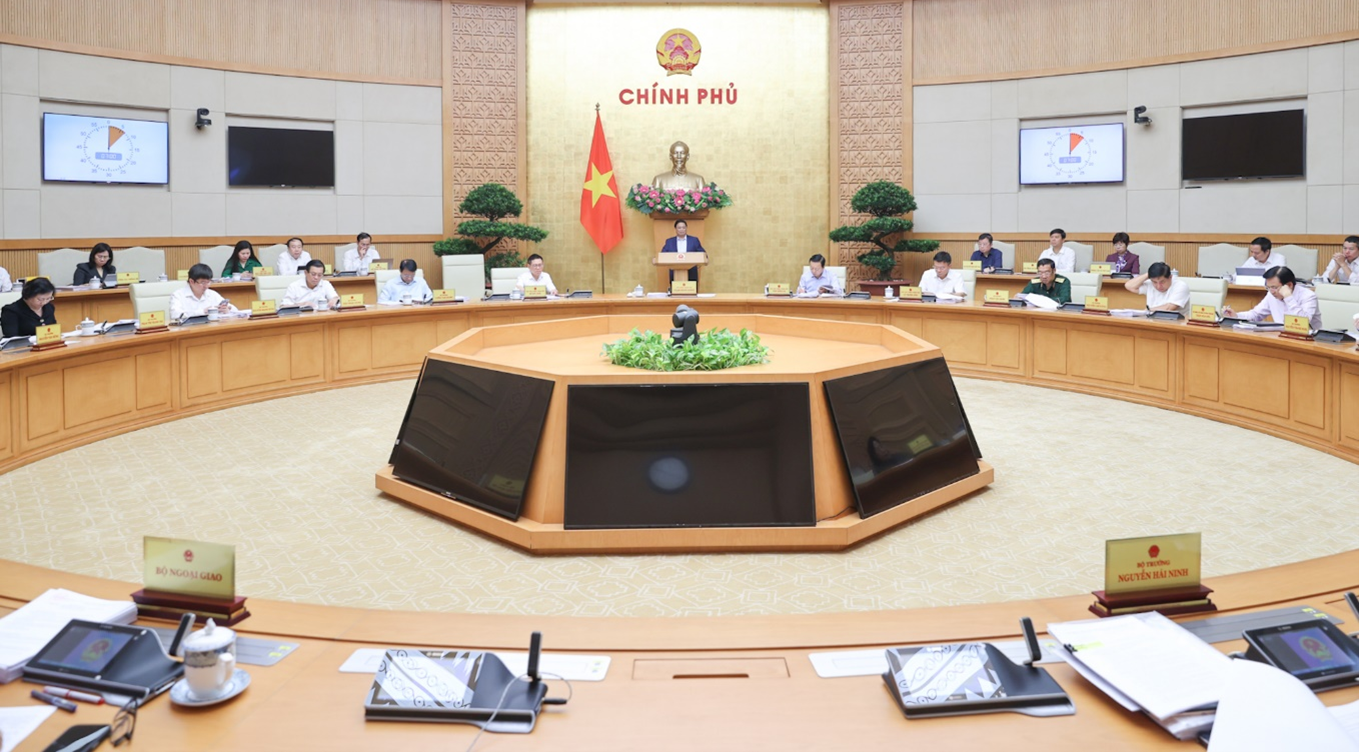
The regular Government meeting in October 2024
Related article










Log in / Register
Continue without an account
Log in / Register
SUBSCRIBE NEWSLETTER