

 English
  日本語
日本語  Tiếng Việt
  简体中文
简体中文  한국어
한국어 Vietnam’s semiconductor industry is on a growth trajectory, supported by government initiatives, rich in resources and a vast amount of labor forces. While still in the early stages of development, the industry is gradually establishing itself as a key player in the global supply chain
27Feb2025
Latest News & Report / Vietnam Briefing
Comments: No Comments.
Vietnam’s semiconductor industry is on a growth trajectory, supported by government initiatives, rich in resources and a vast amount of labor forces. While still in the early stages of development, the industry is gradually establishing itself as a key player in the global supply chain.
Overview of Semiconductor Industry in Vietnam
Vietnam’s semiconductor industry is on a strong growth trajectory. The semiconductor market is projected to reach a revenue of 21 billion USD in 2025, marking an 18% increase from 2024 and an impressive 49% growth over the past five years. The market is expected to continue expanding at a CAGR of 10% from 2025 to 2029, ultimately reaching a total value of 31 billion USD by 2029[1].
Revenue of semiconductor industry in Vietnam
Unit: Billion USD
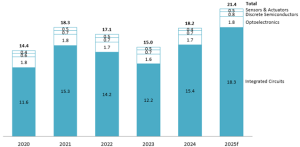
Source: Statista
Vietnam has significant opportunities to develop semiconductor supply chain. The government has introduced various support policies to facilitate semiconductor businesses. The latest is Decision No. 1018/QĐ-TTg in September 2024, aimed at accelerating the development of Vietnam’s semiconductor market. This strategic roadmap outlines Vietnam’s Semiconductor Development Strategy through 2030, with a long-term vision of achieving 100 billion USD in semiconductor revenue by 2050[2]. In addition, Vietnam ranked second in the world in “rare earth” reserves, the key material for semiconductor. As of 2024, Vietnam estimated to have 22 million tons of “rare earth”, accounting for more than 18% of the world ‘s total[3]
Vietnam participation in semiconductor supply chain
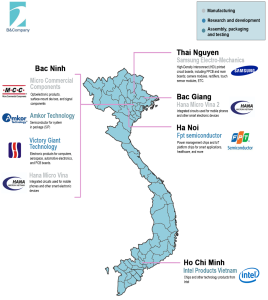
The semiconductor supply chain consists of three main stages: design/research, manufacturing, and assembly – testing – packaging. Currently, Vietnam primarily focuses on design/research, while their involvement in the other 2 stages remains very limited.
In the design and research stage, the main products are chipsets. FPT Semiconductor is the only representative from Vietnam, specializing in designing and developing chips for power management and IoT platforms used in smart applications, healthcare, and more. These designs are then transferred to factories in Korea for production and packaging[4]. The company has also set a goal of delivering 25 million chips globally by 2024–2025[5]. Meanwhile, China’s representative, Victory Giant Technology, received approval for a printed circuit board project in Vietnam, with a total investment of 206 million USD. The company is expected to complete construction of its factory by 2026[6].
Conversely, at the manufacturing stage, companies are focus on producing circuit boards and semiconductor products with only international corporations are involved, including Micro Component from China, as well as Samsung and Hana Micro from South Korea. While Samsung has shown no further investment movement after spending over 2 billion USD on expanding its production[7], Hana Micro is expected to increase its total investment to more than 1 billion USD by the end of 2025[8]. Furthermore, with significant government support in this industry, Viettel has planned to complete the construction of a semiconductor manufacturing plant in Vietnam by 2030, marking the first domestic player from Vietnam in this stage[9].
Related article














Log in / Register
Continue without an account
Log in / Register
SUBSCRIBE NEWSLETTER