

 English
  日本語
日本語  Tiếng Việt
  简体中文
简体中文  한국어
한국어 Vietnam’s beauty industry is going through an important stage in 2025, led by a young and fashion-conscious population and the fast growth of online shopping. Spending on skincare, makeup, and wellness services keeps increasing as both local and foreign brands compete for customers
14Oct2025
Latest News & Report / Vietnam Briefing
Comments: No Comments.
Vietnam’s beauty industry is going through an important stage in 2025, led by a young and fashion-conscious population and the fast growth of online shopping. Spending on skincare, makeup, and wellness services keeps increasing as both local and foreign brands compete for customers. The market is changing quickly with new trends like clean beauty, the rise of e-commerce, and more openness to foreign investment. For global brands and investors, Vietnam is one of Southeast Asia’s most exciting markets — where beauty, technology, and culture come together.
Vietnam’s Beauty Market Landscape in 2025
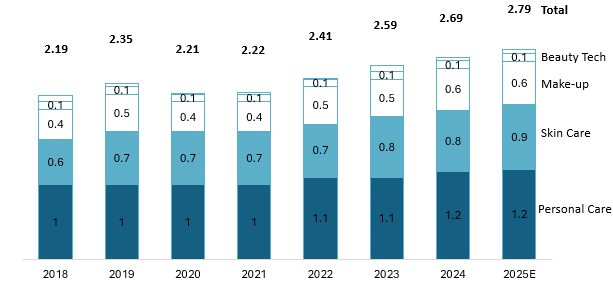
Vietnam’s beauty and personal care market is still growing strongly in 2025, driven by higher incomes, fast urban growth, and consumers who care more about their appearance. The market is expected to reach about USD 2.74 billion this year and keep growing at around 3.3% per year until 2029[1]. Among all categories, personal-care products like toiletries and hair care occupy the biggest part—about USD 1.2 billion—while skincare and cosmetics are growing the fastest as young Vietnamese people focus more on skin health and looking good.
Revenue of the beauty and personal care market in Vietnam from 2018 to
Unit: Bil USD
 Source: Statista Market Insights
Vietnam’s beauty market is influenced by demographic and economic factors, particularly its relatively young population and steadily rising income levels that encourage regular spending on self-care and personal grooming. The country’s median age is about 33.4 years [2], meaning a large share of consumers are in their 20s and early 30s—the most active group in terms of beauty spending. According to Statista (2023), more than 60% of Vietnamese people use skincare products daily, with facial cleansers (49%), perfumes (41%), sunscreens (31%), and moisturizers (25%) being the most common. This young generation views beauty and grooming as part of their lifestyle and self-confidence rather than luxury consumption. At the same time, Vietnam’s GDP per capita exceeded USD 4,700 in 2024 [3], nearly doubling compared with ten years ago. Higher income and growing awareness of health and wellness after the pandemic have led consumers to seek products that combine both beauty and care functions—such as acne treatment, anti-aging, and sun protection. As a result, beauty spending has shifted from occasional to routine, forming a solid base for continued market growth in the years ahead.
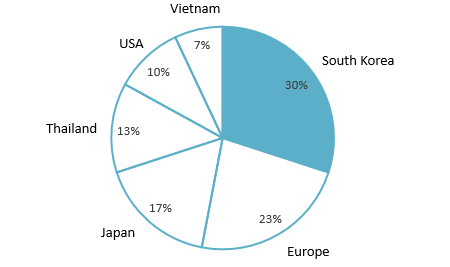
As the market expands and consumers become more sophisticated, international players have taken the lead in shaping product standards and brand perception in Vietnam’s beauty industry. One clear feature of Vietnam’s beauty market is that foreign brands dominate. Imported products make up over 90% of cosmetics sales. Korean brands lead with about 30% of the market, followed by European (23%), Japanese (17%), Thai (13%), and U.S. brands (10%)[4]. Vietnamese brands mostly target the low-price segment and are still working to build trust and reputation. This dominance comes from the belief that foreign products offer better quality, more variety, and stronger brand image. Major companies like L’Oréal, Beiersdorf (Nivea), AmorePacific (Sulwhasoo, Laneige), LG Household & Health Care (The Face Shop, Ohui), and Japanese brands such as Shiseido, Kao, and Rohto have built local branches or strong partnerships in Vietnam.
Market Share of Foreign Cosmetic Brands in Vietnam 2024
 Source: International Trade Administration
Investment activity in 2024–2025 remains stable, with no major new foreign brand entries reported across skincare, cosmetics, or personal care. Most international companies already present in Vietnam—such as L’Oréal, Unilever, Shiseido, and AmorePacific—continue to expand their operations through digital marketing, localized production, and retail partnerships rather than launching new entities. While there have been no recent major investment deals, the sector continues to attract steady interest from both foreign and local investors, reflecting confidence in Vietnam’s long-term beauty market potential.
Market Trends
Recent trends in Vietnam’s beauty market show changing consumer values and new ways of shopping:
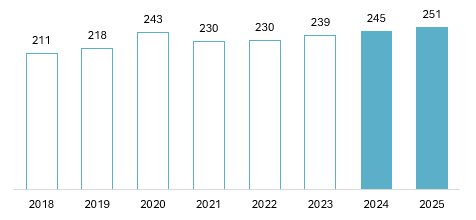
- Natural and Organic Beauty: More people are choosing ‘clean beauty’ products made with natural and herbal ingredients. Acording to Statista Data , natural product now make up about 9–10% of the market and are growing steadily at around 2.5% per year (2018–2025). Consumers are becoming more careful about harsh chemicals and prefer products labeled as organic, vegan, or free from parabens and sulfates Local brands are using Vietnam’s natural ingredients such as coconut oil, green tea, turmeric, and aloe vera to make affordable natural skincare For example, the Vietnamese brand Cocoon uses coffee from Dak Lak and turmeric from Hung Yen in its products. This shift toward gentler, eco-friendly beauty is also driven by stronger environmental awareness among Millennials and Gen Z.
Revenue of natural beauty and personal care market in Vietnam form 2018-2025
Unit: Mil USD
 Source: Statista Market Insights
- Distribution Channels: Retail distribution is changing quickly. Traditional stores still make up the largest share, but their dominance is shrinking. According to Euromonitor (2023)[5], the offline share fell from 92% in 2018 to 81% in 2023, while modern retail and online platforms are gaining ground. Major beauty chains are expanding fast: Hasaki now has about 170 stores, Guardian runs more than 130, and Watsons continues to open new outlets in big cities. Local cosmetics stores such as Nuty and Cocolux are also scaling up, showing strong investment activity in 2024–2025[6] (Vietnam Briefing, 2025). This shift marks the rise of organized retail, giving consumers easier access to branded products and improving overall market transparency.
- E-Commerce Growth: E-commerce has become a major growth driver for Vietnam’s beauty market. Beauty is now among the country’s top online shopping categories. Online beauty sales grew 47.6% in 2022 and 52.2% in 2023, reaching about ₫37.7 trillion (≈US$1.5 billion)[7]. By 2023, online sales accounted for almost 19% of total beauty sales, up from just 8% in 2018. This surge is powered by platforms like Shopee and Lazada, as well as Vietnam’s young, smartphone-savvy population that is increasingly comfortable with digital payments and fast delivery.
Vietnam Beauty E-Commerce Revenue Growth
Source: Metric.vn
- Digital Commerce and Livestreaming: Beyond e-commerce growth, digital platforms are changing how beauty brands engage consumers. Livestream shopping, led by influencers and KOLs, allows real-time product demonstrations and direct interaction with audiences. Global brands such as Estée Lauder, Lancôme, Kiehl’s, and Sulwhasoo actively use livestreams to launch new items and attract young buyers with discounts, “buy-one-get-one” deals, and free samples. This mix of entertainment and shopping fits Vietnam’s tech-savvy generation, who value both convenience and digital connection. To stay competitive, brands must combine online and offline strategies and use data from e-commerce platforms to track customer behavior and respond quickly to new trends.
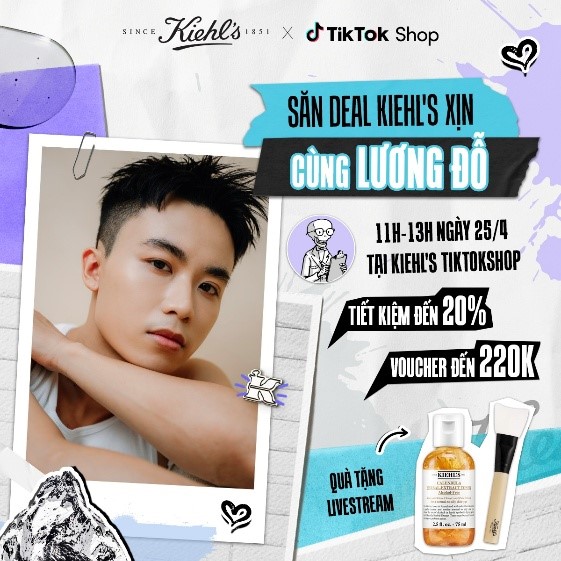
Source: KIEHL’S X LƯƠNG ĐỖ[1]
Main Players
Vietnam’s beauty market is mainly led by large international companies with long experience in the industry. Many of them entered Vietnam in the 1990s and 2000s as the economy opened, setting up local offices or partnerships. Their strong position comes from well-known brands (like Nivea’s popularity or the luxury image of L’Oréal and Estée Lauder) and their large investment in marketing and distribution.
Some main players in Beauty Companies in Vietnam
| Company | Market Entry | Country | Short Profile |
| Unilever | 1995 | UK | This global consumer goods company, known for popular personal care brands like Dove, Pond’s, and Sunsilk, entered Vietnam in 1995 and currently holding ~ 12% of the cosmetics and personal care market of Vietnam’s cosmetics/personal care market |
| Procter & Gamble | Mid-1990s | USA | World’s largest consumer products company (Olay, SK-II, Pantene, Gillette, etc.). Active in Vietnam since mid-90s with local production of hair and grooming products. |
| L’Oréal | 2007 | France | Global beauty leader with a portfolio of cosmetics, skincare, and luxury brands (L’Oréal Paris, Maybelline, Lancôme). Present in Vietnam via L’Oréal Vietnam LLC since 2007. |
| Estée Lauder Cos. | Early 2000s | USA | A leading prestige beauty company with brands such as Estée Lauder, MAC, Clinique, and La Mer. Its products are sold in Vietnam’s high-end retail stores and department stores, focusing on skincare and makeup for wealthy consumers. |
| Shiseido | Early 2010s | Japan | One of the oldest cosmetics companies, known for skincare and fragrances (Shiseido, Anessa, NARS, etc.). In Vietnam it caters to the premium segment; operates via distributors and Shiseido Vietnam Co. |
Source: B&Company compilation
While local Vietnamese brands are starting to grow — especially in the natural and organic segment — their market share is still small compared to global giants. Foreign companies benefit from strong research, global resources, and advanced product development, giving them an advantage in innovation. However, because many big players compete in the same space, the market is very competitive. As a result, global brands must keep adjusting their strategies to fit Vietnamese tastes. This competition benefits consumers, bringing more choices and encouraging constant innovation.
Strategic Takeaways for Foreign Entrants
Vietnam’s beauty market in 2025 is attractive but also more competitive and complex. The growing middle class, strong digital habits, and demand for high-quality international products have driven interest in foreign brands. However, success now requires more than just entering the market — it needs smart adaptation to local customer habits, sales channels, and expectations.
- Localization and consumer insight are decisive.
Vietnamese consumers—especially Gen Z and young professionals—value authenticity, product safety, and ingredient transparency. Foreign brands that localize formulas (light textures, tropical-climate compatibility) and communication styles (Vietnamese-language packaging, culturally tuned marketing) are better positioned to build loyalty. Continuous feedback loops via social platforms and in-store data are essential to keep pace with fast-evolving preferences.
- Digital first and omnichannel strategies are prerequisites
With beauty e-commerce are expanding annually, investors should prioritize digital operations as a core—not complementary—channel. Establishing verified flagship stores on Shopee, Lazada, and TikTok Shop, supported by influencer-driven content, is now standard market practice. However, maintaining selective physical presence through beauty-chain partnerships or pop-up counters remains key for brand legitimacy and consumer trust.
- Collaboration accelerates market learning
Partnerships with local distributors, retailers, and content creators can shorten the learning curve. Such alliances provide market intelligence, facilitate licensing, and enhance localization speed—advantages that pure foreign entrants often lack in the early stages.
Conclusion
Vietnam’s beauty sector is shifting from a volume-driven import market to a value-driven, digitally integrated ecosystem. The most successful investors will be those who combine brand heritage and innovation with local relevance and operational agility. For global companies seeking sustainable growth in Southeast Asia, Vietnam represents both a competitive test and a high-potential platform for long-term expansion.
* If you wish to quote any information from this article, please kindly cite the source along with the link to the original article to respect copyright.
| B&Company
The first Japanese company specializing in market research in Vietnam since 2008. We provide a wide range of services including industry reports, industry interviews, consumer surveys, business matching. Additionally, we have recently developed a database of over 900,000 companies in Vietnam, which can be used to search for partners and analyze the market. Please do not hesitate to contact us if you have any queries. info@b-company.jp + (84) 28 3910 3913 |
[1] https://www.statista.com/outlook/cmo/beauty-personal-care/vietnam?srsltid=AfmBOoqfyi-OsC3fdXz_32kLYoOTYlWlmH0c4P4FPTQrrzXWIINzK_oQ
[2] Vietnam Population (2025) – Worldometer
[3] GDP per capita (current US$) – Viet Nam | Data
[4] Vietnam Beauty and Personal Care Products
[5] beauty_and_personal_care_in_vietnam.pdf – Google Drive
[6] Strategic Entry to Vietnam’s Beauty and Personal Care Sector
[7] https://fr.slideshare.net/slideshow/metric-th-trng-bn-l-trc-tuyn-vit-nam-2023-v-d-bo-2024/266002082
Related article



Log in / Register
SUBSCRIBE NEWSLETTER