
2025年12月24日
最新ニュースとレポート / ベトナムブリーフィング
コメント: コメントはまだありません.
After fully reopening tourism in 2022, Vietnam’s tourism industry has been recovering strongly and has become a bright spot in economic growth. International arrivals to Vietnam in the first 11 months of 2025 surpassed the pre-pandemic record, reaching over 19.1 million visits and increasing by 20.9% year-on-year compared with the same period in 2024[1]. Vietnam’s tourism sector is now facing new opportunities to strengthen its position as a leading pillar of the economy in the country’s socio-economic development agenda. Against the backdrop of surging travel demand, Vietnam is emerging as one of the region’s top destinations, creating many attractive opportunities for foreign investors.
Vietnam Tourism in 2025: From Post-Pandemic Recovery to Strong Growth
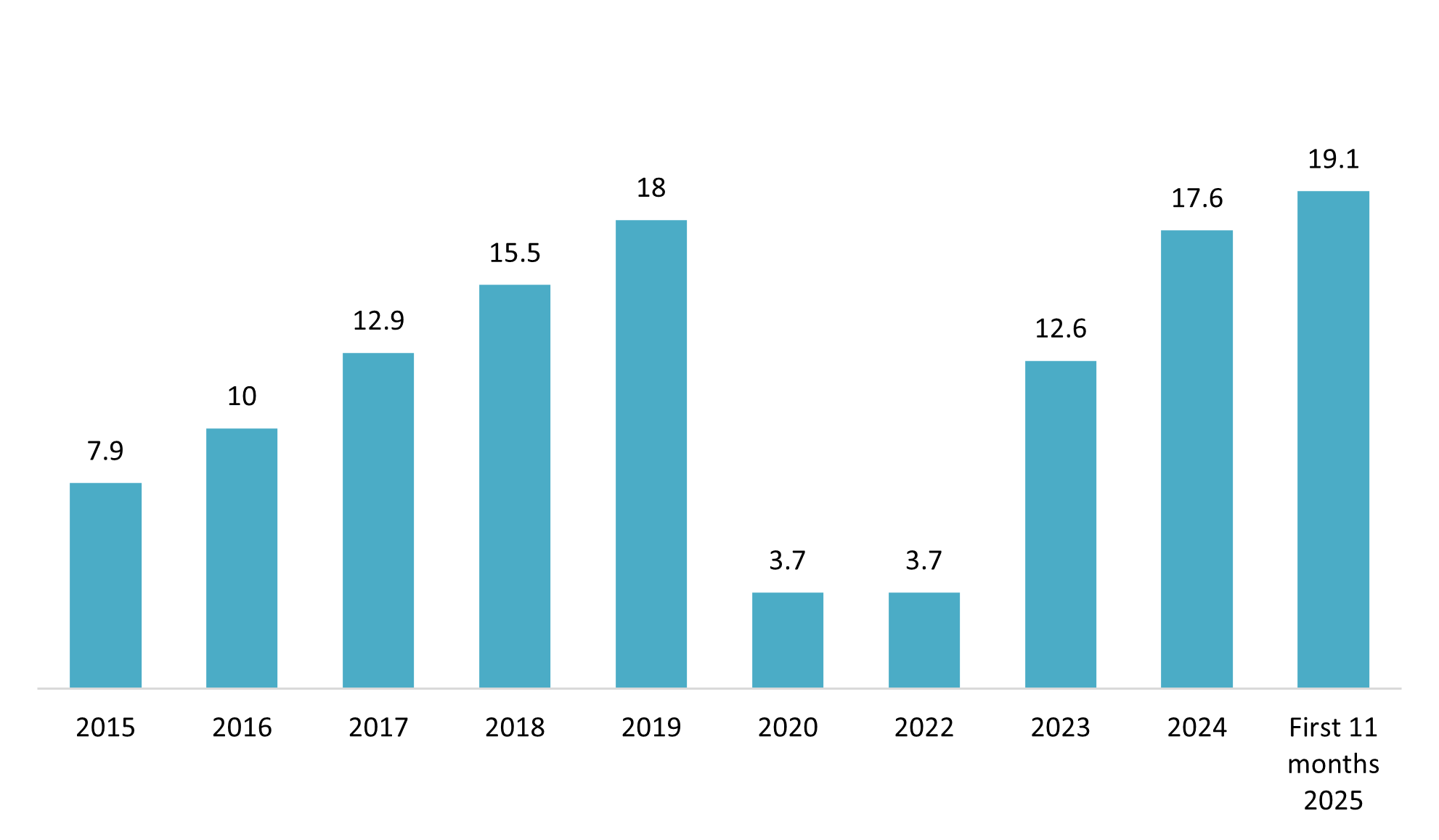
During 2015–2019, Vietnam’s tourism sector recorded steady growth in international arrivals, rising from 7.9 million to 18 million. This was followed by a sharp decline in 2020–2022, with arrivals falling to around 3.7 million due to the impact of the pandemic. From 2023, the market showed a clear recovery and continued to grow strongly in 2024.
Number of international visitor arrivals to Vietnam (2015 – 2025)
Unit: Million visitor
出典: Vietnam National Tourism Administration
In 2025, Vietnam’s tourism sector set the following targets: welcoming 22 – 23 million international visitors, serving 120–130 million domestic trips, and generating total tourism revenue of around VND 980 – 1,050 trillion, approaching the milestone of VND 1 quadrillion in revenue[2]. Notably, in the first 11 months of 2025, international arrivals reached 19.1 million, surpassing the pre-pandemic peak in 2019, reflecting a very strong recovery momentum and achieving 83% – 87% of the stated target.
According to the General Statistics Office (Ministry of Finance), revenue from accommodation and food services in the first 11 months of 2025 was estimated at VND 767 trillion, up 14.6% year-on-year compared with the same period in 2024. Meanwhile, travel services revenue over the same period was estimated at VND 85.4 trillion, up 19.9% year-on-year, indicating that the recovery and the expansion of travel demand continue to strengthen. This growth trend has been particularly evident in key urban centers and major destinations such as Hanoi, Ho Chi Minh City, Da Nang, Quang Ninh, and Vinh Long, highlighting the renewed vibrancy of both the domestic and international tourism markets[3].
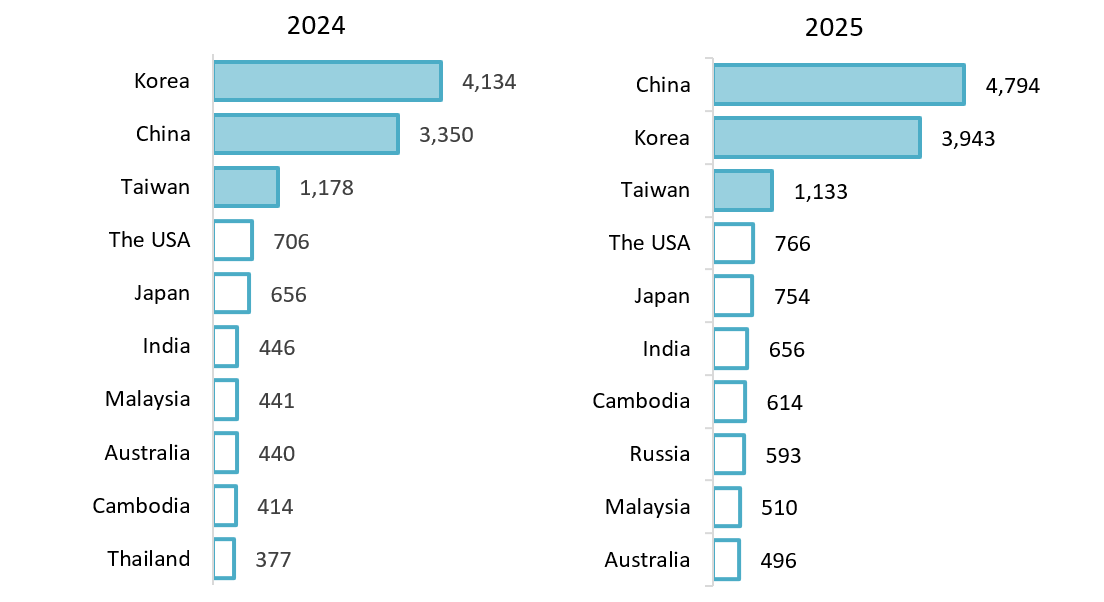
Top 10 source markets with the highest number of visitors to Vietnam in the first 11 months of 2025 compared to the same period in 2024
Unit: Thousand visitors
出典: Vietnam National Tourism Administration
In the first 11 months of 2025, China remained the leading source market for visitors to Vietnam and recorded strong growth compared with the same period in 2024. Japan and the United States maintained solid growth momentum, while the Korean market declined slightly. Nearby markets in Southeast Asia also posted strong increases, including Cambodia and Malaysia, while India saw robust growth as well. European markets continued to expand, highlighting the effectiveness of Vietnam’s visa-exemption policy. Notably, arrivals from Russia reached 593 thousand, surging by 190.9% year-on-year, reaffirming Russia as Vietnam’s largest European source market and the fastest-growing market in the region.
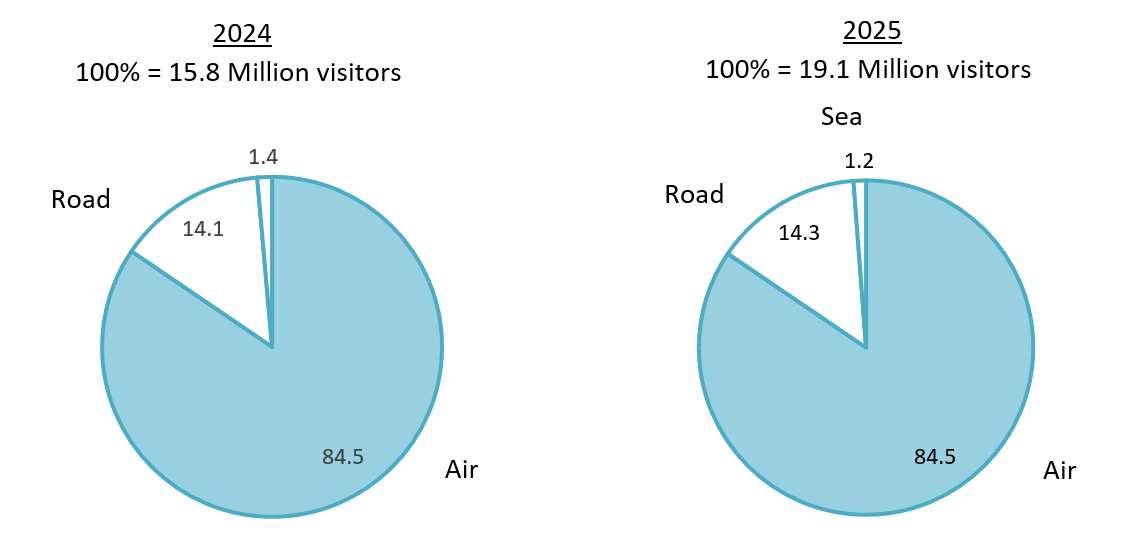
Types of transport used by international visitors to Vietnam in the first 11 months of 2025 compared to the same period 2024
出典: Vietnam National Tourism Administration
Air travel continues to be the dominant mode of travel for international visitors to Vietnam in both comparison periods, reflecting the high dependence of international tourist growth on flight capacity and flight connections. Roads play an important supporting channel role, associated with the flow of visitors from neighboring markets and tourism through border gates, but the proportion is generally stable. Meanwhile, sea routes still account for a very small part, showing that the space is still limited or not yet strongly exploited in the cruise or cruise segment compared to aviation and road.
Growth drivers for Vietnam’s tourism sector in 2025: Open visa policy, stronger tourism promotion and expanding tourism infrastructure
Many positive factors have been driving Vietnam’s tourism upswing. Notably, under Government Resolution No. 44/NQ-CP dated 7 March 2025, citizens of Germany, France, Italy, Spain, the United Kingdom, Russia, Japan, the Republic of Korea, Denmark, Sweden, Norway, Finland, Poland, the Czech Republic, and Switzerland are eligible for visa exemption when entering Vietnam. A flexible visa policy is a key tool for enhancing a destination’s attractiveness, enabling Vietnam to compete more effectively with other countries in the region. This is a positive signal, reflecting Vietnam’s hospitality and openness to the world[4]. In addition, the aviation sector has recovered rapidly, with the restoration and launch of many new direct routes connecting Vietnam with Europe, the United States, India, and Australia, among others, facilitating international visitor flows[5].
Enhanced tourism promotion and marketing activities, both domestically and internationally, have also been one of the key drivers of the sector’s growth. In November, the Vietnam National Authority of Tourism organized promotional programs in the United States, China, and Australia, and participated in WTM London 2025.
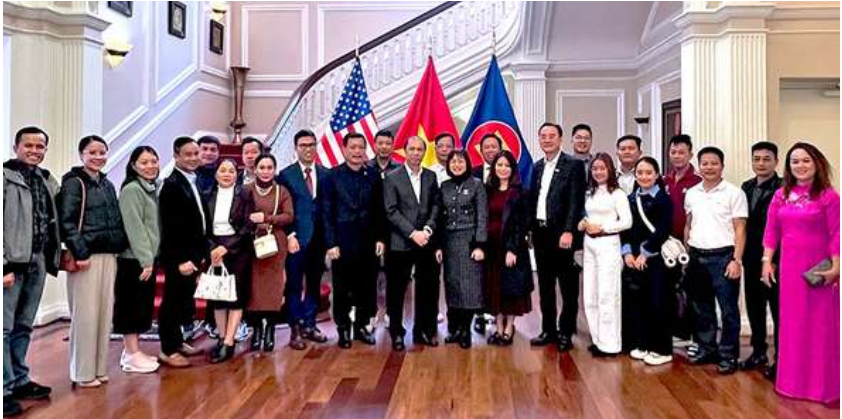
Vietnam Tourism Promotion Program in the United States under the theme: “Vietnam: A World of Experiences, Exceptional Value.”
出典: Vietnam National Tourism Administration
Digital communications, new product development research, and regional linkages were implemented in a coordinated manner, helping expand the visibility of Vietnam’s tourism brand in long-haul markets—particularly North America and Europe, where arrivals increased by more than 50% in November 2025 compared with the previous month. In addition, Vietnam’s tourism infrastructure has continued to expand. As of 20 November 2025, the country had 289 five-star tourism accommodation establishments with 94,599 rooms, and 345 four-star establishments with 47,536 rooms[6]
Key Emerging Trends in Vietnam’s Tourism Market
– Green tourism and sustainability goals: Eco-tourism and green travel are gaining attention. Key eco-destinations such as Phong Nha–Ke Bang, Cat Tien, and Con Dao have recorded visitor growth of over 20%. In the accommodation segment, around 70% of 3-star-and-above properties have implemented energy-saving measures and initiatives to reduce plastic waste. Notable examples include Hoi An with the “Plastic-Waste-Free City” project and Da Lat with its “Green and Sustainable Tourism” orientation[7].
– The application of AI in the tourism industry: Online platforms are increasingly using AI to personalize recommendations for accommodation, itineraries, and services. This trend helps boost conversion and optimize an “all-in-one” travel experience – covering discovery, booking, itinerary building, payments, and in-trip support, especially appealing to younger travelers. For example, Booking.com integrates an AI Trip Planner and GenAI features into the accommodation search and selection process, making it easier for travelers to compare options and choose stays that best match their needs[8].
– Digital transformation in tourism: In Vietnam, tourism businesses are also accelerating digital transformation—digitizing end-to-end operations and integrating digital payments to reduce costs while improving the customer experienceFor example, the Van Mieu Cultural and Scientific Activities Center has adopted e-tickets, QR-based artifact lookups, a digitized database, and 3D mapping to enhance on-site visitor experiences[9]. Meanwhile, some hotel groups have built their own apps—Vinpearl, for instance, enables booking, payment, and in-app check-in/check-out while integrating loyalty points and itinerary management for a more seamless end-to-end stay[10].
Tourists experience green tourism in Ninh Binh
出典: ハノイ
Some updates on tourism business licensing in 2025
| いいえ | コンテンツ | As of September 2024 | As of September 2025 | Updated as of November 2025 | 備考 |
| 1 | Licensing for international travel services | – As of 25 September 2024, Vietnam had 4,144 international tour operators nationwide, including 1,265 joint-stock companies, 38 foreign-invested enterprises, 2,836 limited liability companies, and 5 private enterprises.
– In the first nine months of 2024, the Vietnam National Authority of Tourism reviewed 928 applications for international travel services licenses. Of these, 346 new licenses were issued, 317 licenses were renewed, 2 licenses were re-issued, and 263 licenses were revoked.
|
– As of 16 September 2025, Vietnam had 4,385 international tour operators nationwide, including 1,330 joint-stock companies, 3,049 limited liability companies, and 6 private enterprises.
– From 16 August 2025 to 16 September 2025, the Vietnam National Authority of Tourism reviewed 96 administrative procedures submitted by tour operators, including 43 new licenses issued, 37 licenses renewed, and 16 international travel services licenses revoked.
|
– As of 18 November 2025, Vietnam had 4,437 international tour operators nationwide, including 1,332 joint-stock companies, 3,099 limited liability companies, and 6 private enterprises.
– From 17 October 2025 to 18 November 2025, the Vietnam National Authority of Tourism reviewed and processed 125 administrative procedures, including 54 new licenses issued, 40 licenses renewed, 2 licenses re-issued, and 29 international travel services licenses revoked.
|
– The number of international tour operators continues to rise steadily.
– Licensing remains clearly selective: revoked licenses accounted for a notable share in 2024 and increased across reporting periods in 2025, suggesting tighter oversight of service quality, financial capacity, and regulatory compliance among tour operators. – An international travel services license is mandatory for companies to operate legally in inbound and/or outbound tourism, making it a key indicator for assessing the overall condition of the tourism industry. |
| 2 | Issuance of tour guide cards | – As of 25 September 2024, Vietnam had issued 38,979 tour guide cards: 22,767 international, 14,167 domestic, and 2,045 on-site.
– Among 22,767 international tour guide cards, the main languages were English (12,585), Chinese (6,132), French (1,269), Korean (1,185), Japanese (740), Russian (418), German (358), Thai (347), Spanish (297), and Italian (147), with the remainder in other languages.
|
– As of 16 September 2025, Vietnam had 42,928 active tour guide cards: 25,522 international, 15,232 domestic, and 2,174 on-site.
– Among 25,522 international tour guides, the main languages were English (13,921), Chinese (6,460), French (1,402), Korean (1,335), Japanese (705), Russian (409), German (352), Thai (331), and Spanish (315), with the remainder in other languages.
|
– As of 18 November 2025, Vietnam had 44,171 active tour guide cards: 26,309 international, 15,641 domestic, and 2,221 on-site.
– Among 26,309 international tour guides, the main languages were English (14,422), Chinese (6,625), French (1,453), Korean (1,364), Japanese (719), Russian (417), German (356), Thai (331), Spanish (322), and Italian (202), with the remainder in other languages.
|
-The number of tour guide cards has increased steadily over time, reflecting the recovery and expansion of the tourism workforce.
– International tour guides are growing the fastest, indicating a strong rise in demand to serve inbound visitors. – The language mix remains relatively stable, with English and Chinese dominating; growth in Korean, Japanese, French, and Russian suggests increasingly diversified demand from key source markets.
|
| 3 | Star-rating classification of 4–5-star tourism accommodation establishments | As of 26 September 2024, Vietnam had 269 five-star tourist accommodation establishments with 87,328 rooms and 376 four-star establishments with 51,670 rooms. | As of 19 September 2025, Vietnam had 282 five-star tourist accommodation establishments with 93,058 rooms, and 339 four-star establishments with 46,713 rooms. | As of 20 November 2025, Vietnam had 289 five-star tourist accommodation establishments with 94,599 rooms, and 345 four-star tourist accommodation establishments with 47,536 rooms. | – High-end accommodation supply continues to expand, especially in the five-star segment where the number of properties has increased, driving up room capacity.
– Meanwhile, the four-star segment shows only slight fluctuations, suggesting restructuring or reclassification within the upper-mid hotel tier.
|
Source: B&Company’s synthesis from Tourism Bulletin 09/2024, Tourism Bulletin 09/2025 や Tourism Bulletin 11/2025
Implications for foreign investor
Vietnam’s tourism sector is entering a new growth cycle, driven by the rebound in international demand and stronger policy and market tailwinds. Key catalysts include visa waivers for major European and priority markets, alongside the restoration and launch of new direct long-haul routes—supporting higher-volume, longer-stay visitor flows. At the same time, clear momentum in green tourism and digital travel is creating room for higher value-added, end-to-end tourism offerings.
However, the sector faces notable challenges. International growth remains heavily reliant on air travel, making it sensitive to airfare movements and route connectivity, while sea travel still accounts for a very small share, suggesting underdeveloped cruise potential. Furthermore, an increasing number of international tourists from a wider range of countries are visiting Vietnam, calling for more tailored strategies for each specific visitor segment. A large number of international tour operators and frequent licensing and revocation activities also point to intensifying competition and tightening compliance requirements.
Recommendations for foreign investors
– Prioritize “value over volume”: Focus on high-end leisure offerings, themed experiences, premium mobility experiences and longer-stay products targeting fast-growing source markets (Northeast Asia, India, Europe, and Russia) to optimize revenue. A similar premiumization trend is emerging in rail travel: Vietnam Railways launched new “luxury” carriages on the Hanoi–Hai Phong route in May 2025[11].
– Design projects around green and sustainable standards: Emphasize energy efficiency, eco-experiences and pursue recognized certifications to align with market trends and attract sustainability-minded travelers. Notably, Premier Village Danang Resort has announced its latest international recognition – Green Key certification, a globally respected eco-label for tourism facilities that meet high standards in environmental responsibility and sustainable operations[12].
– Invest in digital tourism infrastructure: Invest in digital tourism infrastructure by integrating with travel service platforms such as Booking.com or developing an in-house travel app (e.g., a Vinpearl-style model) to optimize the customer experience; in parallel, partner with leading travel content creators to expand brand reach and tap into new customer segments.
– Reduce over-reliance on air travel: by prioritizing destinations with strong multi-modal connectivity (road/rail/sea alongside air), developing tailored products for overland visitors from neighboring markets, and leveraging regional linkage models to extend length of stay. A clear example in Vietnam is Quang Ninh developing tailored products for overland visitors from China via the Mong Cai international border gate, welcoming a nearly 1,000-person group traveling by road and delivering a 5-day, 4-night itinerary in Quang Ninh[13].
*ご注意: 本記事の情報を引用される場合は、著作権の尊重のために、出典と記事のリンクを明記していただきますようお願いいたします。
| B&Company株式会社
2008年に設立され、ベトナムにおける日系初の本格的な市場調査サービス企業として、業界レポート、業界インタビュー、消費者調査、ビジネスマッチングなど幅広いサービスを提供してきました。また最近では90万社を超える在ベトナム企業のデータベースを整備し、企業のパートナー探索や市場分析に活用しています。 お気軽にお問い合わせください info@b-company.jp + (84) 28 3910 3913 |
[1] Vietnam tourism surges, welcoming over 19 million international visitors <
[2] Vietnam tourism records strong growth in the first six months of 2025, aiming to meet the 2025 annual target <
[3] Vietnam tourism surges, welcoming over 19 million international visitors <
[4] Visa exemptions as a major boost for Vietnam’s tourism growth <
[5] Digital and green transformation: the “golden key” to sustainable tourism development <
[6] Vietnam Tourism Information – November 2025 (PDF) <
[7] Trends driving green tourism toward sustainable development <
[8] Booking.com Enhances Travel Planning with New AI-Powered Features – For Easier, Smarter Decisions <
[9] Vietnamese tourism on the digital transformation journey: Connecting data, spreading culture <
[10] Vinpearl App: Registration guide <
[11] New luxury carriages launched on Hanoi–Hai Phong rail route <
[12] Premier-village-danang.com.Green certification: Green Key <
[13] Promoting high-end tourist inflows from China <