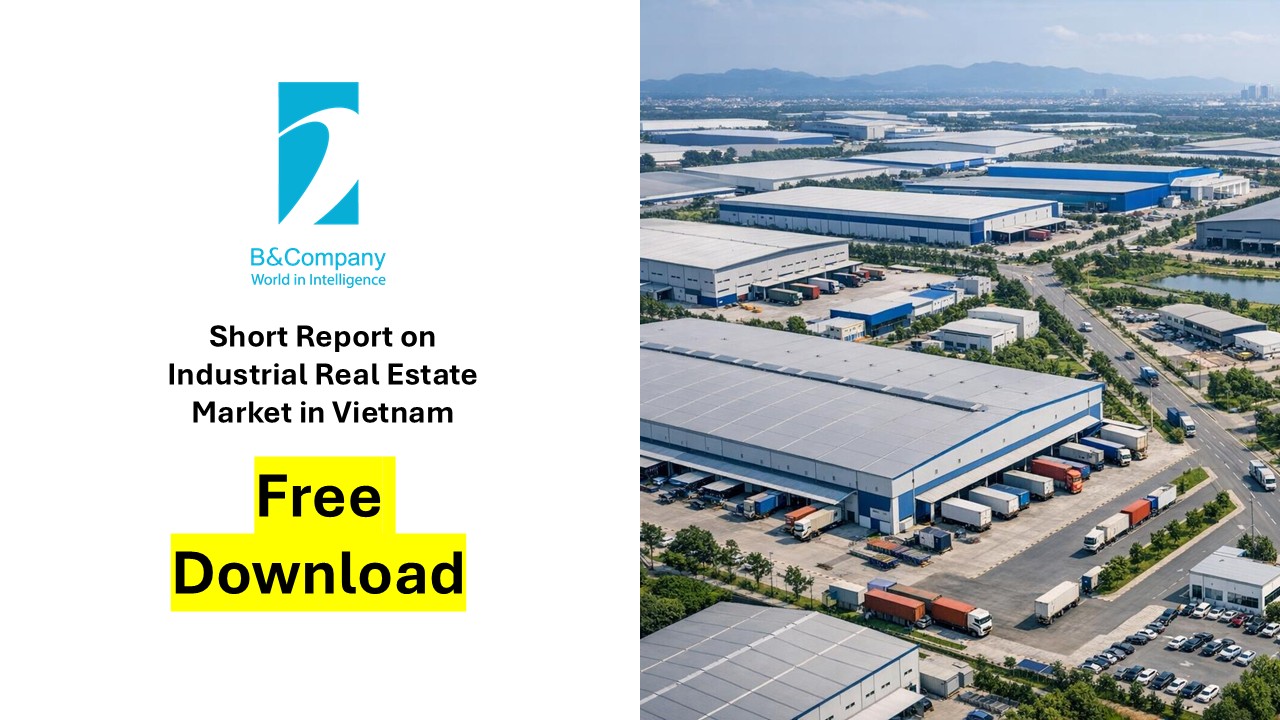

Short Report on Industrial Real Estate Market in Vietnam

Short Report on Industrial Real Estate Market in Vietnam

  • Total page: 7 pages
  • Format: PDF
  • Delivery date: Immediately
Requestrequest Free

Industrial real estate regulations are clear. Land remains state-owned, and foreign investors secure long- term land use rights through leases. High-tech and export projects also benefit from tax incentives and preferential land rents. Growth is supported by state-owned developers and foreign capital and is being driven by the transfer of manufacturing functions from China+1 and demand for logistics and e-commerce. Major trends include expansion into neighboring provinces and the development of smart/green industrial parks. Although there are challenges such as land acquisition, skilled labor, and interregional competition, the medium-term outlook remains favorable.

Basic Statistics

Regulations

All land belongs to the state, and foreigners cannot own land. Investors typically hold land use rights under leases of up to 50 years, which can be extended with approval, potentially allowing for longer terms. They can also own buildings and facilities constructed on leased land. In practice, foreign industrial park developers lease land from the state, build infrastructure, and then sublease plots or rent out completed factories and warehouses to tenants. Tenants sublease land from the developer or rent existing facilities, allowing them to construct and own their own factories or equipment on the plot. They handle their own investment approval (IRC/ERC), environmental permits, construction permits (if building themselves), fire safety procedures, and utilities installation. If requirements are met, they can establish as an Export Processing Enterprise (EPE). The sublease period cannot exceed the remaining term of the industrial estate. Industrial parks and economic zones facilitate smooth entry for manufacturers because developers have already secured all land rights and approvals, making them the primary establishment method for foreign-invested manufacturing. Many developers are joint ventures with foreign capital (e.g., Amata, VSIP). Regarding taxation, the standard corporate income tax rate is 20%. However, projects meeting certain criteria such as high-tech, export-oriented, large-scale, or located within economic zones may qualify for preferential tax rates (e.g., 10–17% for a specified period), tax credits/exemptions, import duty exemptions for machinery not locally producible, and reductions in land rent paid to developers.

Market Overview

The industrial real estate market has shown steady growth and even expanded during the pandemic period. This boom stems from strong FDI inflows and shifts in global supply chains. Stable economic growth and trade agreements are attracting manufacturers of electronics, textiles, machinery, and more. Notably, the “China+1” strategy for production diversification is driving multinational corporations to establish factories in Vietnam. Major electronics players like

Industrial Real Estate Market

  1. Basic Statistics
  2. Regulations
  3. Market Overview
  4. Major Players
  5. Market Trends

[Special Topic] Industrial Real Estate M&A Activity on the Rise

  1. Real Estate Investment Amount
  2. Investment Trends and Factors
  3. Challenges

This report and all materials directly related to it are properties of B&Company. All rights reserved. No parts of this report may be reproduced or transmitted in any form or by any means without the prior written permission.

Should you wish to use this report for any purposes, please kindly contact B&Company through the following given email address for further reference about the terms of use: info@b-company.jp

For more Information:
info@b-company.jp
+ (84) 24 3978 5165
SUBSCRIBE NEWSLETTER