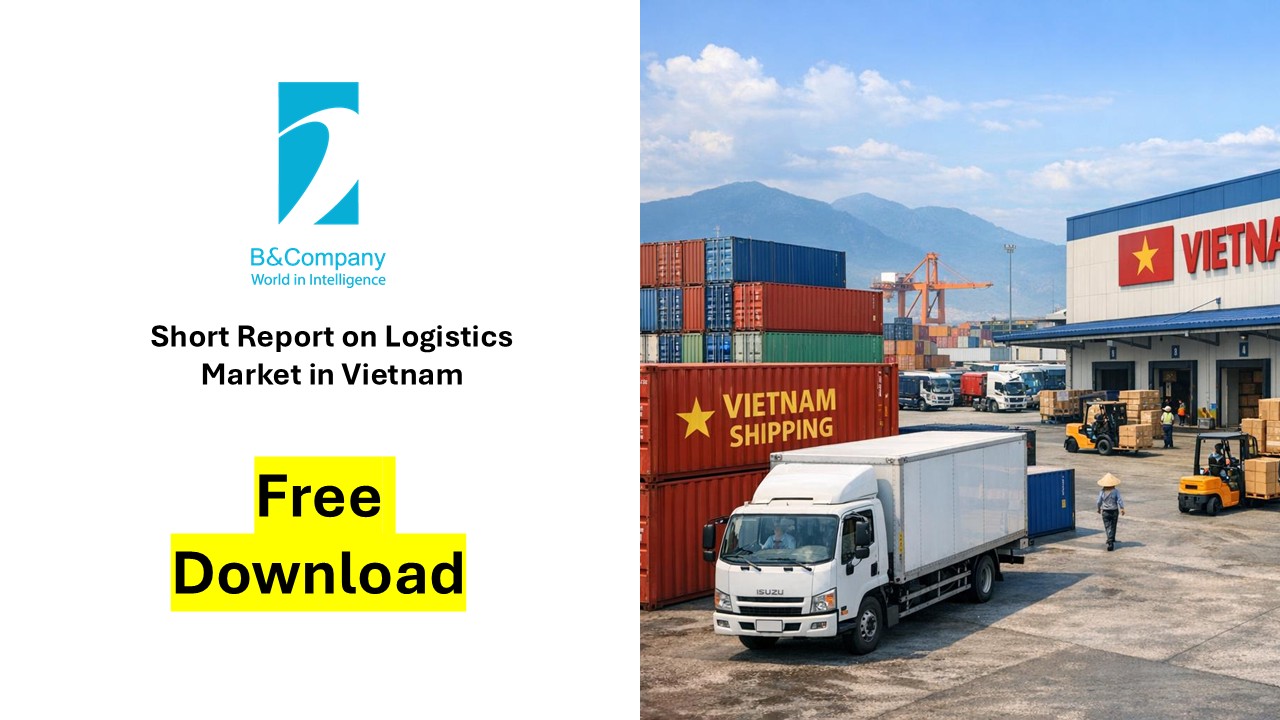

Short Report on Logistics Market in Vietnam

Short Report on Logistics Market in Vietnam

  • Total page: 10 pages
  • Format: PDF
  • Delivery date: Immediately
Requestrequest Free

The logistics industry is expanding rapidly. Growing at an annual rate of approximately 14-16%, it has reached about 52 billion USD, accounting for roughly 10% of GDP. Its accessible location for overseas trade (extensive coastline, rivers, and land borders) and trade agreements (EVFTA, CPTPP, RCEP, etc.) facilitate integration into global supply chains and are essential elements enabling the processing trade model. While high logistics costs were a challenge, improvements in transport infrastructure and competition have boosted efficiency. By 2023, Vietnam’s ranking in the World Bank’s Logistics Performance Index rose to 43rd out of 139 countries.

Basic Statistics

Regulation

Foreign ownership restrictions in the logistics sector range from 34% to 100%. Foreign equity is capped at 34% for air cargo, 49% for maritime, rail, and inland waterway transport, and 51% for road freight transport. Conversely, warehousing, express delivery (parcel and package), and freight forwarding allow for full foreign ownership. While license acquisition and compliance with industry regulations remain necessary, institutional reforms accompanying WTO accession and various FTAs have gradually eased entry procedures and equity restrictions for foreign investment, particularly in warehousing and forwarding. Furthermore, while the government maintains foreign ownership caps for core transport services like aviation, shipping, and railways to safeguard sovereignty and security, it actively promotes foreign and private capital participation in infrastructure sectors such as airports, ports, and highways through FDI and PPP schemes.

In 2023, Government Decision 163/NQ-CP 2022 established a national logistics strategy emphasizing digitalization and efficiency. Looking ahead, growth is anticipated for new 4PL (Fourth- Party Logistics) 104 providers and digital freight platforms aiming to offer end-to-end supply chain management for exporters and major retailers. Overseas investors have opportunities to invest in infrastructure such as port terminals, cold storage, and inland logistics hubs, as well as software platforms that enhance efficiency and visibility.

Market Overview

Total cargo volume rose at a 9% annual rate from 1.38 billion tons in 2017 to 2.58 billion tons in 2024.

Logistics Market

  1. Basic Statistics
  2. Regulation
  3. Market Overview
  4. Major Players
  5. Market Trends

[Special Topic] Regional Disparities in the Cold Chain

  1. Supply and Demand for Cold Storage Facilities
  2. Japanese Companies as Pioneers
  3. Evaluation of Promising Regions

This report and all materials directly related to it are properties of B&Company. All rights reserved. No parts of this report may be reproduced or transmitted in any form or by any means without the prior written permission.

Should you wish to use this report for any purposes, please kindly contact B&Company through the following given email address for further reference about the terms of use: info@b-company.jp

For more Information:
info@b-company.jp
+ (84) 24 3978 5165
SUBSCRIBE NEWSLETTER