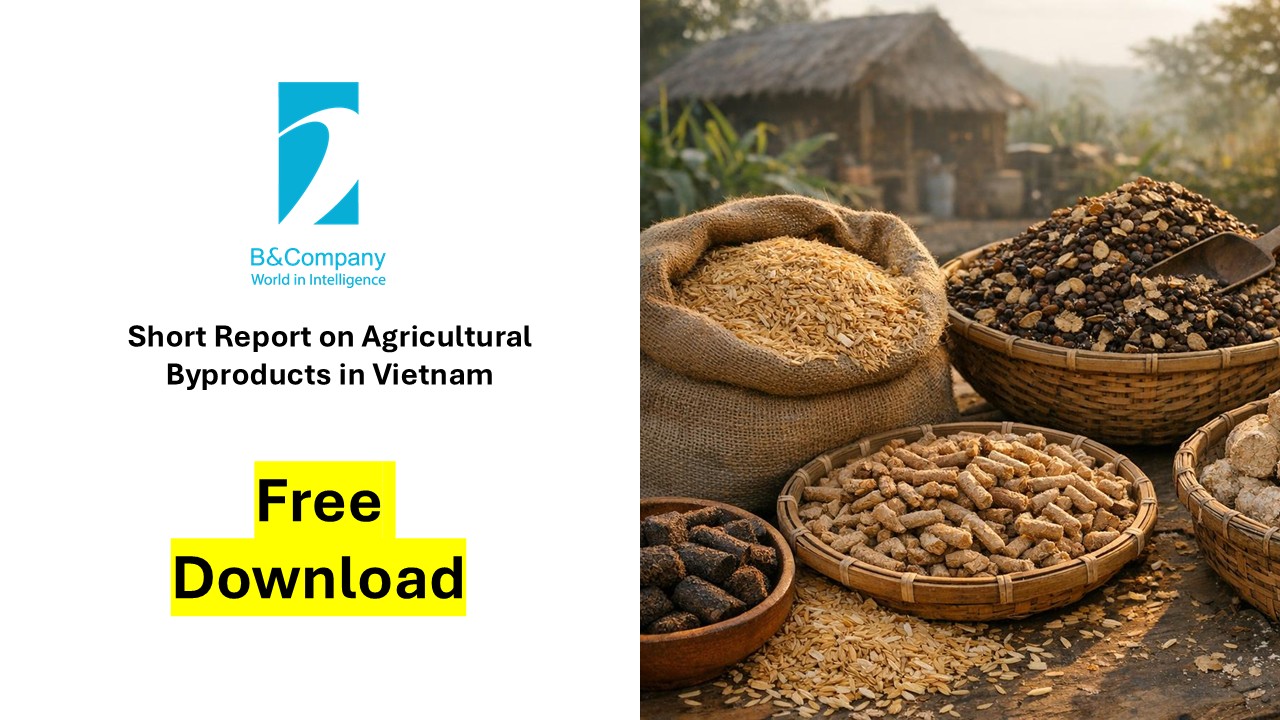

Short Report on Agricultural Byproducts in Vietnam

Short Report on Agricultural Byproducts in Vietnam

  • Total page: 4 pages
  • Format: PDF
  • Delivery date: Immediately
Requestrequest Free

By-products from agriculture, forestry, and fisheries are a significant resource, and utilizing them can promote sustainable agriculture and environmental protection. However, inconsistent policies, low technology, and weak market infrastructure hinder progress. On the other hand, these challenges also create opportunities for innovation and investment. As policies encourage a circular economy in agriculture, foreign companies specializing in environmental treatment, green technology, and circular business models have opportunities to collaborate with local partners through technology transfer and investment.

Government Support for the Circular Economy

Decision 540/QĐ-TTg (2024) “Science and Technology Development Plan to Promote the Circular Economy in Agriculture Towards 2030” positions the recycling and reuse of agricultural by- products (including those from livestock, forestry, and fisheries) as a strategic priority and outlines three strategies for circular agriculture: (1) Advancing research and application of applicable technologies in production processes, (2) Technology transfer, and (3) Development of outlet markets. Foreign investors can explore opportunities to utilize technology in line with the priority solutions outlined in the decision. Operational models include technology transfer, equipment provision, consulting, and partnerships with domestic manufacturers and suppliers. Entry into this sector requires a strategic and informed approach, considering fragmented market conditions, regulatory complexities, and differences in suitable technologies across regions and business segments. Understanding the varying needs, regional differences, and potential partners specific to each subsector is key to identifying viable entry points.

Potential of Agricultural Byproducts

Agricultural byproducts are secondary materials generated during the production processes of agriculture, forestry, and fisheries. While not directly used as primary products, they are recyclable or reusable. Vietnam is a major agricultural nation in Southeast Asia, producing vast quantities of agricultural byproducts annually. In 2022, approximately 159 million tons of agricultural byproducts were generated, with 57% originating from crop production and 39% from livestock production10

Agricultural Byproducts

  1. Government Support for the Circular Economy
  2. Potential of Agricultural Byproducts
  3. Utilization Status of Agricultural Byproducts
  4. Key players in the agricultural by-products market
  5. Challenges

Unless otherwise stated, the materials contained in this report are protected by copyright and are the exclusive property of B&Company. The information contained herein (including forward-looking statements) has been obtained from sources believed to be reliable as of the date of publication. While B&Company believes this information to be accurate, it has not necessarily independently verified each source and therefore makes no warranty or representation as to its accuracy or completeness. Readers should evaluate the relevance and accuracy of the information contained herein at their own discretion.

All rights in this report are reserved. No part of this document, its contents, or any reproduction thereof may be modified, transmitted, reproduced, or distributed to third parties without the prior written consent of B&Company. B&Company shall not be liable for any loss, damage, cost, or expense arising from the use of or reliance on the information contained herein.

For more Information:
info@b-company.jp
+ (84) 28 3910 3913
SUBSCRIBE NEWSLETTER