
 English
  日本語
日本語  Tiếng Việt
  简体中文
简体中文  한국어
한국어 
Short on Labor Market under context of Digtal Transformation in Vietnam
Digital transformation (DX) is advancing across many industries, and the labor market is witnessing significant change.
Request Free
Free
Free
Vietnam: Hanoi
Vietnam: Ho Chi Minh
(84) 24 3978 5165
(84) 28 3910 3913
 Free
Free
The education industry is entering a new phase of development, driven by strong demand, a growing middle class, and encouragement of private sector participation. While public schools form the foundation, the private sector is expanding rapidly, offering diverse options ranging from K-12 (kindergarten through high school) to vocational training. Advances in educational technology are creating dynamic learning environments that transcend traditional models, bringing opportunities for investment and innovation.
The education sector permits full foreign ownership. Foreign investors must obtain an operating license and comply with domestic education standards. Under Decree 86/2018, foreign-invested schools offering foreign curricula in kindergarten and compulsory education are permitted to admit up to 50% Vietnamese students.
However, many schools marketed as international schools are not legally classified as foreign-owned schools. Instead, they are often registered as Vietnamese-owned private schools (bilingual schools or schools with cooperative programs). In such cases, they are exempt from the 50% Vietnamese student cap stipulated by Decree 86. Consequently, it is not uncommon for these schools to have 80-95% Vietnamese students among their actual enrollment. Branding using terms like international or academy is widespread. While they appear identical as internationa schools to parents, the legal classification and applicable regulations can differ entirely from school to school.
The government actively encourages private and foreign investment. Resolution 35/2019 aims to increase the share of private educational institutions (to 13.5% of the total by 2025114 ). Key laws include the 2019 Education Law (liberalizing private school structures), the 2020 Investment Law, and the new Decrees 124/125. The registration process remains multi-stage (IRC, ERC, operating license), though reforms in 2024-25 aim to streamline approval procedures.
The public sector underpins the education system, with near-universal coverage of basic education. Primary school completion rates exceed 98%, and adequate educational standards are ensured in all provinces. For the 2024-2025 academic year, there are approximately 12,000 primary schools, 8,500 middle schools, 2,400 high schools, and 2,900
Education Market
[Special Topic] The Rise of E-Learning
This report and all materials directly related to it are properties of B&Company. All rights reserved. No parts of this report may be reproduced or transmitted in any form or by any means without the prior written permission.
Should you wish to use this report for any purposes, please kindly contact B&Company through the following given email address for further reference about the terms of use: info@b-company.jp
Digital transformation (DX) is advancing across many industries, and the labor market is witnessing significant change.
Free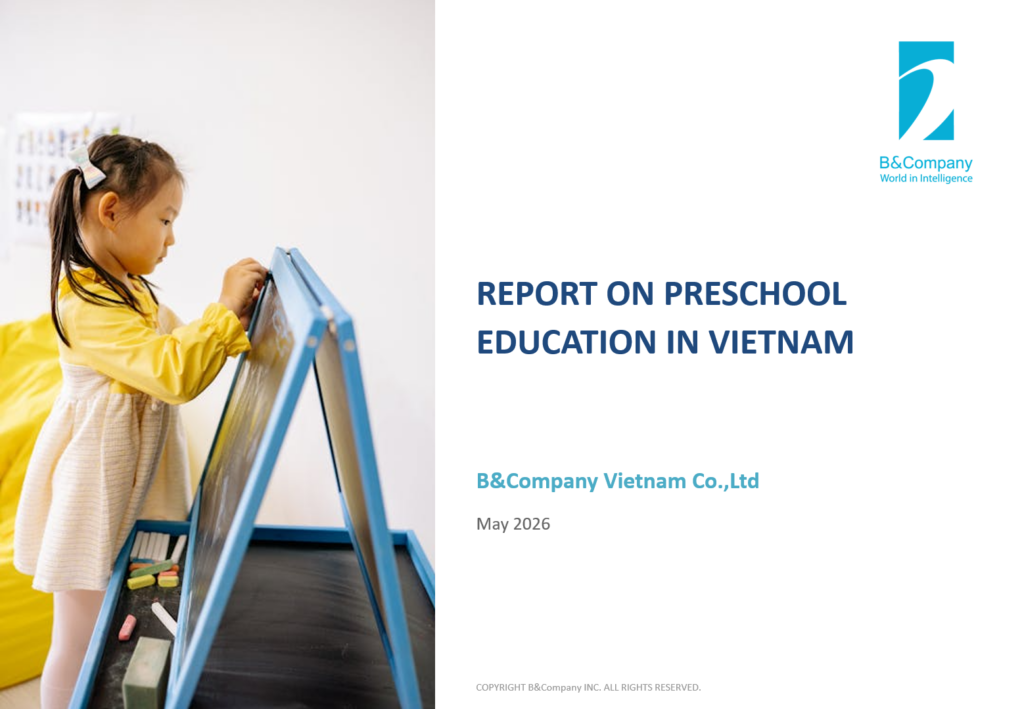
This report provides an overview of Vietnam’s preschool education, covering key aspects: market size, enrollment, number of schools and companies, etc.
VND 15,000,000