
 English
  日本語
日本語  Tiếng Việt
  简体中文
简体中文  한국어
한국어 
Short on Labor Market under context of Digtal Transformation in Vietnam
Digital transformation (DX) is advancing across many industries, and the labor market is witnessing significant change.
Request Free
Free
Free
Vietnam: Hanoi
Vietnam: Ho Chi Minh
(84) 24 3978 5165
(84) 28 3910 3913
 Free
Free
Vietnam is striving to establish a certain regional standing in the development of artificial intelligence (AI) and machine learning. The growth of IT industry over the past 20 years has nurtured private companies, creating a solid foundation for the penetration of AI-powered services. However, Vietnam has yet to catch up to advanced nations in areas such as IT talent, fundamental research, data infrastructure, energy supply, and legal regulations. While it remains uncertain whether the region can become an AI hub, leading foreign companies are responding to the government’s strong leadership by advancing cooperation and expansion, potentially marking a turning point.
AI policy is transitioning from strategy formulation to implementation. The 2021 “National AI Strategy” positioned AI as central to the digital economy, setting targets through 2030 for research capabilities, talent supply, and AI centers. In June 2025, the Digital Technology Industry Act was enacted, introducing risk-based AI governance including transparency, human oversight, and lifecycle risk management. Additionally, AI data centers and AI system development were designated as special priority investment areas alongside semiconductors, qualifying for tax, land, and other preferential measures. These initiatives are being implemented alongside broader digitalization and infrastructure enhancement efforts under the National Digital Transformation Goals. The policy’s impact on market entry and market size spans both facilitation and restriction. On the facilitation side, it established the “Special Investment Procedure” (Government Decree 19/2025), accelerating approvals for cutting-edge projects like R&D, innovation centers, and semiconductor/AI-related investments, effectively shortening licensing timelines. The National Innovation Center (NIC), established under this decree, expands preferential measures for talent, credit, land, and funding, facilitating the establishment of AI demonstration, research, data, and chip design capabilities. Corporate tax exemptions and reductions in designated priority sectors and regions also make many AI and digital infrastructure projects eligible.
AI market is expanding rapidly, reaching 470 million USD in 2022. It is projected to grow to 1.52 billion USD by 2030 with a 15.8% compound annual growth rate (CAGR)1 . This growth is driven by the government’s “National AI Strategy,” which outlines a vision for strategic investment in research, infrastructure, and talent development to establish Vietnam as a regional AI hub 2 . Simultaneously, high internet penetration rates, a young and digitally savvy population, and rising demand for AI solutions across various sectors 3 are accelerating adoption. Global tech giants like Google, Qualcomm (which recently opened an R&D center), and Nvidia, alongside leading domestic companies such as FPT, Viettel, and VinGroup, are showing significant interest in these conditions, driving the formation of an AI ecosystem.
The AI industry’s subsectors include: (1) AI Infrastructure & Platforms (Cloud, AI Data Centers, Networks, GPUs/AI Chips) 2 Vietnam News (2025) < Access> 3 HBLAB Group (2025) < Access> < > 11 (2) Core Technology Tools (machine learning platforms, Electronic Design Automation (EDA) tools, Machine Learning Operations (MLOps), security) (3) Industry-specific applications (finance, manufacturing, healthcare, agriculture, logistics, smart cities, government, etc.) (4) Consulting, SI, and Outsourcing Services Currently, segments (3) and (4)- namely enterprise application development and implementation support services are expected to account for the majority of revenue. Meanwhile, the government’s prioritization of AI data centers and expanded semiconductor investments is anticipated to increase the share of segments (1) and (2) in the future. Furthermore, through collaborations with companies in the US, Japan, South Korea, Singapore, Europe, and elsewhere, offshore development centers, joint R&D labs, and startup acceleration programs have been established. Moves to jointly deploy Vietnam-originated AI solutions into ASEAN and global markets are also accelerating. Vietnam’s corporate AI readiness index exceeds the global average. 69% of organizations report being “fully prepared” or “somewhat prepared,” surpassing the global average of 48%4 .
Looking at user industries, AI adoption is leading in finance, telecommunications, retail/e-commerce, manufacturing, and public institutions. In finance, AI is utilized for credit scoring, fraud detection, chatbots and voice bots in call centers, and delivering personalized recommendations. Major commercial banks are replacing parts of their core business processes with AI-based systems. In retail/e-commerce, recommendation engines, demand forecasting, inventory optimization, and ad delivery optimization are commonplace. Physical stores are advancing proofs of concept (PoCs) for visitor analysis via camera image analysis and checkout automation. In manufacturing/ logistics, pilot projects are 4 CISCO increasing at factories (Japanese, European, etc.) for predictive maintenance, quality inspection, automated warehouses, and route optimization. In the public sector, use cases such as traffic management, video analysis of security cameras, and virtual assistants at administrative service counters are being trialed, primarily in Ho Chi Minh City and Hanoi, seeking to enhance the efficiency and transparency of citizen services. Meanwhile, many SMEs and regional companies, hindered by data preparation, initial investment costs, and talent shortages, often limit themselves to routine automation rather than full-scale AI implementation. Consequently, cloud-based AI services, subscription-based industry-specific solutions, and the provision of shared data/ platforms by large corporations and governments are advancing. Expanding the user base will be a key growth driver going forward.
Unless otherwise stated, the materials contained in this report are protected by copyright and are the exclusive property of B&Company. The information contained herein (including forward-looking statements) has been obtained from sources believed to be reliable as of the date of publication. While B&Company believes this information to be accurate, it has not necessarily independently verified each source and therefore makes no warranty or representation as to its accuracy or completeness. Readers should evaluate the relevance and accuracy of the information contained herein at their own discretion.
All rights in this report are reserved. No part of this document, its contents, or any reproduction thereof may be modified, transmitted, reproduced, or distributed to third parties without the prior written consent of B&Company. B&Company shall not be liable for any loss, damage, cost, or expense arising from the use of or reliance on the information contained herein.
Digital transformation (DX) is advancing across many industries, and the labor market is witnessing significant change.
Free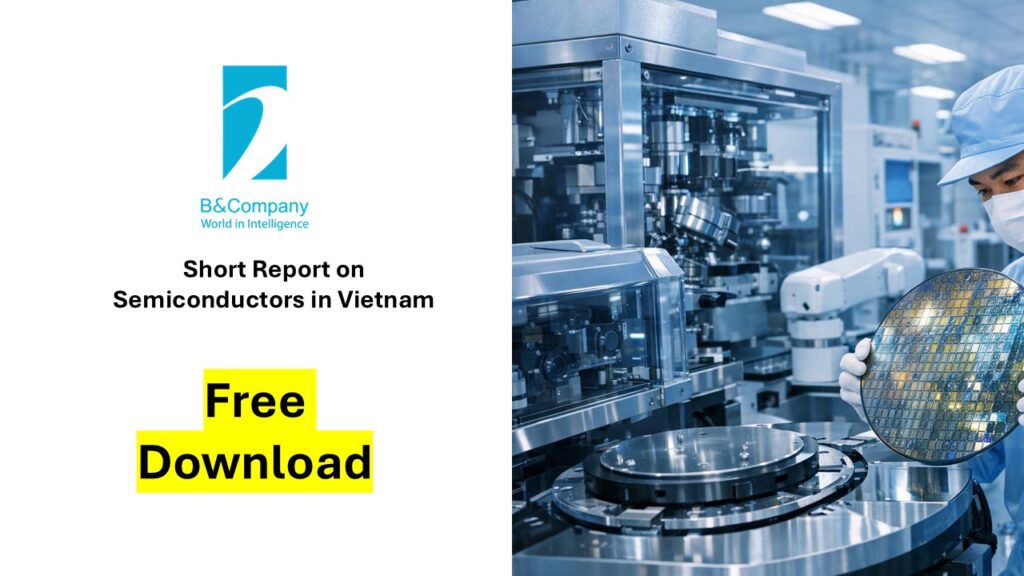
The semiconductor industry is on a growth trajectory, supported by government initiatives, abundant resources, and labor costs. While still in its early stages, it is establishing itself as a major regional player.
Free